 Goes Wedding
Engagement Rings: How to Choose One, and Who Actually Sells Them
The full picture for a first-time buyer in the US: what the money buys, what a grading report does and does not promise, and how ten named retailers differ once you compare their documented terms rather than their marketing. Written for someone spending more on this than on anything else they own except a car.
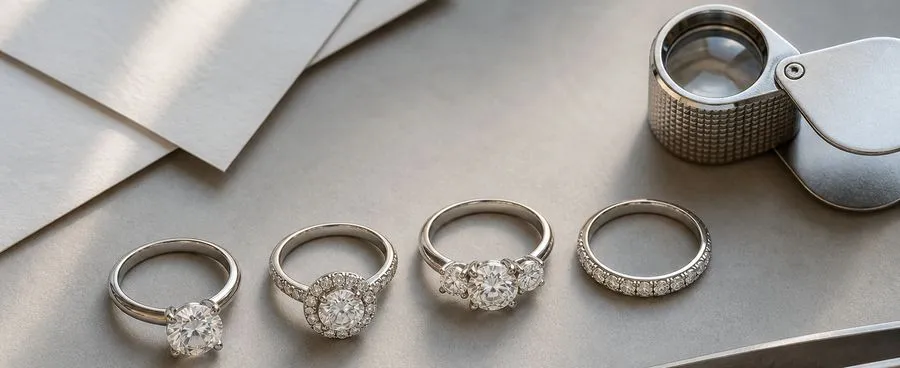
Start with which spec choices you will actually see, then read how the ten retailers compare side by side below.
Some links on this page are affiliate links; if you buy through one, we may earn a commission. That relationship never decides which companies we cover or what we conclude about them - see our review methodology.
What you are actually buying, and where the money goes
A ring purchase is two purchases wearing one price tag. There is a center stone, priced on its own grading characteristics, and there is a setting, priced on metal weight, accent stones and labor. Sellers in this category conventionally budget them as separate line items, and quoting them together is where most confusion about "the price of a ring" starts.
For the stone, the working framework is the 4Cs: cut, color, clarity and carat weight. One carat is a weight, not a size: 200 milligrams, divided into 100 points. Two one-carat stones can look meaningfully different across the finger depending on how they are cut.
Of the four, cut quality has the largest effect on what a stone looks like in daylight, and it is also the only one with a firm limit on what the paperwork can tell you.
The Excellent-through-Poor cut scale applies to standard round brilliants; fancy shapes such as oval, emerald or pear have not historically carried an official cut grade from the major independent labs and get judged on proportions instead.
For a closer look at which of the 4Cs actually changes how a stone looks, see our full breakdown.
Color runs D to Z, with D through F described as colorless and G through J as near colorless. Clarity runs from Flawless down through the Included grades, and the practical line for most buyers sits around SI2, where inclusions can start becoming visible without magnification. Above the eye-clean threshold and above the near-colorless band, extra grades mostly change the certificate rather than the ring.
Fluorescence, graded None to Very Strong, cuts both ways: strong blue fluorescence has historically carried a price discount on colorless stones over a disputed haziness concern, while on a lower color grade it can make a stone read whiter face up.
Before you shop, two labeling traps are worth learning. Total carat weight (t.c.w. or CTW) is the combined weight of every stone on the piece, so a halo ring advertised at 1.5 t.c.w. may have a center stone well under a carat. Ask for the center stone's individual weight whenever a combined figure is quoted.
On metal, 18-karat gold is about 75% pure gold and 14-karat about 58.3% to 58.5%; the higher karat has the richer color and the softer surface, and one 2025 commercial estimate put the 18k premium at roughly 20% to 30% for the same design.
If resizing later is a live possibility, note that a plain band can usually move about one to two sizes, while eternity bands and dense pavé work resist resizing or get distorted by it. If you would rather lock down the number before you order, see how to find her ring size without asking.
Settings alone were estimated at roughly $1,000 to $3,000 for a simple solitaire and roughly $2,000 to $7,000 for halo, three-stone or pavé designs in one 2025 commercial source, with fully custom work starting around $5,000 to $10,000.
Treat those as directional: they are retailer-blog figures, not audited market data, and they say nothing about where the ring sits in the whole wedding budget. If you want to see the visible-versus-paperwork split applied to your own priorities, work out which spec choices you will actually see.
The four kinds of seller, and why the categories are blurring
The US market sorts into four models, and the model predicts more about your experience than any individual brand does.
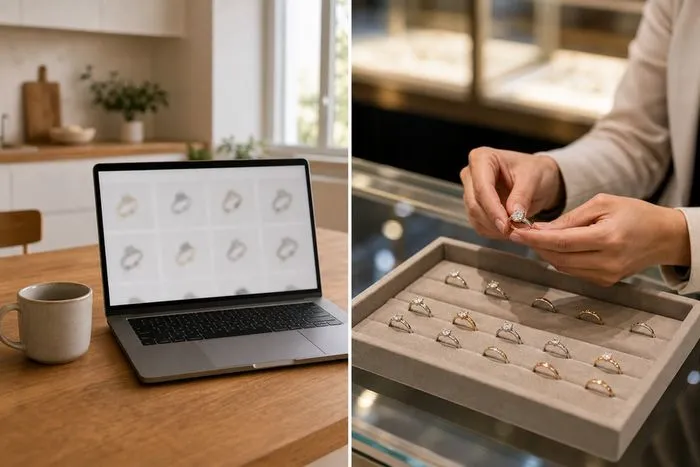
Online-first direct-to-consumer sellers list loose stones and settings separately, publish per-stone data, and compete on inventory depth. Mall and chain jewelers put a counter, a salesperson and financing in front of you. Heritage luxury houses sell a brand, a box and an in-house standard.
Independent local jewelers do custom work at a scale outside this hub's named entities.
The clean segmentation is eroding at the edges. One of the largest online-first sellers now runs roughly two dozen US showrooms with more announced, and another operates 40-plus.
One competitor's marketing material put around 15% of American ring buyers online against around 16% at the Signet-owned chains; that figure is single-sourced from an interested party and undated, so read it as a rough shape rather than a measurement.
Ownership matters more than store signage suggests.
Kay Jewelers, Zales and Jared operate under the same parent, Signet Jewelers, and industry-comparison sources describe sourcing, pricing strategy and markup as shared across them, which is why "shop both" is often the same shop twice.
Tiffany & Co. has been an LVMH subsidiary since the acquisition closed on January 7, 2021, documented in LVMH's own filing. A claim that James Allen is also Signet-owned appears in one competitor's blog and nowhere else we found, so we name it as an unconfirmed single source rather than a fact.
Here is what the documented terms look like across the ten sellers this hub covers. The blank cells are the point: where our research found no primary source, we say so instead of borrowing a competitor's number.
| Seller | Model | What the stones are | Grading lab named in our sources | Return window | In-person access |
|---|---|---|---|---|---|
| Blue Nile | Online-first, now hybrid | Natural and lab-grown | GIA / AGS | 30 days, published by the seller | About two dozen US showrooms (unverified count) |
| James Allen | Online-first | Natural and lab-grown | Not confirmed in our sources | About 30 days, third-party sourced only (unverified) | Not documented |
| Ritani | Online-first, custom build | Natural and lab-grown | Not documented | Not documented | Company-run preview; earlier local-jeweler network reportedly retired (unverified) |
| Brilliant Earth | Online plus showrooms | Natural and lab-grown | IGI on lab-grown centers | Not documented | 40-plus US showrooms |
| Tiffany & Co. | Heritage luxury | Natural only, as last checked (unverified) | Proprietary in-house certificate, not an independent report | Not documented | Own retail stores |
| Kay Jewelers | Mall / chain | Mixed diamond assortment | Not documented | Not documented | National store network |
| Zales | Mall / chain | Mixed diamond assortment | Not documented | Not documented | National store network |
| Diamond Nexus | Single-brand DTC | Two lines: a proprietary simulant, plus lab-grown diamonds | IGI on the lab-grown line | Not documented | Not documented |
| With Clarity | Online-first | Not independently confirmed | Not documented | Not documented | Not documented |
| Grown Brilliance | Online-first specialist | Lab-grown only, per media sources | Not documented | Not documented | Not documented |
Note: counts, windows and assortments change. Verify any figure on the seller's own current policy page before you rely on it.
A couple of head-to-head questions come up often enough to have their own pages: two online jewelers, and one open question about the link between them, and whether the sibling chains are a real choice at all.
Natural, lab-grown, simulant: the line that changes everything
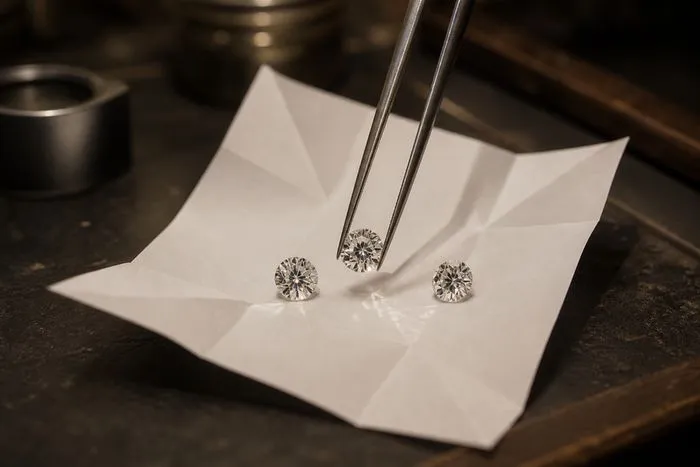
Three product categories get sold in the same display cases and described with overlapping words.
Getting them straight is the single most consequential thing a first-time buyer can do, and it is worth reading in full: see the honest trade-offs between lab-grown and natural stones.
| Natural diamond | Lab-grown diamond | Simulant (moissanite, cubic zirconia, white sapphire, YAG) | |
|---|---|---|---|
| Composition | Crystalline carbon | Crystalline carbon, grown by HPHT or CVD | Not carbon-based; a different material entirely |
| Hardness | Mohs 10 | Mohs 10 | Lower; moissanite rates 9.25 |
| Telling them apart | Baseline | Not reliably separable from natural by loupe or eye; needs lab equipment | Distinguishable, and priced far lower |
| Typical certification | GIA and other independent labs | IGI dominant for lab-grown | Often an in-house document, or none |
Under the FTC Jewelry Guides, finalized August 16, 2018, the word "diamond" used alone is still presumed to mean a mined stone. A lab-grown stone has to carry a qualifier such as "laboratory-grown," "laboratory-created" or "[maker]-created," and cannot be advertised as "real," "natural," "genuine" or "precious."
Materials that merely resemble diamond, cubic zirconia and moissanite among them, must not be called diamonds at all, qualified or otherwise. "Cultured" is permitted only with an equally conspicuous qualifier alongside it.
In April 2019 the FTC's Bureau of Consumer Protection sent warning letters to eight companies over advertising that raised compliance concerns under those Guides. Sellers of lab-grown stones also sit under the FTC's Green Guides, which discourage "eco-friendly" style claims for this category.
On price, resist any single percentage.
Published estimates of the lab-grown discount against comparable natural stones range from 20% to 40% at one retailer's own blog up to 80% to 90% at another, with several figures in between; the gap is structurally wide and moving, and no source we found settles it.
Nothing here should be read as a resale forecast for any stone, mined or grown.
One seller in this hub markets a flagship product whose branding evokes diamond while the product is a simulant. That distinction is the whole page: why this one is not a diamond at all. For a lab-grown-only assortment with genuine carbon stones, the lab-grown specialist we checked is a different proposition entirely.
What Americans actually spend, and what nobody regulates
Average-spend figures for US engagement rings disagree so widely that quoting one number would misinform you. Recent published estimates cluster between roughly $4,600 and $8,600 depending on year, methodology and who paid for the survey, and one source manages to contradict itself inside a single article. Two datasets disclose their methods and are worth more than the rest.
The Knot's 2024 Jewelry and Engagement Study reported that 64% of respondents spent under $6,000 and 33% under $3,000, with 8% in the $10,000 to $14,999 band and 5% above $15,000. Its 2023 regional data put the Mid-Atlantic average near $6,900 against roughly $4,900 in the Midwest, the lowest region surveyed.
A February 2026 survey by Talker Research for Chime, with 2,000 US adults and disclosed methodology, found a gap between belief and behavior: respondents thought a ring "should" cost about $10,600, roughly a quarter of the average reported income in the sample, while actual spending came in near 17% of income.
Around 74% said they would rather start married life debt-free than own an expensive ring.
The "two months' salary" and "three months' salary" rules are not financial guidance. They began as diamond-industry advertising copy in the late 1940s and have no analytical basis. Roughly a quarter of the Chime survey's respondents said they or their partner actually hit the three-month figure, which tells you how durable a good slogan is.
For a way to set your own number instead, see how much you should actually spend.
Nothing about jewelry retail requires a license or approval in the way a medical product does, so "is this seller legitimate?" is rarely the interesting question. All ten sellers here are real, operating retailers.
The regulation that exists governs how they describe what they sell, not whether they may sell it, which shifts the burden of diligence onto documentation: who graded the stone, what the return policy excludes, and whether the certificate in the box came from an independent lab.
Lab identity is not a formality. Grading standards differ between labs, so a "G color, VS1" from a strict, widely recognized laboratory and the same notation from a lenient or franchised one can describe visibly different stones. GIA, a nonprofit founded in 1931, is the reference point in the domestic trade.
IGI, founded 1975 and for-profit, was the first major lab to extend 4Cs-style grading to lab-grown stones and dominates that segment. AGS was known for a granular 0-10 cut scale and, by our understanding, merged into GIA around 2022-2023, a detail we have not confirmed against a primary source. EGL operates independently franchised branches with inconsistent standards.
An in-house or proprietary certificate, whoever issues it, is not an independent third-party grading report, and no seller's brand equity changes that.
Once the ring exists, two more documents enter. A grading report describes a stone's characteristics. An appraisal states a replacement value, and insurers want the appraisal.
Jewelers Mutual advertises jewelry coverage from about $5 a month and puts typical annual cost at 1% to 2% of insured value, recommends coverage above $1,500, suggests updating the appraisal every two years, and accepts a detailed sales receipt dated within 18 months in place of a formal appraisal below $5,000.
BriteCo, underwritten by Glencar, quotes 0.5% to 1.5% of appraised value annually, reimburses up to 125% of appraised value, and requires a formal appraisal on every item; its "no maximum insured value" marketing sits against Investopedia's finding of $750,000 per policy and $300,000 per piece.
Appraisal fees themselves run roughly $50 to $150 an hour or $75 to $300 per item depending on source. A fee calculated as a percentage of the item's value is the wrong structure, because it pays the appraiser to inflate the number.
For the timing that actually protects the ring, from the day it arrives to the next appraisal refresh, see insuring it once it is on her hand.
Cost posture differs sharply between channels, and the honest comparison is relative rather than numeric: our sources document no reliable price figure for either chain jeweler.
If you want that comparison in one place, see the Signet markup and the financing question and what the premium at a heritage house actually covers.
Red flags, and the checks that catch them
Every fraud pattern below comes from jewelry-trade and retailer commentary rather than an enforcement database, so treat them as field knowledge, not case law. They recur because they work.
Ten red flags worth walking away over
- The stone you agreed to becomes "no longer available" and a substitute appears at the same price. Classic bait-and-switch, and the substitute is usually the weaker stone.
- A large percentage discount off an "original price" you have no way to verify, especially paired with a today-only deadline that exists to stop you comparison shopping.
- A grade quoted without the lab that issued it. "VS1" is a claim until you know who graded it.
- A total carat weight quoted with no center-stone weight offered when you ask.
- "Gold" or "platinum" with no karat mark, purity stamp or written description. Plating gets sold as solid metal.
- No disclosure of treatment. Laser drilling, fracture filling and HPHT color treatment must be disclosed, and a fracture-filled stone can be damaged by a jeweler's torch during resizing, so any later bench work needs the treatment named up front.
- "Lab-created" used loosely across both a simulant line and a genuine lab-grown line without the products separated in plain words.
- "Conflict free" or "ethically sourced" presented as an audited guarantee. Those claims usually rest on scheme compliance and a chain-of-custody warranty, not a per-stone independent audit, and the 2003-era international certification scheme has been criticized for defining conflict narrowly enough to exclude state-sponsored violence.
- An appraisal fee quoted as a percentage of the appraised value.
- A seller who cannot produce the return, resize and warranty terms in writing, on their own site, before you pay.
Six checks that take under an hour
- Get the center stone's own carat weight in writing, separate from any t.c.w. figure.
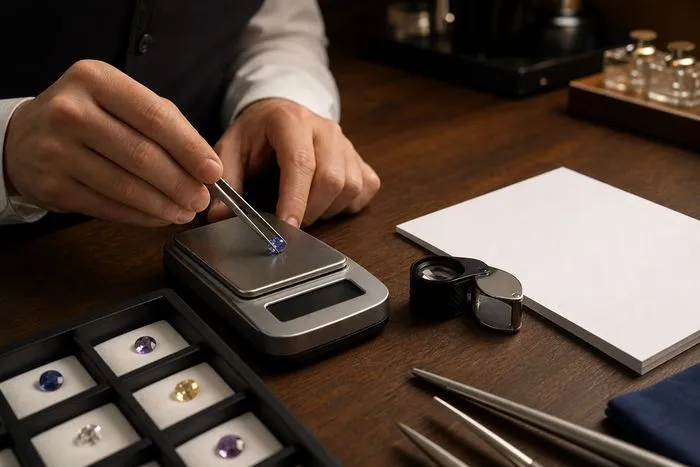
- Name the lab on the report and confirm the report number resolves on that lab's own lookup, rather than accepting the printed sheet at face value. If a stone's characteristics contradict an independent assessment, forum guidance and common sense point the same way: return it for a full refund.
- Read the return exclusions before you order, not after. Engraving, resizing and any work done by a jeweler other than the seller commonly void return eligibility, and about 30 days is the informal norm among online sellers rather than a rule.
- Confirm ring size before engraving anything, and check whether your chosen setting can be resized at all.
- Book an appraisal with someone who is not selling you the ring, credentialed through the American Society of Appraisers, the American Gem Society's gemologist appraiser program or the National Association of Jewelry Appraisers.
- Schedule coverage before the ring leaves your possession for a proposal trip, and diary an appraisal refresh so the insured value does not drift below replacement cost.
Bring in a professional, meaning an independent appraiser or a gemologist with no stake in the sale, whenever the spend is material to your finances, whenever a certificate looks inconsistent with what you see, whenever a stone is described as treated, and whenever you are buying secondhand or from an unfamiliar seller.
If a specific seller's documented complaints matter to your decision, the complaints nobody else prints and what a 4.0 average rating can hide are the two pages where we set them out with dates attached.
Everything above sits inside our wider US wedding planning and buying coverage, and the retailer pages below inherit this frame rather than restating it.
Catalog
Online-first direct-to-consumer sellers
Blue Nile Review: Is It Legit? (2026)
Natural and lab-grown, GIA/AGS graded, a published 30-day policy, and an online-only story complicated by a growing showroom network. Operating retail.
James Allen Review: Does the 360-Degree Video Hold Up?
Natural and lab-grown, built on 360-degree HD video of each individual stone. Operating retail; its return and warranty terms reached us third-party only and need re-checking at source.
Ritani Review: The Complaints, Checked (2026)
Natural and lab-grown, custom build with a company-run in-person preview. Operating retail, with two dated, serious, unresolved complaints we state rather than average away.
With Clarity Review: Is It Legit? (2026)
Named in independent 2026 media roundups, which is a real signal of active operation; our research found no policy-level or certification sourcing, and the page says so.
Online plus showrooms
Brilliant Earth Review: Ratings & IGI vs GIA
Natural and lab-grown, 40-plus US showrooms, lab-grown centers mostly IGI graded. Operating retail, with a polarized review distribution behind a 4.0-class average as of a 2026 snapshot.
Mall and chain jewelers
Kay Jewelers Review: Markup & Financing (2026)
Mixed diamond assortment, in-person-first, financing-forward, under the Signet parent. Operating retail; financing products are documented, no rate or term is.
Zales Review: Same Owner as Kay? (2026)
The same Signet parent, the same financing shape, different signage. Operating retail; the page's job is whether the difference is real.
Heritage luxury
Tiffany Engagement Rings: Price & Certificate
Natural diamonds only as last checked, sold with a proprietary in-house certificate that is not an independent lab report, under LVMH ownership since January 2021. Operating retail.
Lab-grown and simulant specialists
Grown Brilliance Review: Is It Legit? (2026)
Lab-grown diamonds only, per media sourcing, with meaningful third-party review volume. Operating retail; pricing and policy facts are not documented in our sources.
Diamond Nexus: The "Nexus Diamond" Is Not a Diamond
Two separate lines: a proprietary simulant that is not a diamond of any kind, and a genuine IGI-graded lab-grown line. Operating retail; the caution is about product-type clarity, not the business.
Head-to-head and tools
Blue Nile vs. James Allen: Which to Buy From? (2026)
Per-stone video against a large graded marketplace, with the sourcing asymmetry between their policy sets shown rather than smoothed.
Kay vs. Zales: Is There a Real Difference?
What a shared parent means for sourcing, pricing posture and financing, and why this is a location decision more than a value decision.
Ring Spec Trade-offs: Size vs. Paperwork
Enter your own budget split and top priority; get back which spec choices change the look and which mostly change the certificate. No dollar estimates, no grade prescriptions, nothing stored.
Guides
After You Buy: Appraisal and Insurance Timing That Actually Protects the Ring
A grading certificate is not an appraisal. What to do first after you buy, rider versus standalone policy, and why base home coverage rarely covers the ring.
The 4Cs: Which Ones Actually Change the Look?
Cut drives the sparkle; clarity and color mostly move the certificate. How to prioritize the 4Cs on a fixed budget, and why the grading lab matters too.
How Much Should You Spend on an Engagement Ring?
The two months' salary rule was an ad campaign, not advice. See how far the reported spend figures actually disagree, then set a cap from your own savings.
Lab-Grown vs. Natural Diamonds (and Colored Stones): The Honest Trade-Offs
Lab-grown diamonds are near-identical material for far less money, and their resale value falls faster. Compare cost, value, durability and disclosure rules.
How to Find Her Ring Size Without Asking
Discreet ring-sizing methods ranked by accuracy, the online-versus-in-store trade-offs for a surprise, and the seller red flags to check before you pay.
Frequently Asked Questions
How much should you spend on an engagement ring?
Whatever fits your finances, because no benchmark survives contact with the data.
Published US averages range from roughly $4,600 to $8,600 depending on the source and year, and the two surveys that disclose methodology point lower than the headlines: The Knot's 2024 study had 64% of respondents under $6,000 and 33% under $3,000.
The "two or three months' salary" figure is 1940s advertising copy, not a rule of thumb, and 74% of respondents in a February 2026 Talker Research survey for Chime said they would rather begin married life debt-free than own an expensive ring.
Is a lab-grown diamond a real diamond, and is a simulant one?
A lab-grown diamond is crystalline carbon with a Mohs hardness of 10, structurally and optically the same as a mined stone, separable only with lab equipment. A simulant such as moissanite or cubic zirconia is a different material that resembles diamond; moissanite rates 9.25 on the Mohs scale.
Under the FTC Jewelry Guides, a lab-grown stone must be described with a qualifier like "laboratory-grown," and a simulant must not be called a diamond at all.
Does it matter which lab graded the stone?
It changes what the grade means. Labs apply different standards, so identical notations from a strict lab and a lenient one can describe visibly different stones. Check that a report exists, then check who issued it and that the report number resolves on that lab's own lookup.
An in-house or proprietary certificate from the seller is not an independent third-party grading report.
Is a grading report the same as an appraisal?
No, and they do not substitute for each other. A grading report describes the stone's quality characteristics. An appraisal assigns a replacement value, which is what an insurer wants, and it should come from an appraiser with no interest in the sale.
A fee quoted as a percentage of the appraised value is a conflict of interest built into the invoice.
What return window is normal, and what voids it?
Roughly 30 days is the informal norm among online sellers in this category, though it is a convention rather than a requirement and every seller's exact terms differ. Engraving, resizing and any alteration by a jeweler other than the seller commonly void the return, so confirm sizing and skip the engraving until you are certain. Read the exclusions on the seller's own current policy page before you order.
Reviewed by Renata Halloran, CWP, a practicing wedding planner in Chicago. This page is buying guidance, not financial, legal or appraisal advice, and it does not test or authenticate any stone. Prices, return windows, resize terms, warranty coverage, showroom counts and review scores change without notice: verify every figure against the seller's own current policy page and the issuing lab's own report lookup before you rely on it. Average-spend and lab-grown discount figures quoted here disagree across sources and are shown as ranges with their dates for that reason, not as settled facts. Where our research found no primary source for a seller's pricing, certification or return terms, we say so rather than borrowing a competitor's number. No stone described here carries any promise of resale value, buyback or insurance payout. Some links on this page are affiliate links; if you buy through one, we may earn a commission, which never affects which sellers we include, how we order them or what we conclude.