 Goes Wedding
How to Find Her Ring Size Without Asking
 Written by Tessa Broussard
 · Reviewed by Renata Halloran, CWP· Published 2026-08-28· Last checked 2026-08-30
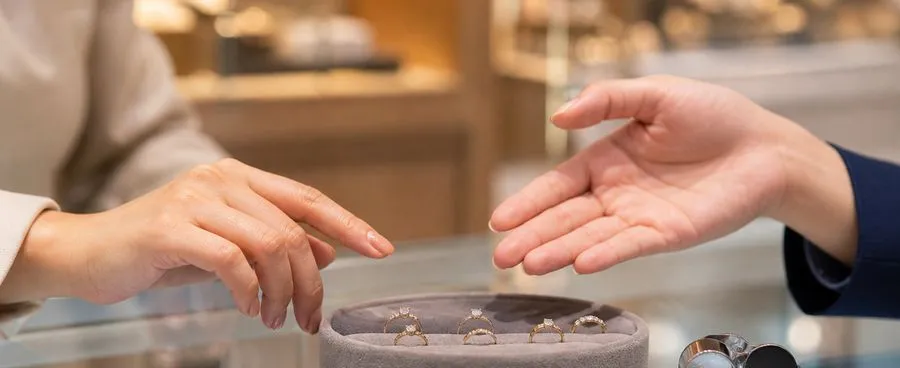
Somewhere between picking the stone and paying for it, most guys hit the same wall: you cannot ask her ring size without saying why you're asking.
I've watched this trip up otherwise organized people who nail the color and clarity math and then treat the size like an afterthought, decided the week before they mean to buy. It isn't one.
A wrong guess doesn't just spoil a proposal photo - it means a resizing trip, sometimes a setting that won't take a clean resize, and a delay nobody planned for.
Below: how to get a workable number without tipping her off, what actually changes between buying online and buying in a store, and the red flags that apply no matter which channel you pick.
None of it requires you to become a gemologist.
It requires picking the method that fits your real access to her jewelry, your real timeline, and how much secrecy you genuinely need right now, not whatever a forum thread happened to recommend.
Get a Ballpark Size Without Tipping Her Off
Five ways exist to get a size before you ever set foot in a store together, and the trade-off runs a specific direction: the most accurate methods usually carry the least risk of her noticing, but not always, which is the part worth sorting before you pick one.
Borrowing a ring she already wears on the equivalent finger is the most accurate of the five, by a wide margin, and usually the lowest-risk too. Most women take rings off for a shower, a workout, washing dishes or yard work - that's your window. Slip it onto a printable sizer or take it to a jeweler, then put it back exactly where it was.
A printable or at-home sizer works the same way but skips the trip. Print the template, size the borrowed ring against it on your kitchen table, and you're finished before she's out of the shower. Slightly less precise than a jeweler's ring gauge, close enough to work from.
Enlisting a trusted friend or family member shifts the risk instead of removing it. Maybe her sister already knows a proposal is coming and can borrow a ring, or take her shopping and get a size read off in conversation. It works well with zero access to her jewelry, but adds a second person who has to keep the secret as carefully as you do.
A covert in-store visit means taking the ring you borrowed to an actual jeweler for a professional measurement, rather than eyeballing a paper sizer yourself. More accurate than doing it at home. It also means an errand, a car ride, a receipt - things that have to line up without questions.
If none of that is workable, propose with a placeholder ring - something inexpensive, or a ring she'll clearly read as a stand-in - and get the real size afterward. Zero secrecy risk. The honest fallback when access and time both run out.
None of these five replace a professional sizing before the ring goes into daily wear. Treat every method above as a starting number, not a final one.
Why That Early Number Isn't the Final Size
That number you just got isn't the one you'll use to order the ring, and here's why. Finger size shifts across the day, and it shifts with temperature and hydration too - a well-documented pattern, even without one fixed figure attached to how much it moves. A measurement taken in the morning and one taken that evening can read differently on the identical finger.
There's a second wrinkle I'd treat with more caution: the same finger reportedly measures differently hand to hand, commonly cited as roughly half to a full US ring size, though that figure comes from trade sources rather than anything independently confirmed.
Worth knowing. Not worth building your whole plan around.
I made a version of this mistake with my own dress, not a ring - I budgeted the money for alterations and never budgeted the time, and missed the shop's window by two weeks. An early size number sets the same trap. Getting it right isn't the finish line; reconfirming it near the actual purchase date is.
Find Your Best-Fit Method
Five methods exist above, but which one actually fits you depends on your own situation, not a generic ranking. How much access you have to a ring she wears, and how much runway you've got before you need an answer, matter as much as the raw accuracy numbers do.
Rather than re-reading the list and guessing which combination applies, answer the questions below and get a specific method back - matched to your actual situation, not the average reader's.
It also flags which buying channel tends to pair with that method, which the next section walks through in full.
Buying Online vs. In Person: What You're Actually Trading Off
Once you have a size to work from, the next decision is where to buy - and it isn't a question with one right answer. It's a trade-off, and the honest version looks like Table 1 below.
Online commonly wins on price and selection: a larger catalog, and stones frequently priced lower than a comparable in-store equivalent, though exactly how much lower varies by source and isn't a number I'd pin to a fixed percentage.
It also tends to be the easier channel to browse and buy quietly, since nobody's watching you scroll a laptop at midnight.
In-store wins on what a screen can't do.
You handle the actual stone, not a photograph of it, and a lot of stores will size a ring on the same visit - something online simply can't offer, since anything bought online either ships pre-sized to a guess or gets resized after it arrives.
Neither channel wins on trust. That's not a channel question at all. It's a seller question, and a disorganized independent jeweler across town can be less trustworthy than a well-run online retailer, or the reverse.
Chase the seller's own track record, not a blanket assumption about which channel is "safer."
One more thing Table 1 deliberately leaves blank: no return or resizing window gets stated here as a fixed number, because there isn't one that holds across sellers. Get the actual policy in writing before you pay, from the actual seller you're buying from, not a number you saw quoted somewhere else.
On the legal side, I looked for a rule specifically restricting interstate or online sale of diamonds and engagement rings in the US and didn't find one in the research behind this article. That's an absence, not a clearance. I'm not telling you online purchase is confirmed legal everywhere - only that no jewelry-specific restriction turned up in what's available.
If that question actually matters for your situation, that's for a lawyer, not this article.
Table 1: Online vs. In-Store - What You're Actually Trading Off
| Factor | Buying Online | Buying In-Store |
|---|---|---|
| Price & selection | Commonly lower-priced, larger catalog | Smaller in-stock selection, commonly costs more for a comparable stone |
| Physical inspection before paying | None - you're relying on the retailer's photos and video | Yes - you handle and view the actual stone |
| Immediate sizing | No - ships pre-sized to a guess, or gets resized after purchase | Often yes, same visit |
| Discreetness | Easier to browse and buy without being seen together | Risk of being recognized or overheard, though a solo covert visit is also a listed sizing method |
| Return/resizing terms | Get the actual seller's written policy before paying - no number stated here | Get the actual seller's written policy before paying - no number stated here |
The Red Flags That Mean Walk Away
Fraud and low-quality sales tactics don't respect the channel - the list below applies standing in a store just as much as scrolling a website at midnight. It isn't built from any single retailer's or insurer's checklist, which would just be one seller grading its competitors.
It's the pattern that repeats across several independent sources on what actually goes wrong, a steadier signal than trusting one company's own list. (I've had a seller wave off two of these at once as "just how the industry works." It isn't.)
The Walk-Away List
- No independent third-party grading report - only an in-house or self-issued certificate.
- Pricing is bundled and non-itemized, and the seller won't break down stone versus setting.
- Manufactured urgency - a discount that expires the moment you hesitate or ask for time to think.
- For online sellers: no verifiable business address, phone number, reviews or history.
- Stock or generic photography instead of the actual stone or ring's own images.
- The price seems implausibly low for the claimed grade and material.
- Missing, blurry or unfavorable return, exchange or warranty terms - or none stated at all.
- A missing, blurry or mismatched gold purity stamp, or "HGE"/"GF" markings sold as solid gold.
- The seller won't allow independent verification or magnification examination of the stone.
Two of those are worth spelling out further. A genuine karat stamp corresponds to a fixed gold percentage: 10K reads 41.7% gold, 14K is 58.3%, 18K is 75%, and 24K is 99.9%, stamped as 375, 417, 585, 750 or sometimes 999.
A magnet test alone proves nothing either way, for what it's worth - pure gold isn't magnetic, but plenty of counterfeit pieces aren't magnetic either, so a piece that doesn't stick to a magnet is not the same as a piece that's been verified genuine.
One flag here is worth a question. Two or more together is the answer: walk away, or hold off until you've verified independently.
The Ring Doesn't Fit After You Propose - What Now
She said yes, and the ring doesn't fit. Don't panic, and don't assume a specific resizing window from something you read on a forum - the number that matters is whatever the seller you actually bought from puts in writing.
Most sellers build some resizing or exchange allowance into the sale; the steps below are the order to work through it in, before this becomes the last practical stop before the ring moves from purchase to protection.
If the Size Is Wrong After You Propose
- Don't assume a specific resizing window. Most sellers build in some allowance, but the number is theirs to state, not a generic one pulled from somewhere else.
- Contact the actual seller with the order or receipt and ask, in writing, for their specific resizing or exchange policy.
- If a resize is offered, confirm two things first: that the work happens at the seller's own bench or with a jeweler they name as reputable, and that it won't void the grading report or warranty.
- If the size gap is large enough that a resize would compromise the setting, ask specifically about an exchange instead.
- Once resized, get the final confirmed size on file. This is also the point to move on to the appraisal and insurance sequence - The moment it is paid for, the ring is uninsured - here is what to do first covers that step.
Common Questions
How do I find her ring size without asking?
Rank the discreet methods by accuracy and secrecy together: a borrowed ring, a printable sizer, a trusted friend, a covert in-store visit, or a placeholder-ring proposal. Answer the picker above for a method matched to your actual access and timeline.
Should I buy the ring online or in person?
Neither is universally better. Online tends to win on price and selection, and it's easier to buy quietly there; in-store wins on handling the stone and same-visit sizing. Trust is a seller question either way, not a channel one - see Table 1 above.
How can I tell if an online jeweler is legitimate?
Run it through the red-flags checklist above: verifiable business identity, itemized pricing, independent grading, no manufactured urgency, willingness to let you verify the stone. One flag is a question; two or more is a reason to walk away.
What should I ask a jeweler before I buy?
Ask for itemized pricing, the grading lab's name and report number, the return and resizing policy in writing, and whether an independent appraisal is available. Get the answers before any money moves.
The ring doesn't fit after I propose - what do I do?
Most sellers offer some resizing or exchange allowance. Get their specific written policy instead of assuming a number, then work through the action steps above.
What if she doesn't like the ring I picked?
Know the seller's return and exchange policy before you buy, not after. A trusted friend or family member at the sizing stage can also lower this risk without spoiling the surprise.
If you haven't settled on the actual grades yet, Before you vet a seller, know which grades you are actually asking for is worth reading first. Still weighing where to shop? Compare the places couples actually buy from rounds up the channel question in one place.
Answer the picker above, get a method that fits your situation, and once the ring is bought, The moment it is paid for, the ring is uninsured - here is what to do first is the next stop.