 Goes Wedding
The 4Cs: Which Ones Actually Change the Look?
 Written by Tessa Broussard
 · Reviewed by Renata Halloran, CWP· Published 2026-08-28· Last checked 2026-08-30
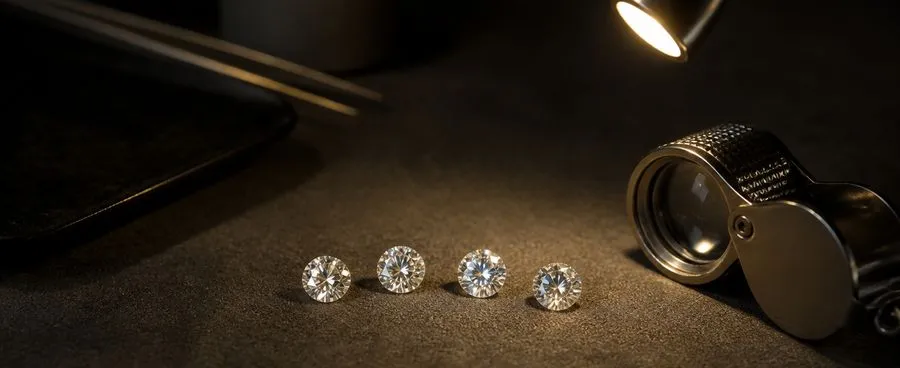
A ring budget does not have to be split evenly across cut, color, clarity and carat, and treating it that way wastes money.
Here is my stance up front: cut is the one C worth stretching for, because it is the one that changes what a stranger actually sees across a table.
Color and clarity, once you clear a couple of specific thresholds, mostly change a number on a certificate, not the picture in front of anyone's eyes.
I've watched shoppers agonize over a single color grade while a mediocre cut quietly worked against them the whole time.
This guide sorts which of the 4Cs earns its price tag and which one is your real, flexible lever.
The 4Cs in One Minute
Four letters, four different scales, and you'll want the shorthand before the rest of this makes sense. Cut is not the diamond's outline shape - round, oval, princess - it's how well the stone's proportions, symmetry and polish were executed, graded Excellent down to Poor. Color runs D to Z, colorless at one end and light yellow or brown at the other.
Clarity runs FL to I3, a scale of how few or many inclusions show under 10x magnification. Carat is a unit of mass, not a size: one carat equals one-fifth of a gram, 200 milligrams, split into 100 "points," so a jeweler quoting "75 points" means a 0.75-carat stone.
Of the four, cut does the most work for what anyone standing across a table actually notices. The other three matter, but differently, and that difference is the whole point of what follows.
Where Your Money Actually Buys Visible Beauty
Every quality spec claims to matter, and marketing treats all four letters as equally precious. They are not equally visible.
Picture the same stone across a restaurant table, in an office, at your own kitchen counter under bad lighting: what a friend or a stranger notices first isn't a certificate number, it's how much a stone catches and throws light back.
That's cut's department almost entirely, which is why I keep circling back to it.
Color and clarity work differently. Past specific thresholds, covered in the next two sections, upgrading either one buys a better number on a report and, at the margin, a modestly higher resale or appraisal ceiling. It does not buy a visibly different ring on the hand.
Carat sits somewhere else again: it's the lever most people reach for first because it's the easiest number to compare between listings, and it is genuinely visible - but how visible depends entirely on how the stone was cut, which gets its own section below.
One more wrinkle on cut before the table: some grading labs also publish a supplementary numeric cut score, roughly 0 to 10 with 0 as "Ideal," layered on top of the descriptive Excellent-to-Poor scale.
I wouldn't name a specific lab for that convention with confidence, so treat any numeric cut score you see as a bonus data point, not a universal standard every report carries.
Table 1: The 4Cs, Ranked by What You Can Actually See
| Factor | Visual effect at normal viewing distance | Certificate/price effect | Recommended priority |
|---|---|---|---|
| Cut | Large - drives brilliance and sparkle directly | Large | Spend here first; never buy below Very Good |
| Color | Small once near-colorless | Large | Buy G-J, matched to your metal, not D-F |
| Clarity | Small to none once eye-clean | Large | Buy the lowest eye-clean grade for the shape, not the highest grade sold |
| Carat | The visible-size lever, priced unevenly at certain weights | - | Treat as your flexible remainder, after the three above |
Use this to decide where your next dollar actually goes:
Where does your next dollar buy something you can actually see?
- Is the cut grade Very Good or better?
- No: upgrade cut before anything else, regardless of color, clarity or carat.
- Yes: move to the next question.
- Is the clarity grade eye-clean for this shape - VS2/SI1 for brilliant cuts, VVS1/VVS2 for step cuts?
- No: prioritize clarity next.
- Yes: move to the next question.
- Is the color grade near-colorless (G-J), and does it read white against the metal you chose?
- No: consider one grade up in color.
- Yes: carat weight is your remaining, flexible variable. Spend what's left there, and remember a smaller, well-cut stone can look larger face-up than a bigger, poorly-cut one.
This article's version stays priority-only, with no dollar figures attached. If you want the fuller budget-plus-spec version, See the full spec trade-off calculator on the rings hub has it.
Cut first
Never buy below Very Good, even if it means trimming color or clarity to afford it. A well-cut stone in a lower color grade will out-sparkle a poorly cut, higher-color one every time I've compared them side by side.
Color and clarity: mostly the certificate
Both scales are real and both affect price, but past the thresholds in the next two sections, neither changes what the ring looks like to the eye. Spending here mostly buys paperwork, not beauty.
Carat: the flexible variable
Whatever's left in the budget after cut, eye-clean clarity and near-colorless color are covered goes here - and a smaller stone cut well can still look bigger than the number suggests, which the next section walks through.
Eye-Clean Clarity: The Grade Where Inclusions Vanish to the Naked Eye
Under a jeweler's loupe, every diamond shows something. The question that actually matters is whether you'll ever see it without one.
Clarity measures inclusions, the internal marks left over from how a diamond forms, graded under 10x magnification on an eleven-step scale: FL, IF, VVS1, VVS2, VS1, VS2, SI1, SI2, I1, I2, I3, flawless down to heavily included.
None of that scale is printed as "eye-clean" anywhere on the report.
That term is trade shorthand, not an official grade, and confirming it takes two steps: reading the clarity plot, the small diagram marking where each inclusion sits, and then actually looking at the stone face-up in ordinary room light, not under the loupe that exaggerates everything.
As a rough guide, FL, IF, VVS1 and VVS2 are eye-clean essentially always, and most VS1 stones are too. VS2 and some SI1 stones usually pass, though "usually" is doing real work in that sentence - I've seen SI1 stones that needed a second look and VS2 stones that didn't need one at all. SI2 and below tend to show something without any magnification.
Shape changes this math. Step cuts - emerald, Asscher - have long, open facets that act almost like a hall of mirrors for anything trapped inside, so they typically need VVS1 or VVS2 to stay reliably eye-clean. Round, oval and princess brilliant cuts scatter light in a way that hides more, so VS2 or SI1 often clears the bar there instead.
Buying the same clarity grade across two different shapes is not buying the same visible result.
Two more things worth knowing before you shop.
Laser drilling opens a permanent channel to lighten a dark inclusion, fracture filling fills a surface crack and is not permanent, and both count as clarity treatments a seller is expected to disclose, because they can affect durability and resale differently than an untreated stone graded the same.
And a grade doesn't travel unchanged across sizes: a 1-carat VS2 can look flawless to the eye while a 3-carat VS2 of the identical grade shows something, because bigger facets act like a bigger magnifying lens on whatever's inside.
Color, Matched to Metal
Color is the C most people overspend on by default, without weighing what it actually buys. The scale runs D (colorless) down to Z (light yellow or brown), with D-F labeled colorless and G-J near-colorless. Past G-J the bands get less clean-cut, and I'd treat anything below J with more caution than the D-F/G-J split itself deserves.
Here's the part that saves money: near-colorless is visually indistinguishable from colorless to nearly everyone, at normal viewing distance, in normal light. Paying up into D, E or F mostly buys a number on the certificate, not a difference a dinner guest will ever notice.
Metal changes the calculation, though.
Platinum and white gold read "whiter" against a given color grade than yellow or rose gold does, so a G or H can look crisper set in platinum than the same stone in yellow gold, where the warmer metal already does some of that work for you. (Platinum was the metal on my own ring, mostly because I liked how it read against my skin, not for any grading reason.) Platinum is also the denser, more malleable metal - prongs tend to bend under stress rather than crack - while white gold is a rhodium-plated alloy whose plating can wear thin over time.
Neither is the "correct" choice, but the metal you land on should inform, not follow, the color grade you buy.
Carat Weight Is Not the Same as Size
Carat is a weight, not a size, and I learned that the expensive way helping a friend shop.
She'd built a spreadsheet ranking stones purely by the carat number, top to bottom - the same instinct that once had me over-order invitations by counting guests instead of households, counting the wrong unit.
She bought the highest number her budget allowed. When the ring came back from setting, it looked smaller across the table than her sister's stone, which was a quarter-carat lighter and, it turned out, cut to noticeably better proportions.
Here's why. Two round diamonds can share an identical 1.00-carat weight and still show a different amount of stone when you look straight down at them.
Diamond A (well-proportioned) vs. Diamond B (cut deep or shallow), both 1.00 carat:
| Callout | Diamond A | Diamond B |
|---|---|---|
| Carat weight | 1.00ct | 1.00ct (identical) |
| Face-up diameter | Larger - more of the weight shows from above | Smaller - weight hides below the girdle or spreads thin |
| Light performance | Brighter, more even sparkle | Duller, weight sacrificed for a bigger number instead of better light |
A stone cut too deep hides weight down in the pavilion, out of sight, where it does nothing for how the ring looks. One cut too shallow spreads that same weight thin and loses brilliance the other way. The practical result: a smaller carat number, cut well, can look larger across a table than a bigger carat number cut poorly.
A spec sheet's carat line doesn't show you this - only a jeweler's proportions numbers, or your own eyes, do. (There's a separate pricing quirk tied to certain carat weights that I'm not covering here; it belongs with the budget math, not with how a stone looks.)
Does the Grading Lab Matter? Trade Reputation and What It Means for You
GIA and IGI both grade under the same named scale structures - D to Z color, 10x clarity, Excellent to Poor cut - so two reports can look interchangeable at a glance. GIA operates as a nonprofit and IGI as a for-profit lab, by each institution's own description, reportedly founded in 1931 and 1975. What sits behind that standardized paperwork, in my experience, is not always the same.
I once compared two otherwise identical-spec quotes, same cut, same color, same clarity grade, from two different sellers, and the price gap between them was too wide for the stated grade alone to explain.
That's not proof of anything by itself, but it's the kind of thing that sends you looking harder at who graded the stone.
Trade sources, mostly commercial blogs run by competing sellers, commonly describe IGI as grading somewhat more leniently than GIA on comparable stones. That's an attributed trade opinion from parties with a stake in the framing, not a finding from either lab, and nothing I've independently verified. Treat it as one input, not a verdict.
A separate, more disputed claim, seen on a single retailer's blog and not confirmed anywhere on gia.edu, holds that GIA stopped issuing full 4C grades for lab-grown stones as of 2025. I'd check GIA's current lab-grown grading policy directly before relying on that one; one uncorroborated commercial source isn't enough to build a decision on.
The practical rule underneath both claims: no law requires two labs to grade the identical physical stone the same way, so treat grades from different labs as not directly comparable, and get a second opinion from a lab you recognize if a report comes from one you don't.
A report also says nothing about durability - hardness (scratch resistance) is not toughness (chip resistance), and a well-graded, hard diamond can still chip from a sharp, well-directed knock, a subject the lab-grown breakdown covers in full.
Nor is it an appraisal; it assigns no dollar value, which is why A grading report isn't an appraisal - here's what to do once you've bought the ring is worth reading before you assume you're covered.
Try It: Prioritize Your Own 4Cs
Ranking beats guessing, so here's a tool to do it with your own priorities instead of mine. Rank or weight cut, color, clarity and carat against each other, factor by factor - there's no budget field and no dollar output, just your own relative priorities.
Feed it your ranking and it returns a short read-out, something like "your order: clarity > cut > color > carat," with one line per factor pointing back to the section above that explains why.
One flag it raises on its own: rank cut below any of the other three, and the tool tells you plainly that cut is the factor most likely to make a stone look smaller or duller than its price would suggest, and that deprioritizing it works against what you'll actually be able to see.
Frequently Asked Questions
What do the 4Cs actually mean?
Cut, color, clarity and carat. Cut covers proportions and finish (Excellent to Poor); color is how colorless the stone is (D to Z); clarity counts visible inclusions (FL to I3); carat is weight, not size. Cut drives visible sparkle the most.
Can a diamond really chip or crack?
Yes. Diamond is the hardest natural material, but hardness means scratch resistance, not chip resistance. A sharp, well-directed knock can still chip a well-graded stone, so a high grade is not a guarantee against damage.
GIA vs. IGI: does it actually matter which lab certified my diamond?
In trade-reputation terms, yes. Both use the same named scales, but IGI is commonly described by competing commercial sources, not by either lab, as grading somewhat more leniently than GIA. Get a second opinion for an unfamiliar lab's report.
Does fluorescence affect how a diamond looks or what it's worth?
Sometimes, and mostly at the extremes. Very strong fluorescence is sometimes treated in trade as a minor negative price factor, though it can occasionally make a lower-color stone look whiter face-up. I wouldn't call this a settled valuation rule.
Are clarity-enhanced diamonds a bad idea?
Not inherently, but the treatment has to be disclosed. Laser drilling and fracture filling both fall under "clarity enhanced" and can affect durability and resale value differently than an untreated stone of the same visible clarity. Confirm the disclosure before you buy.
Start with the priority allocator above and get your own ranking down before you talk to a seller - it turns "I like the certificate" into an actual order of operations.
If cut, color and clarity are locked but you still haven't settled natural versus lab-grown, Reading a lab-grown certificate is a different job - here is why is the next read.
Specs settled either way? Specs settled? Now get the size right and choose where to buy picks up from here.