 Goes Wedding
After You Buy: Appraisal and Insurance Timing That Actually Protects the Ring
 Written by Tessa Broussard
 · Reviewed by Renata Halloran, CWP· Published 2026-08-28· Last checked 2026-08-30
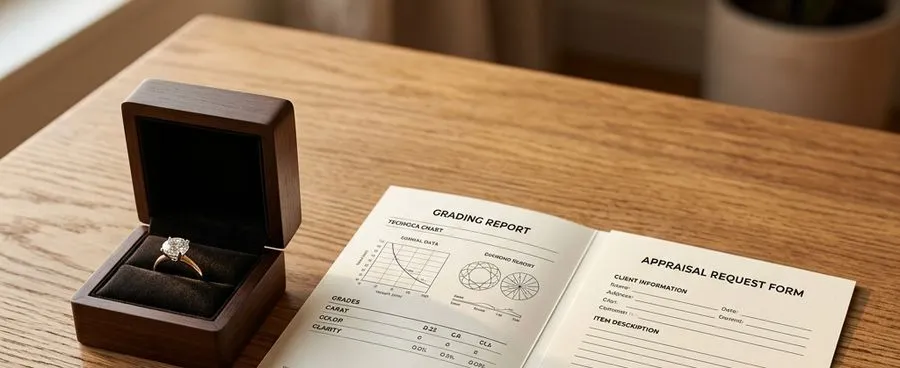
You just paid for the ring. Right now, today, it is not insured.
The grading report in the box with it does something real, but not what most buyers assume: it says nothing about what the ring is worth if it's ever lost, stolen or damaged.
I'm not going to hand you a national dollar figure for coverage limits or premiums, because no such figure exists, only sourced ranges with caveats attached.
What I can give you is the order to do things in, starting today.
General mechanisms only, not the terms of any specific policy. Every dollar figure below carries a named source and should be confirmed with your own provider.
Haven't paid yet? Not bought yet? Vet the seller and the return terms before you pay covers that step, not this article.
A Grading Certificate Is Not an Appraisal
The report in your ring box, likely from GIA or IGI, is a grading document. It records the four Cs, cut, color, clarity, carat weight, sometimes with a plotted diagram of the stone's inclusions. It is thorough and legitimate, and it assigns no dollar value at all.
Nowhere on a grading report will you find a replacement cost.
An appraisal is a different document, from a different kind of professional, for a different purpose. It assigns a monetary value, specifically a replacement value, the number an insurer actually needs to write a policy. A jeweler can hand you a grading report at the counter.
An appraisal has to come from someone who looks at the finished piece as a whole and translates the setting and the labor behind it, not just the stone, into what it would cost to replace.
This is the single most consequential confusion in this whole topic, and I'll keep flagging it wherever both documents come up again: a certificate is not an appraisal, and having one does not mean you have the other.
Skip that distinction and you find out the hard way, at the worst possible moment, that the paperwork in your drawer proves quality but never value.
The Right Order: Purchase, Appraisal, Insurance, Documentation
Here's the order, and it matters more than any single dollar figure in this piece: appraisal, then insurance, then documentation. Not insurance first. Not "I'll get to it after the honeymoon."
Book the independent appraisal as soon as you reasonably can after the purchase, ideally before the ring goes on a finger every day. Once the appraisal is in hand, put the insurance in place immediately, not once wearing it daily has quietly become a habit and the errand has slipped down the list.
That gap, between the safest possible timing and what people actually do, is itself the risk this article is built around.
I've watched this exact pattern in friends who budgeted the money correctly and still lost the timing. I priced my own wedding almost to the dollar and still missed the alteration window on my dress by two weeks, because I'd planned the spending and never once put a date on the calendar for it. Insurance timing fails the same way, for the same reason: the money was accounted for, the clock wasn't.
Once the appraisal and the policy both exist, file documentation the same week: dated photos of the ring from multiple angles, plus every paper, with a copy held by the insurer, not just tucked in your own drawer.
What to gather before you call an appraiser or insurer:
- The purchase receipt or itemized invoice
- The grading report
- Dated photographs of the ring from multiple angles
- Any prior appraisal, if this is a reappraisal
Have these ready before you make the call. It saves a second trip, and it gives the appraiser something concrete to itemize against instead of working from the ring alone.
Why Your Homeowners or Renters Policy Probably Isn't Enough
Most homeowners and renters policies do include some jewelry coverage by default, which is exactly why people assume they're covered and stop thinking about it further. The trouble is what "some" means in practice. Base coverage typically protects against theft only.
It usually doesn't extend to loss or to what insurers call "mysterious disappearance," a ring that's simply gone with no theft to point to. Accidental damage, say a stone popping loose from its setting, is often excluded too.
On top of that narrow peril list sits a low dollar cap, and here's where I won't hand you a number: the cap depends on your insurer and your policy form (an HO-3 reads differently from an HO-5), and it varies again by state.
Every figure floating around online for "the" homeowners jewelry limit belongs to somebody else's policy, not yours. Skip the search and go straight to your own declarations page, the personal-property or jewelry-sublimit clause specifically, and read what it actually says before you assume you're covered.
Rider vs. Standalone Policy: What Each One Actually Covers
Once you know your base policy falls short, you've got two paths: add a rider, also called a scheduled endorsement or a floater, to the policy you already have, or buy a standalone jewelry policy from a specialty insurer.
Both close the same gap, and the underlying mechanism holds across the insurers that publish details on it, Jewelers Mutual and NJM among them: a rider or a standalone policy typically broadens coverage well past theft-only.
Where sources disagree is price, and I'll give you a range instead of a number because that's what the sources themselves give. GEICO, Allstate and Investopedia commonly cite standalone or rider premiums around 1 to 2 percent of the ring's appraised value per year. Treat that as a starting point for a conversation with your own provider, not a figure you plug into your own budget - it's illustrative, not a quote.
The table below lays out the actual trade-off.
Table 1: Homeowners/renters rider vs. standalone jewelry policy
| Peril coverage | Typical cost basis | Effect of a claim on premium | Documentation required |
|---|---|---|---|
| Homeowners/renters rider (scheduled endorsement) | Commonly advertised as broadening base coverage beyond theft-only, adding loss and "mysterious disappearance" (GEICO, Jewelers Mutual, NJM) | Commonly cited around 1-2% of appraised value per year, added on top of the existing policy premium (GEICO, Allstate, Investopedia - illustrative only) | Sits on an endorsement attached to your homeowners/renters policy; ask your insurer whether a claim touches that policy's own claims history |
| Standalone jewelry policy | Commonly advertised as all-risk: theft, loss, "mysterious disappearance" and accidental damage, independent of the homeowners policy (Jewelers Mutual, Progressive/Lavalier) | Commonly cited in the same 1-2% range of appraised value per year, billed and confirmed separately (GEICO, Allstate, Investopedia - illustrative only) | Handled entirely within the standalone policy, with no effect on any homeowners or renters coverage |
Choosing an Independent Appraiser - and Avoiding the Conflict of Interest
Here's a plain fact, not a judgment call: an appraisal from the jeweler who sold you the ring is a conflict of interest. They have every reason to value it generously and no independent check on whether they did. The safer practice, every time, is an appraiser who had no part in the sale.
A few things worth checking when you're vetting one. A legitimate appraiser itemizes the basis for the value; they show their work rather than handing you a single figure with no explanation behind it. They don't also offer to buy the stone from you or resell it - an appraiser with a financial stake in the outcome has the same conflict the seller did.
And watch for a lazy version of the job: an "appraisal" that just restates the grading report's own 4Cs with a dollar sign attached to it isn't an independent valuation. It's a certificate with extra steps.
How Often to Get the Ring Reappraised
There's no universal interval here, and I'm not going to invent one just for a tidy answer. What I can tell you is why an old appraisal goes stale: the market underneath it moves.
Washington Diamond reported gold spot prices rising from around $2,700 an ounce in early 2025 to around $4,700 an ounce by May 2026, over 70 percent, which it linked to a 40 to 50 percent rise in average jewelry-setting prices over roughly the same stretch.
One dated commercial source, not a law of nature, but the point holds: an appraisal from a few years back is pricing a market that no longer exists.
Your stone type changes what the appraisal is worth later. The practical rule stays simple: reappraise after a major documented move like that one, or whenever your policy's own terms call for updated proof of value.
Your Post-Purchase Protection Checklist
Everything above collapses into four steps. You don't need to hold onto the peril lists or the rider-versus-standalone trade-off if you can just work through this and check every box.
- Independent appraisal booked (start this in the first few days after purchase)
- Ring and documents photographed (same week, multiple angles, dated)
- Rider or standalone policy chosen (immediately after the appraisal, not once daily wear has already started)
- Reappraisal reminder set (tied to a major market move or your policy's own review terms, not a fixed date years out)
No dollar figure belongs on this list, and that's by design. This isn't about hitting a number; it's about closing the gap between the day you paid and the day you're actually covered.
Frequently Asked Questions
Is a grading certificate the same as an appraisal?
No. A grading report documents the stone's quality, the four Cs, and assigns no dollar value. An appraisal is a separate document from a separate professional that assigns a replacement value, the figure your insurer actually needs. Confusing the two is the single most common and costly mistake in this whole process.
Does my homeowners or renters insurance already cover my engagement ring?
Usually only partially. Base coverage is typically theft-only and capped well below what a typical ring is worth, with the exact peril list and cap set by your insurer and policy form, and varying again by state. Check your own declarations page rather than trust a figure you found online.
When should I get my ring appraised, and does it matter if I wait?
As soon as possible after the purchase, ideally before you start wearing it every day. The gap between that safest timing and what people actually do, insuring the ring only once daily wear has become routine, is itself the risk this article is built around.
Should I add a rider to my current policy, or get a standalone jewelry policy?
It depends on the trade-off in the comparison table above. A rider is often the lower incremental cost when a policy already exists, while a standalone policy is commonly advertised as broader, all-risk coverage. There's no single right answer, only your priorities weighed against your own policy.
I already bought the ring - how do I know I'm actually protected now?
Work through the protection checklist above: independent appraisal obtained, documents photographed and filed, insurance in place, reappraisal reminder set. Being able to check every one of those boxes is the answer, not any single certificate sitting in a drawer.
Work through the checklist above now, before the ring becomes a daily habit rather than a special occasion - that's the whole point of doing this today instead of "eventually." This is the last article in the sequence; if you want to revisit anything else, Back to the rings hub for sellers, comparisons and the calculator has the rest.