 Goes Wedding
Wedding Attire: Dresses, Suits, Rentals and Order Timing
Wedding attire is more than the gown or tuxedo price on a product page. This guide explains the main buying models in the United States, the costs that appear later, the deadlines that matter, and the evidence worth checking before you place an order.
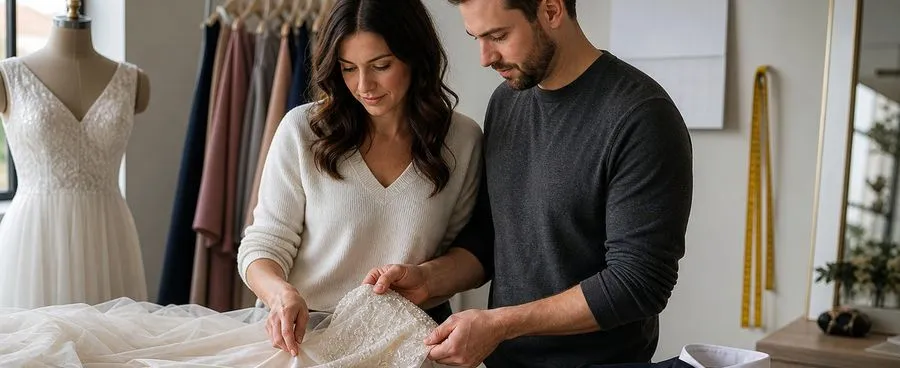
Work out your real order-by date
Some links on this page are affiliate links; if you buy through one, we may earn a commission. That relationship never decides which companies we cover or what we conclude about them - see our review methodology.
What wedding attire includes
Wedding attire covers clothing and accessories for the couple, wedding party, and sometimes guests: bridal gowns, bridesmaid dresses, suits, tuxedos, shoes, jewelry, getting-ready pieces, and alterations.
Guests have a smaller version of the same problem, usually figuring out what a dress code like "black tie optional" actually requires. Those products reach the buyer through several distinct models, and the model often matters as much as the label.
A gown may be bought off the rack from existing boutique or store inventory, ordered from a designer after purchase, or made to a custom specification. Bridesmaid dresses are commonly sold directly online either made to order or ready to ship. Formalwear may be rented through a direct-ship service based on self-measurements, or fitted and collected through a physical showroom.
A dress that is available immediately still needs fitting time; a rental that arrives before the wedding still has a return deadline.
The main practical split comes down to how much lead time a model demands against how much flexibility it leaves you. A made-to-order gown usually requires the longest runway and may be difficult or impossible to cancel once production begins. An off-the-rack gown can solve a compressed deadline, but it may narrow the available size, color, and style choices.
Ready-to-ship bridesmaid clothing can be faster, although “ready to ship” must be confirmed for the exact color and size rather than assumed from a collection page.
Wedding attire is also a category where the quoted price is rarely the complete financial exposure. Alterations, rush work, shipping, restocking charges, return postage, rental extensions, damage charges, and unreturned-item charges can all change the amount paid. See the Attire Order-By Date Planner before setting a purchase deadline.
Our review methodology page states how we weigh conflicting policy and reputation claims, and it is worth reading before you trust one retailer's reviews over another's.
The buying models and how they differ
For bridal gowns, the most time-intensive route is made to order. Research gathered for this hub places standard production and delivery at roughly 4-6 months, designer or custom work at about 6-9 months, and complex custom gowns at about 9-12 months. These are broad, commercially sourced ranges, not promises.
Overall ordering guidance commonly starts at about 8-12 months before the wedding, leaving room for alterations; for the full month-by-month breakdown, see how far ahead you actually have to order.
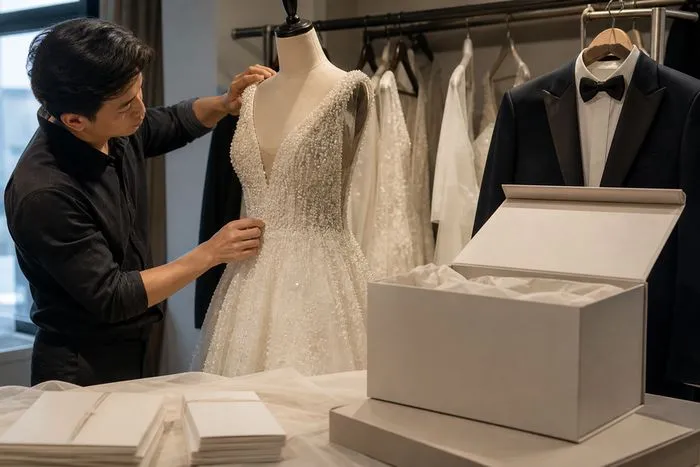
Off-the-rack and floor-sample buying removes the production wait because the garment is already in inventory. It does not remove fitting work, and a sample may have been tried on by many people or require structural adjustments. A national chain such as David's Bridal offers the clearest example of the physical-retail model in this hub.
BHLDN and the Nordstrom Wedding Shop represent fashion-retail and department-store approaches with varying showroom and alteration availability.
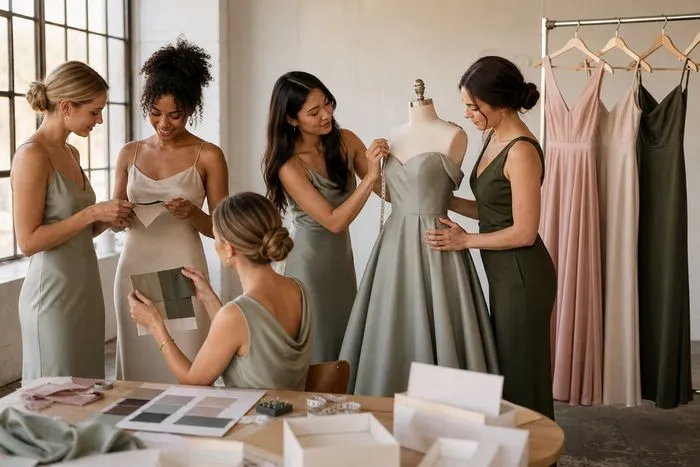
For bridesmaid dressing, made-to-order direct-to-consumer brands generally require more planning than ready-to-ship occasion-wear retailers. A historical baseline for made-to-order bridesmaid dresses is roughly 8-12 weeks, but current brand timelines vary and must be checked against the live processing page.
Azazie, Kennedy Blue, and Revelry belong to the swatch-and-sample-first group.
Birdy Grey, Lulus, and Show Me Your Mumu provide ready-to-ship or occasion-wear routes, subject to stock.
Which brand to pick is a separate question from who typically pays for bridesmaid dresses, and that answer is worth settling before anyone starts shopping.
Suits and tuxedos follow a different pattern: direct-ship rental reduces store visits but shifts more responsibility to measurements, shipping, exchanges, and deadlines. The Black Tux and Generation Tux use this model.
Men's Wearhouse provides the in-store group-fitting contrast, coordinated through its Wedding Tracker or Group Manager tools.
How to choose: a practical checklist
Use this sequence before comparing labels:
- Set the immovable date. Count backward from the wedding, not from the date you hope to shop. Include delivery, one or more fittings, alterations, and a contingency for an exchange or remake.
- Choose the acquisition model. If the wedding is close, inspect floor samples, off-the-rack gowns, and exact ready-to-ship stock first. If the date is distant, made-to-order gives more time for selection but creates greater cancellation and production exposure.
- Measure against the current chart. Wedding sizing is not standardized across brands. For remote ordering, record the measurements used, the date taken, and the size selected. For a wedding party, do not assume one person’s fit predicts another’s.
- Separate the base price from conditional costs. Write down the listed garment or rental amount, then separately identify alterations, shipping, return postage, restocking, rush work, extensions, damage, and replacement terms.
- Test the policy with the actual garment. Ask whether the color, size, fabric, and style are in stock; whether the item is customized; when production starts; and whether a return remains possible after ordering.
- Plan the group order. Match dye lots by ordering together where the company offers that service. Lulus’s Bridal Concierge, for example, holds selected dresses for two weeks and batches a party order to reduce dye-lot variation. That service is different from simply placing several separate carts.
- Create a written fallback. Save the current terms, order confirmation, measurements, promised processing information, and support correspondence. A screenshot or PDF is more useful than relying on a verbal assurance.
A compact comparison of the built options:
| Group | Acquisition model | Useful distinction | Main verification issue |
|---|---|---|---|
| Azazie, Kennedy Blue, Revelry | Made-to-order bridesmaid | Swatches, samples, and broad color or fabric selection | Try-on terms and current lead times vary by source |
| Birdy Grey, Lulus, Show Me Your Mumu | Ready-to-ship or occasion wear | Better fit for a compressed party deadline when exact stock exists | Stock, size, and return terms must be checked |
| AW Bridal, JJ's House | Online import or made-to-order | Low-cost online bridal and formalwear access | Return evidence and complaint patterns are mixed or incomplete |
| David's Bridal, BHLDN, Nordstrom Wedding Shop | Physical or department-store gown retail | Appointments, store service, or alterations may be available | Assortment, prices, and current policies vary |
| The Black Tux, Generation Tux | Direct-ship rental | Remote fitting and shipment-based convenience | Measurement, return, damage, and replacement terms |
| Men's Wearhouse | In-store group rental | Showroom fittings and party coordination | Public prices and return deadlines are not consistently documented |
The table is a starting map, not a winner list. The bridesmaid comparison examines model, turnaround, try-on evidence, and dye-lot considerations. For gowns, see David's Bridal, BHLDN, and Nordstrom.
For menswear fees, see The Black Tux, Generation Tux, and Men's Wearhouse.
Costs beyond the garment
Research for this hub does not support one universal wedding-attire budget or one representative price band for every retailer. Some available figures are examples, starting prices, scraped listings, or secondary estimates rather than comparable catalog ranges. For example, Birdy Grey’s sources conflict between “from $89” on the brand’s own channel and a $99 starting figure in a WeddingWire listing.
Revelry examples include about $189 for one sequin dress and about $199 for one metallic dress. Those figures should not be read as a full collection range.
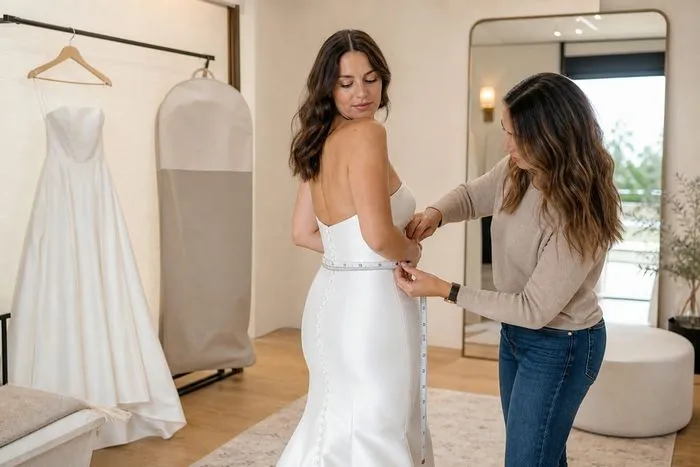
Alterations deserve their own line in the budget.
Commercial and media sources place standard gown alterations across a wide spread, roughly $150-$800, with complex structural work, beadwork, or sleeves sometimes reaching about $1,000-$1,200 or more.
A separate rule of thumb suggests adding about 20-30% of the gown price, but that figure is low-confidence and should not replace a quote from the person doing the work. No government or trade-association schedule was identified for these prices; the figures come from vendors, wedding media, and consumer anecdotes.
Rush work is another exposure. Sources commonly describe starting alterations inside about 6-8 weeks as a point at which rush charges may apply, with one source reporting increases of roughly 25-50%. The exact threshold depends on the tailor, garment, market, and workload.
A typical planning cadence begins with a consultation about 8-10 weeks before the event, followed by major adjustments, refinements and bustle work, and a final fitting about 1-3 weeks before the wedding.
Some providers describe a longer three- to four-month process; the full alterations timeline and price breakdown covers what each fitting stage typically adds to the bill.
Rental pricing needs two separate questions: what is the base rental, and what happens if the item is late, damaged, or not returned? The Black Tux’s own 2026 blog gives a complete-rental range of about $129-$250, while its Rental Agreement states that items must ship back within three calendar days of the event.
A flat $60 extension fee applies after that deadline; optional prepaid extensions are listed at $15 for one day, $40 for three days, or $80 for seven days. Items not returned within 12 days may be charged at full declared retail value plus tax.
Its Accidental Damage Waiver covers only damage repairable by normal dry cleaning or minor tailoring, not every form of damage, and its terms cap total liability at the greater of the amount paid or $100.
Generation Tux’s base figures of about $149 starting and about $200 average all-in come from a third-party estimate rather than a company price list. Its official terms state a $25-per-person-per-day late fee when the return is not deposited with the carrier within three days of the event date.
The terms refer to applicable replacement and processing fees for damage or non-return beyond 21 days, but no itemized standard damage amount was found. Men's Wearhouse public prices conflict: one 2026 comparison source reports about $99-$249 packages, while a current company wedding-attire page says rentals start at $199.99. Neither should be adopted as a universal total.
Its public group incentive also appears in conflicting forms, and no current late-fee or return-window figure was found.
Terms current as of 2026; confirm the company's own live pricing, returns, rental agreement, and processing pages before ordering.
Market and legal reality in the United States
The United States has no dedicated regulator or licensing body for bridal, bridesmaid, or formalwear-rental retail identified in this research. The Better Business Bureau and review platforms can provide complaint-pattern context, but they are not government regulators.
General consumer-protection rules may apply to mail-order apparel, deposits, cancellations, and deceptive practices, yet those rules were not researched sufficiently here to state a jurisdiction-specific legal right.
The market includes established retailers, department-store divisions, direct-to-consumer labels, imported made-to-order sellers, and rental platforms. “Official retail” means the named company operates a direct retail channel in the research; it does not mean every order is risk-free, every review is reliable, or every policy is favorable.
AW Bridal and JJ's House show why a bare legitimacy verdict is inadequate: positive blogger or fast-turnaround accounts appear alongside complaints about returns, delivery, or product-versus-photo differences.
Neither side resolves the question by itself.
David's Bridal’s two Chapter 11 filings, including the April 2023 filing and subsequent sale, are a deposit-safety consideration. They are not evidence that a currently operating store will fail, and they should not be turned into a going-out-of-business claim.
The sensible response to any large prepaid order is to understand the cancellation language, retain records, and consider the payment method’s dispute protections without assuming a dispute will succeed.
One specific corporate correction also matters. Generation Tux was founded by George Zimmer, Men's Wearhouse’s former founder, and operates under a holding company identified as Gen Tux. This research found no support for an AI-generated claim that Tailored Brands owns Generation Tux.
Ownership and affiliation claims should be checked against traceable company or business-press sources, not repeated from search summaries.
Red flags and when to get help
Pause before ordering if the return page is missing, the window changes between pages, a custom item is described as returnable without conditions, or support will not state the policy in writing. A price that appears only on a marketplace or a blog is not a current company price.
A review pattern that combines glowing affiliate-style articles with serious independent complaints needs triangulation, not a quick label.
For rentals, read the return deadline and the damage or non-return consequence together. A low base price can become a much larger obligation if a shipment is late, damaged beyond minor cleaning or tailoring, or never returned. Ask who pays for an exchange, what happens if a measurement is wrong, and how much lead time is required to correct the fit.
With made-to-order dresses, ask when production begins and whether cancellation is possible after that point. Confirm the exact color and size, especially for a party order. Do not rely on a stated three-to-six-day ready-to-ship window until the exact combination is confirmed as in stock.
If a retailer disputes a refund, fails to deliver, or charges an unexpected fee, gather the order records and current terms first. A consumer-protection resource may help with a dispute; for a substantial deposit or signed contract, independent legal or financial advice is more appropriate than forum consensus.
The category research found no illegal or gray-market channel among the named entities, but that does not remove the need to verify the seller, contract, and payment details.
Catalog
Made-to-order bridesmaid and party dresses
Azazie Reviews: Why the Scores Disagree (2026)
DTC bridal and bridesmaid label where Trustpilot, WeddingWire, and The Knot review evidence differs materially; current try-on and lead-time terms require checking.
Kennedy Blue: Price, Lead Time & Verdict (2026)
Made-to-order bridesmaid dresses with a dye-lot rematch policy, plus maternity and junior-bridesmaid options; the brand’s own review counts conflict.
Revelry: Metallics, Sequins and What They Cost
Made-to-order bridesmaid brand known in the research for metallic and sequin examples; its attributed try-on terms remain unconfirmed.
Online bridal retailers with mixed evidence
AW Bridal Reviews: The Complaint Pattern (2026)
Online bridal and bridesmaid retailer with a documented split-reputation pattern and conflicting 30-day versus 45-day return claims.
JJ's House: The Complaint Pattern, the Timeline and the Shipping Upsell
Overseas made-to-order retailer with fast stated processing but incomplete return-policy evidence and mixed delivery complaints.
Ready-to-ship and occasion-wear routes
Birdy Grey: How Fast It Ships & What It Costs
Ready-to-ship bridesmaid model advertising a three-to-six-day turnaround, subject to exact stock confirmation.
Lulus: Price, Lead Time & Verdict (2026)
Occasion-wear retailer with a dedicated bridesmaid category and Bridal Concierge dye-lot coordination.
Show Me Your Mumu: Price, Lead Time & Verdict (2026)
Persistent Bride, Bridesmaids, and Wedding Guest sections with an advertised XXS-XXL bridal-party range.
Gown retail and store service
David's Bridal: Is Your Deposit Safe? (2026)
National chain offering in-store, off-the-rack, made-to-order, and alteration services; bankruptcy history makes deposit terms important.
BHLDN: What a Gown Return Actually Costs
Fashion-retailer bridal line with an official gown return fee and in-store return restriction.
Nordstrom Wedding Shop: What Stores Carry
Multi-brand bridal vertical whose in-store assortment is location-dependent and may exceed the online listing.
Suit and tuxedo rental
The Black Tux: Rental Price, Fees & Verdict (2026)
Direct-ship rental with the most fully itemized dated fee terms found in this research.
Who Owns Generation Tux? Price & Fees (2026)
Direct-ship rental founded by George Zimmer, with official late-fee terms but no itemized standard damage figure.
Men's Wearhouse Tux Rental: What It Costs
In-store group-fitting model with a Wedding Tracker and conflicting public package prices.
Guides
What Wedding Dress Alterations Really Cost
Itemized alteration ranges with the sources counted, why two bustle quotes differ by hundreds, and when to book each fitting so the last is not rushed.
Attire Order-By Date Planner (Dress, Party, Tux)
Plan your dress, wedding-party dresses and suit rentals from one date: order-by, fitting and return windows, dated and shown as ranges, never guessed.
Azazie vs. Kennedy Blue vs. Revelry vs. Birdy Grey (2026)
We compared Azazie, Kennedy Blue, Revelry and Birdy Grey on price and try-on terms, checked 2026: what each charges, where evidence is thin, and who each suits.
David's Bridal, BHLDN & Nordstrom: What Each Charges (2026)
We compared David's Bridal, BHLDN and Nordstrom on service, returns and price, checked 2026: what each charges, where evidence is thin, and who each suits.
How Far Ahead to Buy Your Wedding Dress
Work backward from your wedding date to a real order-by date, compare made-to-order, off-the-rack and sample sale, and see what a rush order adds.
What Does Black Tie Optional Mean? Codes Decoded
Black tie optional, cocktail, semi-formal, festive, garden party: what each phrase asks you to wear, where the sources disagree, and the safe fallback outfit.
Wedding Dress Silhouettes for Your Venue
Which silhouette and fabric survive sand, grass or a cathedral aisle, what bridal sizing really means, and how much the body-type advice is worth.
Black Tux vs. Generation Tux vs. Men's Wearhouse
We compared The Black Tux, Generation Tux and Men's Wearhouse on price, late fees and liability caps, checked 2026: what each really charges and who it fits.
Rent or Buy a Tuxedo? Cost, Timing, Returns
Rent or buy a tuxedo: run the break-even yourself, compare rental providers on return deadlines and late fees, and plan fittings that work for out-of-town men.
Who Pays for Bridesmaid Dresses? The Real Answer
Who pays, how far ahead to order, and how to mix and match dresses that still read as a set. Compare the lead times retailers give, then take the safe one.
Frequently Asked Questions
How far ahead should I order wedding attire?
For a made-to-order gown, broad research ranges run from about four to six months for standard production to about nine to twelve months for complex custom work. Starting about eight to twelve months before the wedding leaves room for shipping and alterations, but no range guarantees delivery. Ready-to-ship or off-the-rack clothing can shorten the production window, not the need to verify fit and stock.
What is the difference between made-to-order and ready-to-ship wedding clothing?
Made-to-order clothing enters production after purchase and usually offers more choice but less cancellation flexibility and a longer lead time. Ready-to-ship clothing is already in inventory and can suit a compressed deadline, although the exact size and color must be confirmed. Both models may require alterations.
How much should I budget for wedding dress alterations?
Sources collected for this hub place standard alterations across a wide range of roughly $150-$800, with complex work sometimes reaching about $1,000-$1,200 or more. No official government or trade-association price schedule was found, so treat these figures as planning ranges and obtain a quote from the tailor who will handle the dress.
What rental fees should I check before ordering a tuxedo?
Check the return deadline, late fee, extension option, damage definition, replacement charge, and any liability cap. Company terms differ substantially: some publish a flat extension fee and retail-value consequence, while others state only that applicable processing or replacement fees apply. The base rental price alone does not describe the full possible cost.
Is there a wedding-attire regulator in the United States?
No dedicated bridal or formalwear regulator or licensing body was identified in this research. The Better Business Bureau and review platforms can provide complaint context but are private organizations, not government regulators. For a specific dispute, consult an appropriate consumer-protection resource or qualified professional.
Reviewed by Renata Halloran, CWP, practicing wedding planner in Chicago. All prices, fees, timelines, return terms, and review information in this hub are estimates or snapshots gathered from company statements, industry commentary, and consumer reports at a point in time. They change, and readers must confirm current live terms with the company before committing money. This content is not legal advice; a reader with a specific agreement or dispute should read that agreement in full and seek qualified consumer-protection, legal, or financial advice as appropriate.