 Goes Wedding
Lab-Grown vs. Natural Diamonds (and Colored Stones): The Honest Trade-Offs
 Written by Tessa Broussard
 · Reviewed by Renata Halloran, CWP· Published 2026-08-28· Last checked 2026-08-30
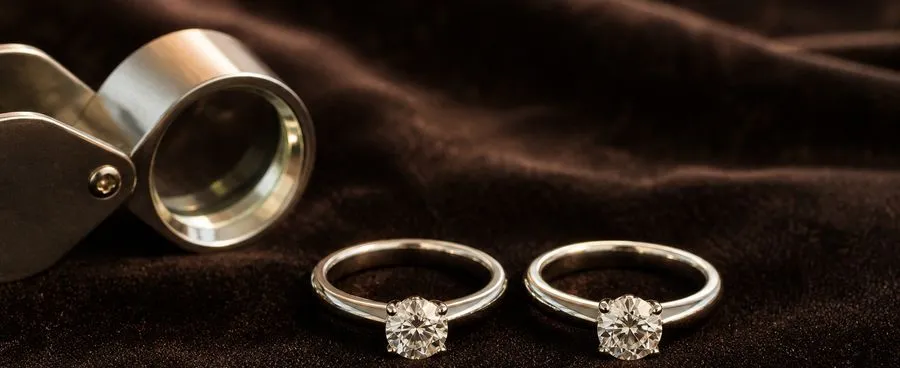
A lab-grown diamond really is the same material as a natural one. That part of the marketing is true, not spin.
What the sales copy skips is what happens to that stone's value a few years later, and it is not because anyone looks down on lab-grown.
The mechanism is structural, and you deserve to understand it before you buy, not after you try to sell.
This piece lays out the full trade-off, material, price, resale, disclosure and daily wear, so you choose a stone type on purpose.
The Four Options, Side by Side
Four stone paths lead to an engagement ring: a natural diamond, a lab-grown diamond, a colored stone such as sapphire or morganite, and a diamond simulant like moissanite. Table 1 lines them up on cost, resale trajectory, durability and what a seller has to disclose about origin.
Read every cost and resale cell as a range with a date attached, not a single number; a source handing you one tidy percentage is often the same source that disagrees with itself elsewhere in its own article.
The sections below unpack each row in full.
Table 1: The Four Options, at a Glance
| Stone type | Relative cost | Resale-value trajectory | Everyday durability | Disclosure requirement |
|---|---|---|---|---|
| Natural diamond | Highest entry price of the four | Reported 25-60% retained, varies by source and years held | Mohs 10; hard to scratch, can still chip along cleavage planes | None beyond standard "diamond" labeling |
| Lab-grown diamond | Substantially less than natural; reported savings vary widely by source | Reported 10-40% retained, trending lower as production scales | Same physical hardness as natural (identical material) | Must disclose "lab-grown" origin near the word "diamond" (FTC) |
| Colored stone (sapphire, ruby, emerald, morganite) | Mid-range; varies by stone and origin | Not covered in this research | Mohs 7-9; minor scratching reported at the lower end with daily wear | Standard gemstone disclosure; no diamond-specific rule applies |
| Diamond simulant (moissanite) | Lowest of the four | Not covered in this research | Mohs about 9.25; very hard, but not a diamond of any kind | Must not be sold or described as "diamond" |
What "Lab-Grown" Actually Means
Start with what is not in dispute. A lab-grown diamond is, for all practical purposes, the same material as a natural one: the same crystalline carbon and crystal structure, with matching optical and physical properties. Origin is the difference, not the substance.
I say "for all practical purposes" on purpose, since no independent lab study in this research confirms every property matches in every respect, so treat "essentially identical" as the accurate claim, not "identical, full stop."
The two paths to that structure differ completely. Natural diamonds form roughly one to three billion years ago, deep in the Earth's mantle.
Lab-grown diamonds get there in weeks to months, through one of two processes: high-pressure high-temperature (HPHT), which recreates the mantle's conditions inside a chamber, or chemical vapor deposition (CVD), which builds a diamond layer by layer from carbon-rich gas.
None of that shows up in the finished stone. A jeweler's loupe, the standard 10x magnifier behind every jewelry counter, cannot tell a lab-grown diamond from a natural one, and neither can your own eye. Separating the two takes specialized lab equipment a retail counter simply does not own.
That matters for what follows. The resale argument later in this article is not a backhanded way of calling lab-grown a lesser stone. It is not.
What changes is what happens to its price after you buy it, and that has nothing to do with quality.
The Price Gap, and Why It Keeps Moving
A note before the numbers: every discount and resale-retention figure below comes from a commercial retailer or insurer source, not an audited or independently verified benchmark, and several of these sources disagree with each other, sometimes within their own reporting.
These figures move as the market moves. Read them as a documented range, not a fixed fact.
Goodstone Inc's 2025 pricing puts a one-carat natural diamond at roughly $4,200, with a reported range of $3,000 to $6,000, against roughly $1,000 or less for a comparable one-carat lab-grown stone, stone only, no setting.
At two carats, the same source reports natural diamonds running $16,000 to $17,500, against $3,500 to $7,500 for lab-grown. The gap widens with size, it does not shrink.
The percentage version of that gap is where sources stop agreeing with each other.
Diamond Rensu, GIVA, Nathan Alan Jewelers, With Clarity, BriteCo and Liori Diamonds each publish a discount figure, and reading all six together gets you 20 to 40 percent, 30 to 40 percent, 30 to 50 percent, 30 to 60 percent, and a stated 40 to 70 percent range whose own price example implies something closer to 70 to 90 percent.
Two of these sources contradict their own stated numbers inside their own articles. Sources disagree here by roughly a factor of three to four, not a rounding error, and I would not repeat a single number pulled from just one of them.
I made a version of this mistake myself once, in a different context.
Building my own invitation count, I worked off the guest list instead of the household list, one clean number that turned out to be counting the wrong unit entirely, and ordered forty invitations too many.
A single confident-sounding figure, wherever it comes from, deserves the question: compared to what, and counted how.
The gap keeps moving because production keeps scaling. Lab-grown manufacturing gets cheaper and faster year over year, which pushes retail lab-grown prices down, and that is the exact mechanism behind the resale problem in the next section. If you have not set a budget yet, that decision comes first: Still setting the number? Start with a budget cap built from your own savings.
The Resale Trade-off Nobody Selling You a Stone Wants to Explain
Chemically, lab-grown and natural diamonds sit close to the same thing. Financially, they are not the same instrument, and the gap between them is not a one-time discount, it is a moving target. That is the honesty commitment this whole article is built around.
Resale retention for natural diamonds is reported as 25 to 50 percent by one source, 40 to 60 percent by another, and 50 to 60 percent in a different section of that same source's own coverage, ranges that do not fully agree with each other, let alone converge on one number.
Lab-grown resale comes back lower across every source that reports it: 10 to 30 percent, 10 to 20 percent, 20 to 40 percent, or 20 to 30 percent, depending on which of four sources, Liori Diamonds, Nekta New York, Gem Jewelers Co, and Buchroeders Jewelers, you read.
I am not going to average any of this into one tidy figure. Averaging a set of internally contradictory ranges produces a number that looks precise and means nothing.
The reason lab-grown trends lower is not that the stone degrades sitting in a box. It is production. Lab-grown diamond manufacturing keeps getting cheaper and faster, so the retail price of a newly made lab-grown stone keeps falling, year over year.
That new, cheaper stone is what any buyer compares your used one against. Your ring is not worth less because it got worse. It is worth less because the thing it is being measured against got cheaper while yours sat in a safe deposit box.
Natural diamonds do not escape depreciation either; mined stones do not typically appreciate the way real estate sometimes does. But they are not competing against a shrinking production cost the same way lab-grown is.
I do not think either stone type is the wrong choice here. I think the wrong move is not knowing which trade-off you just accepted. Chemically near-identical.
Financially, not the same instrument, not close.
Disclosure Rules Sellers Must Follow
The rule here is federal, not a guideline a retailer chose to follow.
Under the FTC's Jewelry Guides (16 CFR Part 23, revised 2018), a seller can call a stone a "diamond" only if the non-mined origin is disclosed clearly, conspicuously, early in the listing, and close to the word "diamond" itself, not three paragraphs down or tucked onto a separate FAQ page.
Acceptable wording includes "laboratory-grown," "laboratory-created," a manufacturer's own created term, or naming the growth process directly, CVD or HPHT. "Synthetic" is allowed too, though nothing requires a seller to use that specific word.
What a seller cannot do: bury the disclosure where a shopper has to go looking for it, or use the bare word "diamond" for a lab-grown or simulated stone anywhere a buyer would reasonably read it as unqualified.
That last part applies to how this article talks about lab-grown diamonds too, not only to how a retailer's listing does.
One honest gap in the record: I found no published fine schedule anywhere in the sourced material. What enforcement has looked like so far is warning letters; the FTC sent these to a group of companies in the year after the 2018 revision, not fines with dollar amounts attached.
A separate, stricter claim shows up in some commercial commentary, that words like "real," "genuine," "natural" and "precious" are themselves flatly forbidden for lab-grown stones. That claim traces to commercial blog commentary the FTC itself never published, so I am flagging it as unconfirmed rather than repeating it as settled law.
Colored Stones and Simulants: Do They Survive Daily Wear?
Hardness numbers get thrown around like they settle the daily-wear question on their own. They do not, not by themselves. Table 2 lists the Mohs hardness for nine stones people actually consider for a ring, next to a note on how each one holds up worn every day, and the two columns tell different stories.
Table 2: Hardness and Everyday Wear, Nine Stone Types
| Stone | Mohs hardness | Toughness / everyday-wear note |
|---|---|---|
| Diamond | 10 | Scratch-proof in practice; can still chip along cleavage planes from a sharp blow |
| Moissanite | About 9.25 | Very hard; wears comparably to sapphire day to day |
| Sapphire | 9 | Minor surface scratching commonly reported over years of daily wear |
| Ruby | 9 | Same corundum family as sapphire; similar day-to-day wear profile |
| Topaz | 8 | Durable for daily wear; more prone to chipping than corundum |
| Emerald | 7.5-8 | Natural inclusions are common; more fragile in practice than the hardness number alone suggests |
| Morganite | About 7.5-8 | Fine for occasional wear; needs more care for daily use than diamond or corundum |
| Amethyst | 7 | Holds up to daily wear reasonably well but scratches more easily than the harder stones above |
| Opal | About 5.5-6.5 | Softest of the nine; a poor choice for a ring worn every day |
Diamond sits at the top of that scale, a 10, and that number gets read as bulletproof. It is not.
Diamond has perfect cleavage along specific crystal planes, meaning a sharp, well-directed knock, the corner of a ring caught wrong against a countertop, can chip or split it along that plane even though almost nothing in ordinary wear scratches the surface.
Hardness measures scratch resistance. Toughness measures resistance to chipping and cracking, and the two are not the same property.
Sapphire runs a 9, one step down, and gets marketed as nearly diamond-tough. Mostly, it is.
But wearers commonly report minor surface scratching over years of daily wear despite that high number, not because sapphire is fragile, it is not, but because "very hard" and "impossible to mark" turn out to be different claims.
Treat that as a commonly reported pattern, not a controlled study finding.
Moissanite deserves its own mention here because it is not a diamond simulant chemically the way people assume. It is silicon carbide, not carbon, a mineral that happens to look diamond-adjacent once it is cut and set. Its refractive index runs higher than diamond's, which throws more visible rainbow "fire," flashes of color rather than pure white light, especially at larger carat sizes.
Some buyers love the extra color play. Others find it reads as less white, less diamond-like, the bigger the stone gets, and that is a look preference, not a durability issue. On hardness alone, at roughly 9.25, moissanite wears about as well as sapphire does across a normal week.
Myth vs. Fact: "Same Ring, Just Cheaper"
Four claims about lab-grown diamonds keep circulating in truncated form. Here is the fuller version of each.
Myth: Lab-grown is the same ring for a fraction of the price, no downside. Fact: The material is the same. The financial instrument is not. Resale trajectory diverges structurally, and it keeps diverging because production cost keeps falling.
Myth: Any GIA-equivalent grade means the same quality. Fact: A grade is only as reliable as the lab that issued it, and whether GIA and IGI grade comparably is itself a disputed, unsettled question in the trade.
Myth: The price gap between lab-grown and natural is a fixed percentage. Fact: Reported discount figures disagree by roughly a factor of three to four across sources, and the gap is explicitly moving, not fixed, as lab-grown production scales up.
Myth: You can tell a lab-grown diamond from a natural one by looking closely. Fact: No. Distinguishing them takes specialized lab equipment, not a loupe and not a trained eye. Origin is the only real difference between them.
Which Stone Type Fits Your Priorities?
Ranking beats guessing here too.
The quiz below asks you to rank three things against each other, price, resale value, and personalization or ethics, and points you to the row of Table 1 that actually fits your answer, not a universal "best" stone.
The result is only ever a stone type and the one trade-off you are accepting by picking it, never a dollar figure.
Price-first. Lab-grown or a simulant fits your priority. The trade-off you are accepting: a steeper resale drop for lab-grown, or, with a simulant, a different look under bright light that some people notice and some never do.
Resale-conscious traditionalist. Natural fits. The trade-off: a materially near-identical stone to lab-grown, at a meaningfully higher entry price.
Personalization or ethics-first. A colored stone or lab-grown both fit here, depending on which value drives you more. The trade-off: a colored stone's durability profile differs from diamond's, and lab-grown still carries the same downward resale trajectory covered above.
Undecided, want the numbers first. Go back to Table 1 and start there instead of here.
One more piece belongs in this decision, not earlier: which lab certifies the stone.
A single commercial source reports that GIA stopped issuing full 4C color and clarity grades for lab-grown diamonds as of 2025, using descriptive categories instead, while IGI reportedly continues full grading.
I could not corroborate that against GIA's own materials, so treat it as one industry source's claim, not a confirmed policy. The same caution applies to IGI's trade reputation for grading somewhat more leniently than GIA. Both claims come from sources with a stake in the comparison, and neither is settled.
Once the stone type is decided, the spec work starts. Picked your stone type? Next, choose the specs that change how it looks picks up from here.
Questions Buyers Ask Before They Choose
Is a lab-grown diamond a real diamond?
Yes. It shares identical chemical composition and crystal structure with a natural diamond; origin is the only real difference. Under FTC rules, that non-mined origin has to be disclosed clearly and early, close to the word "diamond" itself.
Do lab-grown diamonds lose their value faster than natural ones?
Yes, according to every documented resale range in this research, even though the ranges disagree with each other on the exact numbers. The mechanism is falling lab-grown production cost, which keeps undercutting the resale value of stones already bought, not any change in the stone itself.
Do sellers have to tell me if a diamond is lab-grown?
Yes. Non-mined origin has to be disclosed clearly, conspicuously, and close to the word "diamond," early in the listing, under the FTC Jewelry Guides. A retailer cannot bury that disclosure on a separate page.
Is a sapphire engagement ring tough enough to wear every day?
Mostly. At Mohs 9, sapphire is close to diamond-hard, but minor surface scratching is commonly reported with years of daily wear despite that number. Hardness measures scratch resistance, not chip resistance; the two are different properties, and neither makes sapphire a fragile choice.
Moissanite vs. lab-grown diamond: what is the difference?
They are different materials entirely. Moissanite is silicon carbide, not carbon, with more visible rainbow fire and a much lower price than either kind of diamond. It is not a diamond of any kind, lab-grown or natural, and its resale value was not covered in this research.
If you have not run the priorities quiz above yet, that is the fastest way to turn everything on this page into one stone type and one accepted trade-off, and the next real decision, the 4Cs, is already linked from the section above once your stone type is set.
Compare where each stone type is actually sold rounds up where to actually shop, across all four options covered here.