 Goes Wedding
Wedding Invitations: How to Choose a Seller, What It Costs, and What to Mail
A working guide to the four kinds of invitation seller in the US, what a real order costs by print method, and what the postal rules do to your budget. Written for couples about to spend money they can't get back.
Start with how to choose within this hub, or run your numbers through the invitation count and postage estimator.

Some links on this page are affiliate links; if you buy through one, we may earn a commission. That relationship never decides which companies we cover or what we conclude about them - see our review methodology.
What "wedding invitations" actually covers, and the four kinds of seller
A wedding invitation is rarely one card.
Sources reviewed for this hub describe a standard suite as three to five pieces (invitation, outer envelope, response card, response envelope, often a details or enclosure card), rising to seven or more for destination weddings, multi-day events, and very formal celebrations.
Every extra piece adds paper cost, and, more importantly, weight and thickness, which is where postage stops being an afterthought.
The market splits into four structurally different kinds of seller. Getting this distinction right matters more than any individual brand comparison, because it determines what you can control, what you pay for, and who is accountable when something goes wrong.
Single-brand semi-custom catalogs. You pick a design from the company's own catalog and personalize it: wording, colors, paper, sometimes envelope liners. One company designs, prints, and ships.
Pricing is published per card, and quality is consistent within the brand. Minted, Basic Invite, Zazzle, and Vistaprint sit here, with Paper Source as the hybrid that also has physical stores.
Digital-only platforms. No printed product at all. Delivery runs over email, SMS, or a shareable link, with RSVP tracking built into a dashboard.
Greenvelope charges a flat one-time price by guest-count tier; Paperless Post uses a coin-based, pay-per-send model. Postage does not apply, which removes an entire category of risk and adds a different one.
Open marketplaces of independent sellers. Etsy is the clearest example: thousands of separate businesses, each setting its own price, turnaround, and policies. There is no "Etsy price" and no "Etsy quality" any more than there is a single price at a farmers market.
Zazzle is a marketplace of independent designers but fulfills centrally, which puts it closer to a catalog on the fulfillment side and closer to a marketplace on the design side.
Design-led premium and luxury heritage stationers. Founder-led or long-established brands where the design itself is the product. Rifle Paper Co. sells largely through a wholesale partner rather than a dedicated own-site wedding checkout.
Crane & Co. is cited by wedding media as a heritage stationer working in cotton papers, though as noted below, that claim rests on thinner ground than the confidence of the coverage suggests.
Where a specific company is concerned, the detail sits on its own page: see Minted's real total once add-ons are counted, what a flat guest-tier digital price actually buys, and why a marketplace is not a company.
What print method does to the price
Print method is the single biggest lever on cost, and it also sets the formality ceiling.
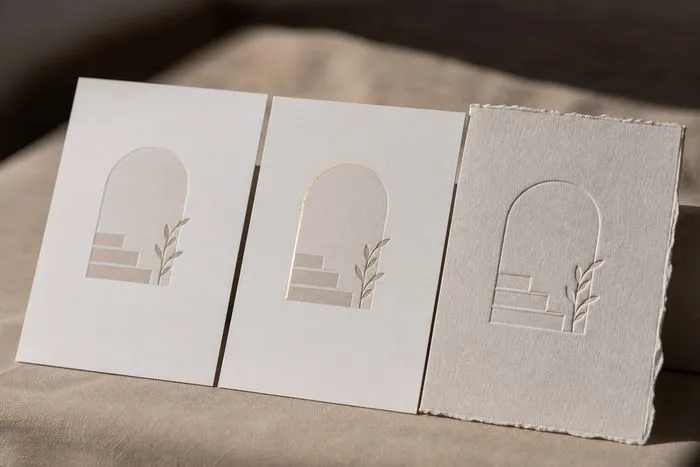
The hierarchy, in ascending order of both price and perceived formality: digital or flat printing is cheapest and fastest; metallic and flat-foil accents sit in the middle; foil stamping and letterpress are the premium tier and typically carry a paper-stock restriction plus a minimum order quantity.
Engraving is traditionally the most formal and most expensive technique, with thermography as a lower-cost raised-ink alternative, though our sources gave no current pricing detail for either of those two, so treat that placement as directional rather than measured.
The dollar figures below come from commercial and media sources published for 2026, each with medium or low reliability, and several of them disagree with each other at the top of the range. Read them as bands, not quotes.
| Tier | Per invitation (about) | Per 100 (about) | What you get |
|---|---|---|---|
| Budget | $1-$3 | $100-$300 | Digital print, standard paper, template design |
| Mid-range | $3-$8 | $300-$800 | Digital print on premium or linen stock, flat foil accents |
| Luxury | $8-$20+ | $800-$2,000+ | Letterpress on cotton paper, foil stamp, bespoke suite |
Sources disagree on where the luxury tier starts and stops: one puts premium designs at $6-$15 per invitation, another at $8-$20 and up, a third says $15 or more per card from a custom stationer. Take the overlap as the reliable part.
For a full order of 100 four-piece suites, the sourced bands run roughly $300-$600 for digital and DIY, $900-$2,100 for semi-custom, and $3,500-$7,500 and up for fully custom.
That top figure is itself contested: the same article that gives $3,500-$7,500 in its body text says $3,500-$8,000 in its own automated summary, and a different studio quotes $4,000-$8,000+ for a fully custom letterpress or foil suite from a named designer.
When the ceiling on a five-figure-adjacent decision moves by $500 depending on which paragraph you read, that is your cue to get a quote rather than a range.
At the category level, The Knot's Real Weddings Study is cited as putting national average spend on the complete paper suite at about $518, with roughly $226 of that attributable to invitation cards specifically.
We reached that figure secondhand rather than reading the study directly, so it carries a verification flag. Commercial sources tracking spend by guest count give about $123 for 50 guests or fewer, about $185 for 51-100, and about $276 for 101 and up. Stationery as a line item is generally described as 2-3% of total wedding budget.
Add-ons are where budgets quietly break. Wax seals run about $1-$3 per invitation, bevel or painted edges about $4, and belly bands, vellum jackets, or ribbon ties roughly $0.50-$2 each. Design fees, where charged separately, span $75 to $1,500 and up.
Minimum order quantities attach to techniques, not just to vendors: flat foil is commonly gated around 10 cards, foil stamping around 50. Two different floors, and a vendor's own minimum can be a third number on top.
Deeper on the money side: what a real Minted order costs with add-ons, Basic Invite's per-card entry price and its review record, and three budget printers compared on what is actually confirmed.
Postage: the part that catches people
Mailing printed invitations is the one genuinely regulated layer in this category. USPS sets retail postage rates, which the Postal Regulatory Commission reviews and approves. USPS announced a mailing-services price change effective July 12, 2026, averaging about a 4.8% increase, and published the following (confirmed by USPS's own newsroom release):
| Mail piece | Rate from July 12, 2026 | Previous |
|---|---|---|
| First-Class letter, 1 oz (Forever stamp) | $0.82 | $0.78 |
| First-Class metered letter, 1 oz | $0.78 | $0.74 |
| Domestic postcard | $0.65 | $0.61 |
| International postcard and letter, 1 oz | $1.75 | $1.70 |
| Each additional ounce, single-piece letters | $0.29 | unchanged |
A 2 oz First-Class letter therefore runs $1.11 and a 3 oz letter $1.40, both matching the denominations USPS sells as its "Two Ounce" and "Three Ounce" stamps.
If you still see "the current Forever stamp is $0.78" on a 2026 wedding blog, that is a stale figure from the previous rate table. We found exactly that error circulating in content dated 2026.
Then there is the surcharge that ruins the arithmetic.
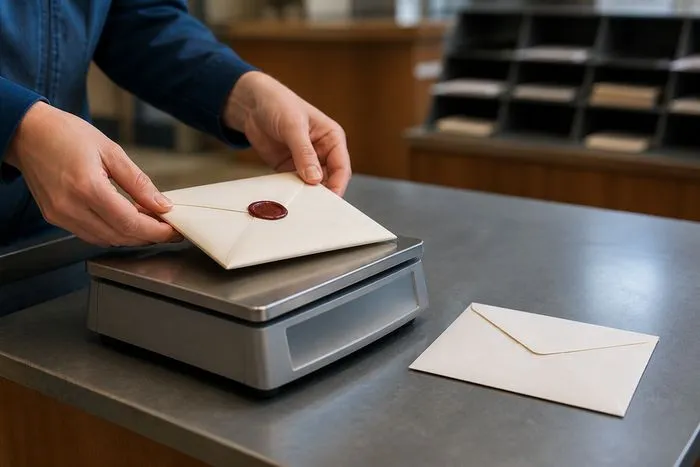
A non-machinable or nonstandard surcharge of about $0.49 is added on top of the applicable letter rate for envelopes that a sorting machine cannot handle: square envelopes, wax-sealed envelopes, envelopes thicker than 0.25 inches, envelopes with closures that protrude, and envelopes containing rigid inserts.
That is almost a checklist of what makes a wedding invitation feel special. A 1 oz square envelope lands at about $1.31 after July 12, 2026, which matches the official combination stamp USPS sells at that denomination. A 2 oz square works out to about $1.60 by the same arithmetic.
One commercial source states $1.31 for that 2 oz scenario, which appears to conflate it with the 1 oz non-machinable rate; treat it with caution.
The surcharge amount itself and the trigger criteria come from commercial sources, corroborated indirectly by the official $1.31 combination-stamp product rather than restated in the official release.
Same for the large-envelope rate (about $1.69 for 1 oz plus $0.29 per additional ounce) and the size thresholds that separate a letter from a flat. Verify against USPS Notice 123 or pe.usps.com before you buy stamps in volume.
The practical rule survives every rate change: weigh one fully assembled suite with its final envelope, every insert, and any embellishment, before buying postage in bulk. Insufficient postage on a time-boxed mailing means returned mail, delayed mail, or postage-due mail arriving at guests' homes with an RSVP deadline already ticking.
Run your own combination through the invitation count and postage estimator, which shows which figures are official and which are derived.
How to choose a seller without guessing
Work through this in order. It is built from the quality markers and failure patterns our research surfaced, and it is deliberately weighted toward what you can verify before money changes hands.
- Decide printed or digital first, before you look at a single design. This is the fork that eliminates the most options fastest. Digital removes postage, mail delay, and mail loss entirely, and gives you centralized RSVP tracking. It also introduces risks you cannot see or fix: a message landing in a spam folder, or a guest who does not comfortably navigate email. You will not always know it happened.
- Count households, not guests. Sourced guidance puts households at roughly 50-70% of headcount, and that spread is not precision, it is disagreement between sources. Add a buffer, which sourced guidance puts anywhere from 10-20% to a flat 25 extra invitations. Ordering a small reprint later is consistently described as more expensive per unit than ordering extra upfront, though no source we found quantifies the premium.
- Set your per-card ceiling from the tier table above, then multiply by your household count plus buffer. Do this before browsing. Designs are engineered to move you up a tier.
- Check whether you can order a sample or proof. This is the strongest quality marker in the category. If a vendor will not let you verify paper, color, and print quality before a bulk commitment, that is a structural problem, not a preference. Confirm the sample is representative of the stock you are ordering: one brand's free-sample program has been documented sending premium stock that does not reflect what a standard order produces.
- Read the actual policies on reprints, delays, and errors before ordering. No consumer-protection statute, licensing regime, or category-specific returns rule surfaced anywhere in this research. What exists are individual vendor policies, which vary. There is no uniform right you can fall back on.
- Cross-check reputation on at least one independent platform, and look at the review count, not just the score. A 4.6 on twelve reviews tells you almost nothing. A "Poor" standing on a seventeen-review sample tells you almost as little, especially where the platform itself notes the company has no history of soliciting reviews.
- On a marketplace, vet the seller, not the platform. Shop reviews, stated policies, response time, whether a physical sample is available, and what the marketplace's own buyer protection actually says.
- Confirm turnaround directly with the vendor. Production commonly runs 2-4 weeks depending on print method, with letterpress and foil stamping at the long end, but nobody should be relying on a generic category figure for a fixed-date event.
- Weigh the assembled suite and price the postage before ordering 120 envelopes, not after.
Timing, so the sequence works: save-the-dates go out roughly 4-8 months ahead for local weddings and 8-12 months for destination weddings (up to 18 for international), invitations are typically ordered 4-6 months out, mailed 6-10 weeks before the date, with an RSVP deadline 3-4 weeks out.
Sources disagree on the first two windows by months, so build in margin rather than treating any single number as the deadline. The backward-planned timeline works through the whole sequence date by date.
Red flags: the seller you should walk away from
The dangerous patterns in this category are informational, not transactional. Nobody is going to steal your credit card. What happens is that you commit to a large, unrepeatable purchase and discover the problem after it is printed.
- No sample or proof available before a bulk order, especially for a premium print technique. The highest-risk pattern in the whole category.
- No verifiable, continuously updated independent review history for the seller or company. Testimonials on the vendor's own site are not this.
- Vague or absent stated policies on returns, reprints, delays, or a damaged or incorrect print run.
- Cost-affecting details withheld until checkout: paper weight and rigidity, envelope shape, add-on pricing, per-envelope fees.
- On an open marketplace, per-unit prices that swing wildly between sellers with no visible explanation for comparable products.
- A listing that invokes a well-known brand's aesthetic without being sold by that brand. Marketplace listings described as "inspired by" a named stationery brand are unrelated third-party products, and their prices tell you nothing about the real brand's pricing. This is a trademark grey area, and it is a real source of confusion when a design appears at wildly different prices across channels. Print-exclusive distribution arrangements add to the muddle: some designer collaborations are genuinely available in print only through one specific retail partner.
- A superlative you cannot check. "Heirloom quality" and "premium" from a vendor's own marketing copy are claims, not findings.
Where a specific caution applies to a named company: why one independent reviewer advises against a well-known printer for wedding stationery specifically, where genuine Rifle Paper Co. product can actually be bought, and what is and is not verified about a heritage stationer's claims.
Market and legal reality in the United States
Two things to be clear about, because a lot of published content in this category implies otherwise.
No licensing or registration regime exists specifically for wedding-stationery retail or design services in the US. We found none, and none of the sources reviewed cited one. Anyone can sell wedding invitations.
There is no credential to check, no register to search, no approval status that separates a legitimate stationer from a hobbyist with a website. General business licensing applies to businesses generally, which tells you nothing about this category.
No consumer-protection statute, returns regulation, or marketplace buyer-guarantee text specific to this category was located either. General e-commerce and mail-order frameworks would presumably apply to a purchase like this, but we did not source that, and we are not going to imply a right we have not read.
On open marketplaces, practical buyer protection runs through the platform's own seller-rating and review system, and we did not locate the published policy text for the major marketplaces in this research pass.
That gap is ours to disclose, not yours to guess around. Read the specific seller's or company's own stated policy before ordering.
The consequence for how this hub is written: every company covered here carries an "unverified" legitimacy read. That is not an accusation. It means no formal business-register check was performed, because in this category there is nothing to check against.
What each entity page does instead is state the concrete evidence found (operating history, official pricing pages, review volume, absence of any fraud or shutdown finding) and the evidence missing, separately and plainly.
The one regulated layer is the mail itself, covered above. That is also the only dataset in this hub sourced to an official origin at high reliability.
Regionally, one media source reports couples in the Southeast spending about 30% more on invitations than couples in the Southwest. Single-sourced, uncorroborated, and flagged accordingly.

Where etiquette stops being a rule
Invitation wording has no governing authority, and credible sources genuinely contradict each other on the questions couples actually get stuck on. Anyone presenting one convention as the correct answer is presenting a preference.
On explicit "adults only" wording, four credible sources give four positions: that it has no place on a formal invitation and should be handled through envelope addressing; that writing it is straightforwardly tacky; that "Adults only, please" at the bottom of the card is the way to indicate it; and that it belongs on the wedding-website card in the suite rather than the invitation itself.
The safest defaults are envelope addressing (children's names on the inner envelope if invited, parents only if not) or a note on your wedding website card. If you want the direct wording, credible sources do endorse it. Just know you are choosing between conventions, not following one.
On divorced or remarried parents, the well-corroborated part is that the parents' names appear on separate lines without "and" joining them.
Whose name goes first is contested: one source says the mother always, unless she is not contributing financially and asks otherwise; another describes a trend toward listing the financially contributing father first; a third says the mother regardless of remarriage on either side.
Where the family situation is complicated enough that no template fits, a professional stationer is a better investment than a generic etiquette article, yours included.
The wording guidance in depth, including addressing examples for the situations above, lives in our full wording and envelope-addressing guide rather than on this page.
Catalog
Single-brand semi-custom catalogs
Minted Wedding Invitations: Cost & Verdict (2026)
Curated designs from independent artists, with premium letterpress and foil-press options; the page prices the real total once the venue illustration, monogram, custom design fee, and the 10-set order minimum are counted. Legitimacy: unverified, with official dated pricing pages and a large Trustpilot review volume on record.
Basic Invite Wedding Invitations: Cost & Verdict (2026)
Budget-to-mid catalog with unusually granular per-element color customization and a paid printed sample before ordering. Legitimacy: unverified, and the review scores disagree sharply across platforms, which the page shows rather than averages.
Zazzle Wedding Invitations: Cost & Options (2026)
Print-on-demand marketplace of independent-designer templates with centralized fulfillment and a broad paper, shape, and print matrix. Legitimacy: unverified, and no official pricing page content was captured, so the page discloses the gap instead of filling it.
Vistaprint Wedding Invitations: The Caveats (2026)
Mass-market general printer with wedding stationery as one line among many. Legitimacy: unverified, and a sourced independent review advises against it for wedding stationery specifically, which the page leads with.
Paper Source Invitations: Reviews & Verdict (2026)
The hub's only genuine brick-and-mortar option, with in-store stationery consultations plus in-house and licensed design lines. Legitimacy: unverified, with a "Poor" Trustpilot standing on a seventeen-review sample set against thousands of Yelp store reviews; the page shows both pictures together.
Digital-only platforms
Greenvelope Wedding Invitations: Cost & Verdict (2026)
Flat one-time price by guest-count tier, delivered by email, SMS, or link with centralized RSVP tracking; the page gives the exact dated tier pricing plus an honest read on formality and deliverability. Legitimacy: unverified, with two of the platform's own claims contradicted by a third party and both positions disclosed.
Paperless Post Wedding Invitations: Cost & Verdict (2026)
Coin-based, pay-per-send digital platform with a free tier by recipient count; the page explains how the coin mechanics translate into a real total. Legitimacy: unverified, and every pricing figure reaches us through a competitor's comparison page rather than the platform's own publication, disclosed alongside each number.
Open marketplace
Etsy Wedding Invitations: Is It Safe? (2026)
Thousands of independent sellers ranging from editable digital templates to fully printed suites, where price, quality, and turnaround are set per seller. Legitimacy: unverified, and assessable only per seller, never at platform level; the page gives the vetting method instead of a rating.
Design-led premium and luxury heritage
Rifle Paper Co. Wedding Invitations: Where to Buy
Founder-led premium brand whose designs originate as gouache paintings, sold through a wholesale retail partner and a digital-invitation collaboration rather than a dedicated own-site wedding checkout. Legitimacy: unverified, with confirmed distribution but no current official per-suite wedding price on its own site.
Crane & Co. Wedding Invitations: What's Verified
Luxury heritage stationer associated with cotton papers and traditional engraving-tier work. Legitimacy: unverified, and the multi-century heritage claim traces to a single secondhand media roundup rather than the brand's own site or an independent record; no price point was found at all.
Comparisons and tools
Greenvelope vs. Paperless Post: Cost (2026)
Flat guest-tier pricing against coin-based pay-per-send, worked at the same guest count, with the sourcing asymmetry stated before the table.
Basic Invite vs. Zazzle vs. Vistaprint: Which Budget Printer Is Actually Safe?
One officially sourced price against two with none captured, plus the add-on fees, the sample question, and the independent caution that separates cheapest from safest.
Wedding Invitation Count & Postage Estimator
Households from headcount as a range, buffer and extras, envelope class and weight tier resolved to a stamp combination, with each figure labeled official or derived.
Guides
Digital vs. Paper Wedding Invitations: How to Choose
Printed, digital or hybrid? Compare cost, formality and guest access, see exactly where the etiquette sources disagree, and pick a format you can defend.
How Many Wedding Invitations Do I Need? Count Households
One invitation per household, not per guest. Turn your guest list into an order quantity, add a sensible buffer, and handle the awkward edge cases.
When to Send Wedding Invitations: The Backward Timeline
Set your save-the-date, invitation and RSVP dates by working backward from your caterer's final headcount deadline. Worked example plus destination timing.
How Much Postage for Wedding Invitations, and What Goes In
Current postage rates with an as-of date, why square envelopes cost more, what belongs in the suite, and the one envelope to weigh before buying stamps.
Wedding Invitation Wording and Addressing Examples
Host-line wording for divorced, remarried and blended families, plus addressing for unmarried couples, titles and adults-only - with the disputed cases named.
Frequently Asked Questions
How much do wedding invitations really cost?
There is no single number, and any source giving you one is rounding away most of the variation.
Sourced 2026 tiers run about $1-$3 per invitation for budget digital printing, $3-$8 for mid-range premium stock with foil accents, and $8-$20 or more for letterpress or foil stamping on cotton paper.
For 100 four-piece suites that translates to roughly $300-$600 digital, $900-$2,100 semi-custom, and $3,500 and up fully custom. National average spend on the complete paper suite is cited at about $518, with roughly $226 of that on the invitation cards themselves.
Those figures are commercial and media sourced for 2026 and several of them conflict at the top of the range, so use them to set expectations, not to build a budget line.
How many invitations should I order?
One per household, not per guest, which is the single most common mistake in this category. Sourced guidance puts households at roughly 50-70% of headcount, and that range reflects genuine disagreement between sources rather than precision. Add a buffer on top for keepsakes, addressing mistakes, and lost mail: guidance ranges from a 10-20% margin to a flat 25 extra invitations.
Order the extras in the original run, because reprinting a small batch later is consistently described as costing more per unit, thanks to setup fees and minimum-order thresholds.
Is it rude to send a wedding invitation only by email or text?
Credible sources genuinely split on this. One position frames digital invitations primarily by their drawbacks: loss of formality, the spam-folder risk, and inaccessibility for guests who are less comfortable with email. The other frames them by benefits: faster RSVP tracking, lower cost, no mail delay or loss, and a smaller environmental footprint, with formality treated as a fading concern.
Neither is wrong. The practical consideration that survives both framings is deliverability, since you cannot always tell that a guest never saw the message. A hybrid approach, with printed invitations for the guests who need them and digital for the rest, sidesteps the argument entirely.
How much postage do I need?
As of July 12, 2026, a 1 oz First-Class letter is $0.82, a 2 oz letter $1.11, and a 3 oz letter $1.40 (official USPS rates, effective that date). Add about $0.49 for a non-machinable envelope, which covers square shapes, wax seals, anything thicker than 0.25 inches, protruding closures, and rigid inserts. A 1 oz square envelope therefore runs about $1.31.
The surcharge figure is corroborated indirectly rather than stated verbatim in the official release, so verify before a bulk stamp purchase. And weigh one fully assembled suite first: no fixed number of stamps is safe regardless of shape, weight, and rigidity.
What happens if my invitations go out with the wrong postage?
Underpaid mail can be returned to sender, delayed, or delivered postage-due, meaning your guest pays the difference at the door. On a mailing tied to a hard RSVP deadline, any of those outcomes costs you real response time and some goodwill.
The fix is cheap and takes ten minutes: assemble one complete invitation with its final envelope, all inserts, and any embellishment, and have it weighed and assessed at a post office before you buy stamps in quantity.
What is the difference between semi-custom and fully custom?
Semi-custom means you personalize an existing design from a company's catalog: wording, colors, paper, sometimes layout within limits. It is the volume model, it is published pricing, and it covers most of the catalogs in this hub.
Fully custom means a designer creates the suite for you from scratch, usually with a separate design fee on top of printing, and typically with premium techniques like letterpress or foil stamping. Sourced 2026 ranges put a fully custom 100-suite order at $3,500 and up, against $900-$2,100 for semi-custom, and design fees alone span $75 to $1,500 or more depending on tier.
Can I reorder later if I run out?
Yes, but expect to pay more per card than you would have paid to include them in the original run. Setup and plate fees get charged again, and minimum-order thresholds mean a request for fifteen extra cards may be billed as a larger batch. No source we reviewed quantifies the premium, so we cannot give you a multiplier, only the direction.
Building the buffer into the first order is the cheaper path.
This page is informational and is not legal, financial, or professional purchasing advice. Prices, postal rates, minimum order quantities, review scores, and production times are point-in-time figures that change on their own schedules: verify every number against the vendor's current pricing page or the official USPS source before you commit to a purchase. Postage rates quoted here are USPS rates effective July 12, 2026; derived figures, including the non-machinable surcharge and square-envelope totals, are corroborated indirectly and marked as such in the text. No licensing regime, register, or category-specific consumer-protection statute for wedding-stationery retail was identified in the research behind this hub, and no company covered here has passed a formal business-register check, because none exists to pass; each entity page states the evidence found and the evidence missing. Invitation wording conventions are contested among credible sources and are presented here as such, not as rules. We may earn a commission on some links to sellers named on this site; that plays no part in which companies are covered, how they are ordered, or what any verdict says. Author: Tessa Broussard. Reviewed by Renata Halloran, CWP, a practicing wedding planner in Chicago holding the Certified Wedding Planner credential and a CPCE-class catering and events credential.