 Goes Wedding
Rent or Buy a Tuxedo? Cost, Timing, Returns
 Written by Tessa Broussard
 · Reviewed by Renata Halloran, CWP· Published 2026-08-28· Last checked 2026-08-30
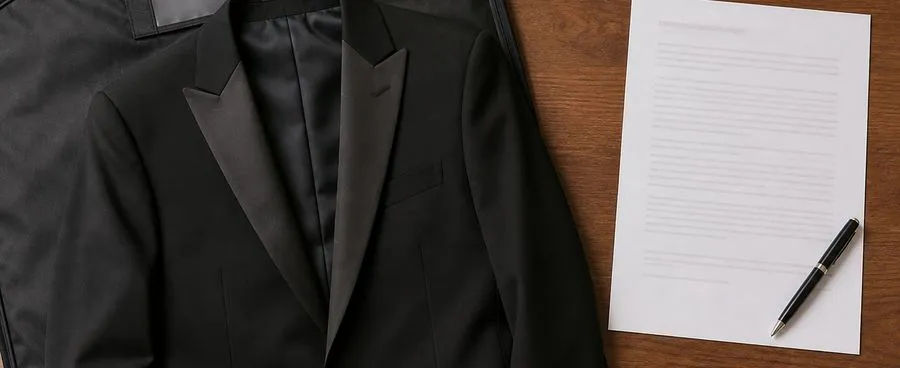
Rent it if he is going to wear it twice. Buy it if he is going to wear it five times.
And read the return clause either way, because the fee does not stop at twenty dollars a day at every shop - at more than one company, a tuxedo that stays out past the deadline stops being a rental and turns into a purchase at full retail price.
That is the short version.
The long version is what this article works out: a real break-even calculation instead of a marketing headline, a side-by-side look at what the big rental providers actually publish about their own return windows and late fees, and as straight an answer as the record allows to the one legal question nobody selling a tuxedo wants to touch, whether an escalating late-fee clause would actually hold up if a renter pushed back.
Most retailer content quotes one company's own price and stops there. This one puts the terms next to each other and says where the sources disagree.
Rent or Buy? Run the Break-Even Math First
Start with the math, not the vibe. A rental tuxedo runs roughly $150 to $300; a rental suit is a bit cheaper, about $150 to $250. The Knot's 2025 Real Weddings Study puts the average rental spend around $205, a number that lines up with what most groomsmen actually pay once a vest or bow tie gets added to the base package.
Buying costs more up front.
A tuxedo purchase, alterations included, commonly runs $700 to $1,000 or more; a suit is cheaper to own outright, typically $300 to $800, and a made-to-measure suit runs higher still, roughly $800 to $1,200.
Set those two ranges against each other and a pattern shows up fast: the break-even point, the number of wears before buying beats renting on pure cost, is commonly cited at around three to five wears.
I have not found a single authoritative study that pins that number down. It is closer to industry consensus than hard data, and it is worth treating that way.
Table A below lines up the ranges by garment.
For a full wedding party of four to six groomsmen, the rent-versus-buy call can swing total spend by roughly $600 to $1,800, real money on top of a wedding budget that is usually stretched thin already.
Multiply that swing across five groomsmen who each land on a different side of the decision and the total gap widens further, which is exactly why the group-discount check in step three below matters as much as the individual math.
Rent vs. Buy: Total Cost and Break-Even
| Garment | Rental cost | Purchase cost | Wears to break even |
|---|---|---|---|
| Tuxedo | $150-$300 | $700-$1,000+ (with alterations) | about 3-5 wears |
| Suit | $150-$250 | $300-$800 (made-to-measure: $800-$1,200) | about 3-5 wears |
| Full groomsmen party (4-6 men) | scales with the per-person rental cost above | scales with the per-person purchase cost above | swings total party cost by roughly $600-$1,800 |
The Rent-or-Buy Decision Tree
- Will he realistically wear formalwear again in the next few years, another wedding as a guest, a black-tie work event? If the honest answer is no, rent, and the decision is over.
- If yes, how many more times in the next two or three years? A count that clears the three-to-five-wear break-even above usually means buying wins on total cost. One or two more occasions means rent, and reconsider buying only if a made-to-measure suit is something he wants for its own sake, not as a cost-saving move.
- Either way, check a provider's group-discount terms, in Table B below, before deciding for the whole party. A strong group incentive can shift the math at the margin, especially for a party of five or six.
I built a version of this math into the calculator on this page, so you can swap in your own quotes instead of the illustrative ranges above. The ranges get you in the right neighborhood. Your actual quote from a specific shop is the number that matters.
Comparing the Named Rental Providers on Price and Terms
Three national providers show up in almost every groomsman's search: The Black Tux, Generation Tux, and Men's Wearhouse. Their pricing pages do not always agree with each other, or with the outlets that write about them, and that gap matters more than it looks.
Comparing the Named Rental Providers
| Provider | Base rental price | Return deadline | Late-fee / escalation structure | Group-discount terms |
|---|---|---|---|---|
| The Black Tux | $149-$189 per its own materials (as of the 2026 research pass); a competing rental company describes it as "upwards of $280" | 3 days after the event date (5 days for orders placed before July 16, 2026), per its own current rental agreement | $60 flat extension fee past the deadline; full Retail Value plus sales tax if unreturned within 12 days | No current figure surfaced in this research pass - check the group-order page before booking the party |
| Generation Tux | $149 on its own site; The Knot's research cites $139 for the same comparison | No current figure surfaced in this research pass | No current figure surfaced in this research pass | No current figure surfaced in this research pass |
| Men's Wearhouse | No current figure surfaced in this research pass | No current figure surfaced in this research pass | Could not be confirmed to a current terms page; the only figure found traces to a 2016 class-action complaint, not the company's current agreement | No current figure surfaced in this research pass |
Generation Tux lists its own base price at $149. The Knot's cost research, by contrast, cites $139 for the same comparison. Neither number is wrong exactly, they are likely pulling from different packages or promotional windows, but it means the figure you see quoted depends on where you are reading it.
The only number that actually applies to your order is the one on the checkout page the day you book.
The Black Tux runs into a sharper version of the same problem. Its own materials put the base price at $149 to $189. A competing rental company, in its own marketing, describes The Black Tux's pricing as running "upwards of $280."
That is a competitor's characterization of a rival, not a receipt, and I would treat it that way. A company describing what its competitor charges has an obvious reason to make that number look bad.
(A habit from my contract-reading years: I go looking for a company's actual current agreement before I quote its price anywhere. More than once I have found it buried three clicks past the pricing page. Do the same before you book.)
Men's Wearhouse is the harder case.
I could not confirm its current late-fee policy against a current terms page; the only figure that turned up traces back to a 2016 class-action complaint, a legal filing about a past dispute, not a statement of today's contract terms.
Table B states that plainly rather than guessing at a number.
If you are renting to a dress code printed on the invitation rather than a strict tuxedo requirement: Renting to a stated dress code? Check what the phrase on the invitation actually asks for.
Some of the price gap above comes down to renting the wrong formality tier entirely. And if a rental company's own site quotes you a price meaningfully different from what is here, that is not automatically a red flag, packages and promotions shift constantly. It is a reason to read the actual order page before you commit, not the homepage banner.
Getting Measured When Not Everyone Can Show Up in Person
Advice on fitting timelines is inconsistent almost everywhere you look. Some sources say six weeks is plenty. Others push it to eight or twelve.
The two largest national rental companies each cite their own reservation windows, running anywhere from two or three months out to as long as five to eight months for a full party booking. There is no single industry standard here, which is frustrating if you want a clean answer, so I would plan around the longer end. Booking early costs nothing.
Scrambling in the final weeks costs you your first-choice size and color.
The harder problem is the groomsman who cannot show up in person: out of town, deployed, working a schedule that will not bend.
The usual fixes are a self-measurement kit mailed to him with instructions, a franchise or affiliate measurement network with a location near him, or simply walking into any local tailor or tux shop, getting measured there, and phoning or emailing the numbers to whoever is placing the order.
None of that is as good as standing in front of a professional with a tape measure, and no source I found presents self-measurement as equivalent to an in-person fitting. It is a fallback, not a substitute. The errors that show up most often are mundane: measuring over a shirt instead of against skin, or letting the tape go slack or twist mid-measurement.
Both are fixable if caught before the order ships, and both are exactly the kind of thing a rushed, last-minute measurement misses.
The Return Deadline, the Late Fee, and the Damage Waiver's Fine Print
Three days.
That is the entire return window on The Black Tux's current rental agreement, an actual contract page, not a marketing blurb, for a groom whose wedding already happened: ship the tuxedo back within 3 days of the event date, or 5 days if the order was placed before July 16, 2026.
Miss that window and a $60 flat extension fee kicks in. Miss it by more than 12 days and the charge stops being a fee at all; you now owe the full Retail Value of the garment, plus sales tax. I am quoting the current version of that page as of this research pass.
The fact that the window itself shortened from 5 days to 3 sometime in mid-2026 is the whole point: these terms move, so check the live page before you book, not this article.
Independent and regional shops follow a looser but recognizable pattern. Per-day late fees commonly cluster around $20 to $50, and several shops escalate to a flat multiple of the daily rate, or to full retail replacement cost, somewhere around a week to twelve days out. That is a description of a pattern across many small businesses, not a ranking of any one of them.
No reliable review data exists to back a ranking, so none appears here.
Then there is the damage waiver, usually $10 to $15 tacked onto the order. Read what it actually covers before assuming it is insurance: it typically pays for minor, unintentional damage only, a torn seam, a scuffed shoe, never loss, theft, or serious damage. If a groomsman spills red wine down the lapel at the reception, that waiver is not going to be the thing that saves him.
Signs a Rental Deal Will Cost More Than the Sticker Price
- The return, cancellation, or late-fee terms are only disclosed after you have already paid.
- There is no stated cap anywhere on the late fee or the damage charge.
- A "starting at" price is quoted with no full example cost shown anywhere on the page.
- No written return policy is available before you book.
- A same-day or rush turnaround is promised with no stated exception process if something goes wrong.
- Self-measurement is presented as just as accurate as an in-person fitting.
Any one of these is a reason to read the actual contract before you pay, not a reason to assume the provider is typical, good or bad.
Is That Late Fee Actually Enforceable? An Honest, Unresolved Answer
Can they actually charge that? That is the question every groom eventually asks me, usually right after reading a late-fee clause that looks steep.
The honest answer is that I do not know, and neither does anyone else writing about this topic with a straight face. In 2016, a California class action, Anthony Smith v.
Men's Wearhouse, challenged a national chain's escalating late-fee clause, arguing it functioned as a possibly unenforceable penalty under the state's consumer-protection law rather than a reasonable estimate of actual damages.
I could not find a confirmed public outcome for that case: not a settlement, not a ruling, nothing. So I am not going to tell you the clause is enforceable, and I am not going to tell you it is not. Both of those would be a guess dressed up as an answer.
Then there is the felony question, which comes up almost as often and deserves a narrower answer than it usually gets. One Arizona statute, A.R.S. 13-1806, classifies failing to return rented property within 72 hours of the specified date as a class 6 felony, and one Arizona tux shop cites it, by name, as a deterrent on its return policy.
That is a real statute in one state, cited by one company.
It is a general property-return law, not written specifically for formalwear, and I found no evidence it exists in other states in any similar form. "Late return is a felony" is not a nationwide rule, and treating it like one is simply wrong.
Read the actual rental agreement before you sign. This is general information, not legal advice.
Before You Book: The Checklist That Keeps You Out of the Fee Trap
Everything above boils down to one habit: read the contract before you pay, not after something goes wrong. Here is the checklist I would hand a groom the day he starts calling shops.
Before You Book a Rental
- Is the event date fixed, not tentative?
- Has each groomsman been measured, in person if at all possible?
- Have you read the actual rental agreement, return window, late-fee schedule, damage-waiver scope, and the point where a late return becomes a full-price charge, not just the marketing page?
- Have you compared at least two named providers on total cost, not the headline "starting at" price?
- Is the exact return deadline, the shipping deadline, not the event date, on a calendar with a buffer reminder?
- Has it been confirmed, before any order is placed, who is paying for what?
That third item, reading the actual rental agreement instead of the marketing page, is the one people skip most, and it is the one that matters most. A pricing page shows the best-case number. The agreement shows what happens on a bad day: a late shipment, a lost box, a groomsman who forgets to drop the garment bag at the shipping counter until the deadline has already passed.
Compare quotes from at least two named providers on total cost, not the "starting at" headline but what you would actually pay for the full package, before booking the first one that emails you back. A price that looks lowest on the landing page has a way of catching up once shipping, the damage waiver and a group fee get added at checkout.
Then put the actual return deadline on a calendar now, not after the invitations go out. Before you book anywhere: See every rental provider's terms side by side, and get your return deadline on a calendar.
Frequently Asked Questions
Quick, direct answers to what comes up most, pulled from the sourcing above.
Is it cheaper to rent or buy a tuxedo? Renting is cheaper for one or two wears; buying tends to win around the three-to-five-wear break-even, though no single study pins that number down. Set the rental range ($150 to $300) against the purchase range ($700-plus) and the math flips fast. Run the calculator on this page with your own quotes for a sharper answer.
How do groomsmen get measured if they live out of town? A local tailor or tux shop taking the measurements in person, phoned or emailed to whoever is ordering, is the most reliable fix. A self-measurement kit or a franchise network's remote location are fallbacks, not the first choice. No source treats self-measurement as equivalent to an in-person fitting.
How many days do I have to return a rented tuxedo? It depends on the provider, and the window is commonly just a few business days. The Black Tux's own current agreement gives 3 days after the event, 5 for orders placed before July 16, 2026, one company's terms, not an industry standard. Confirm the actual figure before paying.
Can a tuxedo rental company legally charge me a late fee? Probably, within some limit, but the limit itself is unsettled. A 2016 class action challenged a major chain's escalating late-fee clause as a possibly unenforceable penalty, with no confirmed public outcome. Read the actual contract before assuming either way.
Is it illegal to return a rented tuxedo late? For almost every renter, no, it is a civil fee, not a crime. The one confirmed exception is a single Arizona statute cited by one shop there, not shown to exist as a formalwear rule anywhere else.
What is the actual break-even number of wears where buying beats renting? Commonly cited at three to five wears, based on industry consensus rather than one study. What moves it: the purchase price tier, the rental price tier, and how many real formal events he actually has coming up.
Naming these three companies here is for comparison, not endorsement. None of them sponsored or reviewed this article, and no fee changes what is written above. Run the calculator on this page with your own numbers, then See every rental provider's terms side by side, and get your return deadline on a calendar before you book.
If you are splitting group costs the same week, The dress side of the same order: who pays, and by what date is worth settling too, before the first deposit goes out.
Some links on this page may earn us a commission if you book through them, at no extra cost to you.