 Goes Wedding
What Wedding Dress Alterations Really Cost
 Written by Tessa Broussard
 · Reviewed by Renata Halloran, CWP· Published 2026-08-28· Last checked 2026-08-30
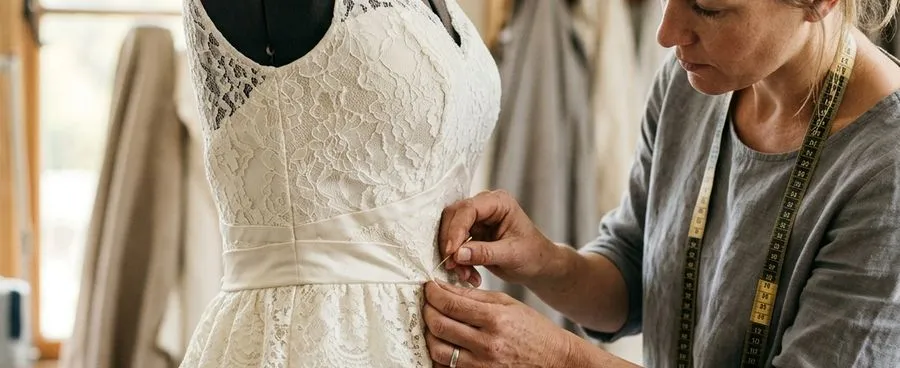
The dress is not the last check you write.
Alterations get billed separately from the gown price, on their own invoice, usually by a seamstress you have not met and the bridal salon never mentioned by name. Nobody hides this on purpose.
It just is not the seller's line item to explain, so it becomes yours to discover.
For a gown under $1,000, that discovery can sting: alteration work can approach the cost of the dress itself, according to one bridal-cost breakdown I trust more than the glossy copy that sold the gown in the first place.
That is not a scare number. It is the reason this article exists.
I missed my own alteration window by two weeks, a mistake I will walk through later, in the fitting-calendar section, because that is where it belongs, not here.
What you get instead of one confident average: itemized ranges with the disagreement between sources stated plainly, an explanation for why two bustle quotes can land hundreds of dollars apart, and a method for checking whatever quote is sitting in your inbox right now.
What Wedding Dress Alterations Actually Cost, Itemized
Start with the disclaimer that should come before any number: nobody regulates wedding dress alteration pricing. There is no board, no licensing body, no published fee schedule the way there might be for a notary in some states. Every figure below comes from a bridal retailer's blog, a wedding-media roundup, or a regional alteration shop's own marketing page.
That does not make the numbers useless. It means you read them as a range, not a receipt.
Three independent commercial sources put a standard alteration job somewhere between $250 and $1,000 or more, depending on how much work the gown needs. Zola's own breakdown separates a $300 to $800 "standard" tier from a $1,200-plus "complex" tier for structural changes, resizing a bodice or replacing boning. A second source lands closer to $350 to $1,000, and a third settles around $250 to $800-plus.
None of the three agree on the exact edges, and that disagreement is the honest answer, not a flaw in the research. (I spent three years reading vendor blogs like these for a living, and a range that refuses to converge usually means the writer priced from one shop's invoice book, not a market.)
Geography moves the number too. One Bay Area alteration shop quotes $400 to $1,200 or more for the same category of work, which it attributes to regional labor costs. Treat that figure as informative, not representative.
It is a single source describing one expensive market, not a national trend.
What cannot be given here, because it does not exist in independently verifiable form anywhere in this research, is a clean line-item breakdown: this much for a hem alone, this much for the bodice, this much for straps or bra cups.
Anyone quoting an exact per-service national average is quoting from thin air. The table below is a sanity check against your own seamstress's price list, not a substitute for it.
| Job type | Low end | High end | Independent sources | Reliability note |
|---|---|---|---|---|
| Aggregate/standard alteration job | $250 | $1,000+ | 3 | National ranges disagree on the exact band; no per-service breakdown independently available |
| Bustle addition | $30 (informal) | $1,000+ (complex) | Multiple, two evidence tiers | Order-of-magnitude spread; see the annotated example below, never merge buyer self-reports with published guides into one figure |
| Regional note: Bay Area | $400 | $1,200+ | 1 | Single-sourced, explicitly non-representative nationally |
One more thing this table cannot do: break any row into a price for a single service. Hem alone, bodice alone, straps alone, bra cups alone, none of that is independently sourced in a way worth standing behind. Use this as a sanity check against your own quote, not a line-item price sheet.
Why Two Bustle Quotes Can Differ By Hundreds of Dollars
If one number in this article deserves its own section, it's the bustle. Nothing else in alteration pricing spreads this wide. At the informal end, brides posting in wedding forums report paying $30 to $65 for a seamstress to add a simple bustle to a gown that already had the fabric and hooks roughly where they needed to be.
At the other end, commercial alteration guides quote $300 to $1,000 or more for a complex bustle on a heavily beaded or structured gown. Most of the "typical" quotes found across commercial sources cluster in between, roughly $75 to $300.
That's not three prices for the same job. It's two different jobs wearing the same word.
A bustle with four or five simple points on a lightweight fabric is a different task than a bustle threaded through beading on a heavy train, and the second one takes real hours a seamstress has to bill for.
Below is one of each, side by side, not because either is "the" bustle price, but because the gap between them is the actual lesson.
Two real bustle quotes, annotated
- Quote A: $45. A home-based seamstress added a simple over-bustle, four points, to a lightweight crepe gown with no beading. The bride supplied her own thread-loop kit; the seamstress charged for roughly forty-five minutes of hand-sewing.
- Quote B: $650. A boutique alteration studio quoted a French bustle with eleven points on a heavily beaded ballgown skirt, threading ribbon loops through embellishment without damaging the beadwork. The studio's overhead, a storefront, staff, liability insurance, is baked into that number on top of the harder sewing itself.
- What explains the $605 gap: how many bustle points there are, how heavy the fabric is, how much beading the stitching has to work around, and whether you're paying a single home-based seamstress or a studio carrying rent and staff.
Neither figure is wrong, and neither is a target to negotiate toward. They exist to show you what to ask a provider about before you compare any two quotes to each other.
How to Tell If Your Alteration Quote Is Fair
Here's the stance I hold through this whole article: a quote is not automatically a scam because it's high, and it is not automatically fair because it's low. What actually protects you is not a single average pulled off a website. It's the itemized breakdown in front of you, checked against a real method.
The method runs three steps. Compare the total against the table above, for the category of work you're getting, standard alterations, bustle, or both. If you only have a verbal number so far, ask for a written, itemized quote before agreeing to anything; a seamstress who won't itemize is asking you to trust a total you can't check.
And if the number sits above the high end of the published range, ask specifically what's driving it, more bustle points, heavier fabric, structural work like replacing boning, rather than assuming you're being overcharged or that the higher figure must be justified.
One hard limit is worth knowing before that conversation. Most gowns can only be taken in by roughly two to three sizes; letting a gown out is far more limited still.
A quote implying open-ended resizing, taking a gown in far beyond that, is worth a second look regardless of the dollar figure, because it may be promising something the fabric and seams cannot deliver.
That's not a reopening of the whole goal-size conversation, which belongs elsewhere: Some shapes cost more to alter than others; here is why.
Signs your alteration quote deserves a second opinion
- The quote is verbal-only and never gets put in writing.
- The provider won't say which specific services make up the total.
- The price sits far above the published range, and nobody offers an explanation when you ask.
- You're pressured to pay a deposit or agree on the spot, before comparing it to anything.
- The provider won't confirm how many fittings are included in that price.
- The work implied, taking a gown in far beyond two to three sizes, exceeds what alterations can structurally deliver.
Budgeting for Veil, Shoes and Undergarments
Budget for more than the dress and its alterations. Undergarments and shoes are the first two most brides underestimate; a veil or headpiece, if you're wearing one, tends to run the widest range of all.
Undergarments run roughly $100 to $200 for shapewear built for a gown, not everyday wear. Shoes are murkier: one source puts the range at $150 to $350, another at $50 to $300, and a third simply cites a $250 average, three numbers that don't reconcile into one figure.
Veils and headpieces spread even wider: $200 to $600 by one account, $350 to over $1,000 (or $150 to $1,200) by another, and under $100 to a few hundred dollars by a third.
That's thin, mostly self-interested commercial data, not a settled figure, and the honest move is budgeting toward the higher end of whichever range you find rather than anchoring to the cheapest one. (Shoes were the one line item I actually got right at my own wedding, mostly by accident, since I'd already bought them for another event.)
Here's the part that matters for your calendar, not just your wallet: bring the real shoes and the real undergarments to your fitting before the final one, not the first. The hem length and how the gown sits get set against what you're wearing that day. Show up in flats when you're wearing heels, and the fit that looked perfect gets undone by an inch.
Your Fitting Calendar: How Many, When, and Why the Window Isn't Optional
Some brides describe leaving a first fitting with something still not right, a bodice loose in the wrong place, a slit still crooked on the third visit. That's not a sign anything went wrong. It's exactly why the schedule has more than one round built into it.
Plan on two to three fittings for most gowns, though some sources put the range at two to four. A fully bespoke gown commonly needs one more round than a made-to-order piece with tweaks, three to four fittings instead of two to three, because there's more structural work to check at each stage.
Space them this way: your first fitting roughly eight to twelve weeks before the wedding, your second around four to six weeks out, and your final fitting one to two weeks before the day itself. Once alterations actually begin, the whole process commonly runs eight to twelve weeks, though some sources describe a longer three-to-four-month window with return visits every four to six weeks.
I treat that calendar with the same seriousness I'd give an invoice, because I once didn't. I missed my own alteration-start window by two weeks planning my own wedding.
Not because I didn't know the date mattered, I did, I'd read the same advice I'm giving you now, but because I was tracking my budget line by line and lost track of the calendar entirely, until a seamstress told me she couldn't guarantee a final fitting before my date.
It worked out, barely, and only because I called around immediately instead of waiting another day to see if it would resolve itself.
Before each fitting: a short checklist
- Bring the actual shoes you'll wear, not a placeholder pair.
- Wear or bring the exact undergarments and shapewear you're planning for the day.
- Bring your itemized quote or invoice from the previous fitting, if this isn't your first.
- Confirm the date of your next fitting before you leave the studio.
- Raise any new alteration need, wanting a bustle added, for instance, as early as possible rather than as a late surprise.
- Don't schedule your final fitting so close to the wedding that there's no time left to fix anything found there.
If you're already behind that window, do what I eventually did: contact providers today, expect to pay a rush surcharge, and prioritize fit and length over anything cosmetic if time is genuinely short.
Rushed alterations start with a late order - here is how the dates line up.
FAQ
Are wedding dress alterations included in the price of the dress? Usually not: alterations are commonly billed separately from the dress and often performed by a seamstress the bride arranges herself, not the boutique that sold the gown. Confirm this before you buy, not at your first fitting, so the extra cost isn't a surprise.
How many wedding dress fittings do you actually need? Commonly two to three, though some sources put it at two to four, rising to three or four for a fully bespoke gown. Treat that as a convention rather than a fixed standard; no one regulates it. Some brides describe a first fitting that didn't get everything right, and that's exactly why the schedule has more than one round, not a sign something went wrong.
When should I buy my wedding shoes relative to my dress fittings? Before your final fitting. The hem length and how the gown moves both get set against the shoes you'll actually wear, not a placeholder pair you swap out later.
What should I budget for accessories like a veil, shoes and shapewear? Treat it as its own line item alongside the dress and the alterations, not an afterthought. The published ranges for each piece conflict across sources, so budget toward the higher end of whatever range you find rather than anchoring to the lowest number.
How can I tell if an alteration quote is unreasonably high before I agree to it? Compare it against the published aggregate and bustle ranges, then ask for a second itemized quote if the first one was verbal-only. Ask specifically what's driving any amount above the high end. A quote above the range isn't automatically a scam, and one inside it isn't automatically fair; the itemized breakdown is what actually tells you.
I missed the recommended window to start alterations. What do I do now? Contact providers immediately rather than waiting to see if it resolves itself. Expect to pay a rush surcharge, and prioritize fit and length changes over anything cosmetic if time is genuinely short. It's the exact mistake I made planning my own wedding, and calling around immediately is what saved it.
Ready to find someone to do this work? Find alteration and preservation services, and the full date planner to compare providers near you and see the rest of the attire timeline. Some links on this page may earn us a commission if you book through them, at no extra cost to you.