 Goes Wedding
Wedding Dress Silhouettes for Your Venue
 Written by Tessa Broussard
 · Reviewed by Renata Halloran, CWP· Published 2026-08-28· Last checked 2026-08-30
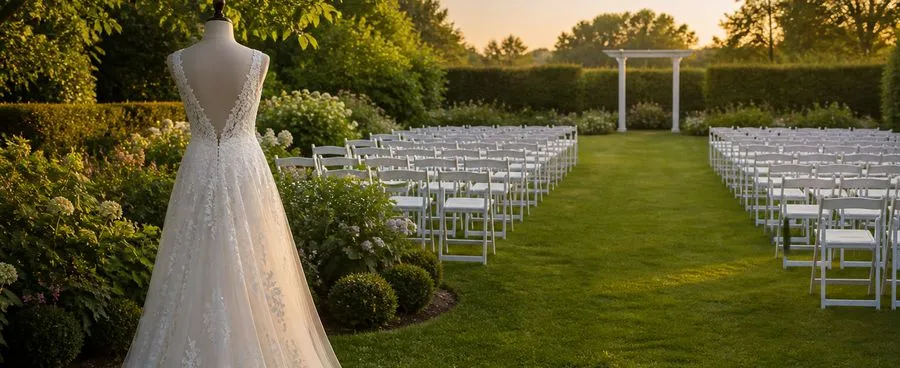
Before anyone tells you which shape flatters your body, ask a plainer question. Can you walk across the aisle in this dress?
Sit through the whole dinner in it? Dance until the band packs up?
That question decides more about whether a gown works than any list ranking A-line against mermaid.
I spent three years running a wedding vertical for a regional lifestyle publisher, mostly reading vendor contracts instead of admiring lace.
The habit stuck: when a "most flattering silhouette" claim crosses my desk now, I want to know who is selling what and why. So here is the honest premise of this page.
It gives you the vocabulary, the venue math and the sizing reality. It treats body-type advice as a caveated layer, not the headline, because that is what the evidence actually supports.
Silhouette and Neckline Names, Decoded
The seven names printed on almost every hanger tag mean less than the industry implies, and they are still worth learning.
A-line skims close at the bodice and flares gradually from the waist. Ball gown does the same flare, but dramatically, from a fitted bodice into a full skirt that needs room to move. Sheath, sometimes called column, runs straight from shoulder to hem with almost no flare at all.
Fit-and-flare hugs through the bodice and hip, then releases into a skirt at or below the knee. Empire sets its seam just under the bust and falls loosely from there, which is why it reads as the least structured option near the waist.
Mermaid and trumpet cause the most confusion, and Kleinfeld Bridal's own taxonomy page admits the line between them, and sheath, is not fixed: mermaid hugs the body from bust to knee before flaring hard, trumpet flares higher and more gradually, and sheath barely flares at all.
Different retailers draw those three boundaries in slightly different places. That is not a gap in this article's research. It is a real, minor terminology inconsistency across the bridal trade itself, and no single source settles it.
Necklines layer on top of any of these shapes. Sweetheart curves into two soft points over the bust. V-neck cuts a straight angle to a similar effect.
Illusion covers the collarbone or upper chest in sheer, sometimes beaded, mesh, so the eye reads bare skin where there is actually fabric.
Before you fall for a shape, check whether its lead time still fits your date - a heavily custom mermaid or an intricate ball gown often takes longer to order than a simpler cut.
What Actually Works at a Beach, Garden, or Destination Wedding
Heat and sand punish a gown a formal ballroom never touches. A heavy, structured fabric traps warmth against the body for an entire outdoor ceremony, and a wide, dragging hem picks up sand and grit within the first twenty feet of aisle.
Lightweight fabrics handle this better. Crepe, chiffon and light satin move with the body instead of insulating it, and they shed loose sand more easily than a stiff mikado or a heavy tulle. Simpler silhouettes pair naturally with those fabrics, since less skirt means less material dragging across sand or grass in the first place.
At least one bridal brand has built part of its line around this problem directly.
Grace Loves Lace documents choosing hem treatments and fabrics for its beach-wedding gowns specifically to avoid sand catching in the seams and weave, according to the brand's own ordering-timeframes page.
Treat that as one brand's documented design choice, not a universal engineering rule every gown follows. It is useful evidence that the sand problem is real and solvable, not proof that any lightweight dress handles it the same way.
Destination weddings add a variable that has nothing to do with terrain: the flight. A gown has to survive a garment bag, an overhead bin or a hotel closet, then get steamed back into shape in a day or two, not a week. Crease-resistant, packable fabric matters here as much as the silhouette itself.
Chiffon and lightweight crepe both travel better than heavy satin or dense tulle, which can hold a fold line stubbornly enough that a rushed pre-wedding morning is not enough time to release it.
| Venue type | Recommended fabric(s) | Recommended silhouette(s) | Practical caution |
|---|---|---|---|
| Beach / outdoor ceremony | Lightweight crepe, chiffon, light satin | A-line, sheath, fit-and-flare | Heat and sand traction; hem drag on uneven ground |
| Garden / backyard | Similar lightweight fabrics, with more structure tolerance | A-line, tea-length, fit-and-flare | Grass and uneven terrain; heel sink |
| Cathedral / formal indoor | Heavier structured fabrics (satin, mikado, structured tulle) | Ball gown, structured mermaid or trumpet | Mobility for sitting and dancing; train management on stairs and aisles |
| Destination / travel | Crease-resistant, packable fabrics | Simpler silhouettes that pack flat | Garment-bag survivability; wrinkle recovery time on arrival |
What Actually Works at a Cathedral or Formal Indoor Wedding
Structure reads as formal for a reason. A ball gown or a structured mermaid built from satin, mikado or heavy tulle holds its shape under cathedral lighting and against a long aisle in a way a soft chiffon sheath cannot. That is the traditional choice for an indoor, formal wedding, and the table above reflects it.
What most style guides leave out is the cost. A heavily structured bodice restricts how far you can bend at dinner.
A full skirt takes real effort to maneuver through a narrow pew or a set of stairs, and a structured mermaid can make sitting through an entire reception genuinely uncomfortable if you have not tried sitting in it, at length, before the day.
I have not personally shopped for a cathedral gown, but the complaints line up with what any full-skirted formalwear does at a seated dinner. This is not a reason to avoid the silhouette. It is a reason to test it seated, not just standing in a mirror.
Train length compounds the problem. A cathedral train, the longest common length, extends how much fabric you or an attendant has to manage on stairs, through doorways and around a dance floor. A chapel or sweep train asks less of you logistically while still reading formal in photos.
If dancing matters as much as the aisle walk does, ask at the fitting whether the train bustles up cleanly, and how long that changeover takes. A bustle that takes twenty minutes to pin is twenty minutes you are not on the floor.
None of this makes a structured silhouette the wrong choice for a formal venue. It means giving real attention, at the fitting, to how the gown behaves in motion, not just how it photographs standing still.
Before Anyone Tells You Which Shape Flatters Your Body
For some brides, this stage of shopping does not feel neutral. A few describe trying on gown after gown as something that sharpens an existing body-image anxiety rather than settling it, in the accounts they leave for each other online. That reaction is real for the people who describe it, and it deserves acknowledgment rather than a chirpy line about how every body is a wedding body.
This section will not diagnose your shape or hand you a verdict. It is going to look hard at where the "flattering" advice actually comes from.
Myth vs. fact: body-type advice
Myth: Certain silhouettes are objectively more flattering for certain body types, and choosing correctly is part of getting the dress "right."
Fact: This framing is a retail marketing convention, not a measured standard. (I have read enough of these buying guides for a living to recognize marketing copy borrowing the language of expertise when I see it.) Stylists and editors within the bridal trade itself have criticized "flattering for your body type" guidance as reductive, because it reduces a body to a category and treats the dress as a correction rather than a garment.
Venue practicality and personal comfort, the questions this article opened with, are more defensible and more checkable than a body-type prescription. You can test whether you can sit down in a dress. You cannot test whether a stranger's opinion of "flattering" holds up.
Where sources disagree about silhouette boundaries, that disagreement gets stated plainly here rather than resolved into a confident rule that does not exist. A shape either survives your venue and feels good to move in, or it does not. Nothing about your body needs fixing to get there.
What Your Bridal Size Number Actually Means
Bridal manufacturers commonly run their own size charts smaller than everyday ready-to-wear, so the number on a sample gown at your first fitting is often above what you buy off the rack elsewhere. That is a widely cited convention across the bridal industry, not a figure any standards body has published or verified, so treat it as a heads-up rather than a fixed rule.
A bigger number on a bridal size chart is not a comment on your body. It is a quirk of an industry that never standardized its own sizing.
Here is the part that carries real financial weight, and it deserves careful wording because no primary regulator publishes it either.
Commercial alteration sources cite a practical range of roughly two to three sizes as the maximum a gown can typically be taken in; letting a gown out is far more limited, bound by whatever seam allowance the manufacturer actually left in the fabric.
That range is a commonly cited approximation, not a guaranteed number for your specific dress, and it matters because most bridal gowns are sold under a final-sale or non-refundable term. Order outside what alteration can realistically deliver, and there is often no return to fall back on.
That is exactly why one piece of advice worth naming directly, and rejecting, keeps circulating: do not order a smaller "goal size" gown as motivation for a fitness or weight goal before the wedding.
Alterations are bounded, not infinitely flexible, and a gown ordered two sizes down from where you measure today is a bet against your own body on a garment you likely cannot return if the bet does not pay off.
Order for the body you have at the time you order, and let alterations do the smaller, achievable work they are actually built for.
What it costs to make this shape actually fit you
Get Your Shortlist in Three Questions
Three questions, asked in order, narrow the entire silhouette conversation down to something you can actually shop against.
Get your shortlist: a three-question decision tree
- What is the venue setting? An outdoor space, beach or garden, points you toward the lighter fabrics and simpler silhouettes in the table above. Cathedral or formal indoor points toward heavier structured fabric and a ball gown or structured mermaid. Destination or travel-heavy points toward crease-resistant, packable fabric in a simpler cut.
- What is the season or climate? Within whichever venue answer you gave, a hot climate pushes you toward the lighter end of that row's fabric options; a cold-weather or evening formal event tolerates the heavier end.
- Comfort or formality, which matters more today? This narrows your row down to two or three specific silhouette-and-fabric pairings, each carrying exactly one practical caution pulled from the table, sand traction, train management or wrinkle recovery, whichever applies.
That is the same logic behind the venue-and-priority tool below. Pick your venue, your season and your priority, and it returns a short list with the caution attached to each option, not a single verdict about which shape is "yours." If you came here hoping one shape would be declared correct for your body, this tool will disappoint you on purpose.
Questions Real Brides Ask
What's the real difference between a mermaid and a trumpet wedding dress? Both fit close through the hip and flare out below it; the disagreement across sources is exactly where that flare starts. The general convention is that a trumpet flares higher, closer to the knee, while a mermaid flares lower. That boundary is not fixed across brands, so treat the tag as a starting point, not a guarantee.
Is it true that certain silhouettes are more flattering depending on my body type? That framing is a marketing convention, not an objective rule, and the trade itself has criticized it as reductive. Venue practicality and personal comfort are more reliable, checkable factors than a body-type prescription.
Do I need to order a wedding dress a size up from what I normally wear? Often yes, in the sense that bridal size charts commonly run smaller than everyday ready-to-wear, so the number on the tag is frequently higher than your usual size. That is a widely cited convention, not a verified standard, and it says nothing about your body.
Is a ball gown too much for an outdoor wedding? Not automatically, but a heavier, more structured silhouette carries real heat, mobility and terrain costs outdoors. Check the beach and garden rows in the venue table above and weigh the caution listed there against how much formality actually matters to you.
How do I know if a dress will actually hold up through a full day at my venue? Test it against the question this article opened with: whether you can walk the terrain, sit through dinner and dance at the end of the night in it, not whether it photographs well standing still. The venue table and the decision tool above both exist to answer exactly that.
Run the venue-and-priority tool above for your shortlist, then head to Compare retailers and see where each silhouette is easiest to find to see where each option is actually sold.
If your finalist needs real alteration work, the cost guide covers that next; if it turns out to be fully bespoke or heavily custom, double-check the lead time before you commit to it.