 Goes Wedding
Wedding Invitation Count & Postage Estimator
 Written by Tessa Broussard
 · Reviewed by Renata Halloran, CWP· Published 2026-08-28· Last checked 2026-08-30
Some links on this page are affiliate links; if you buy through one, we may earn a commission. That relationship never decides which companies we cover or what we conclude about them - see our review methodology.
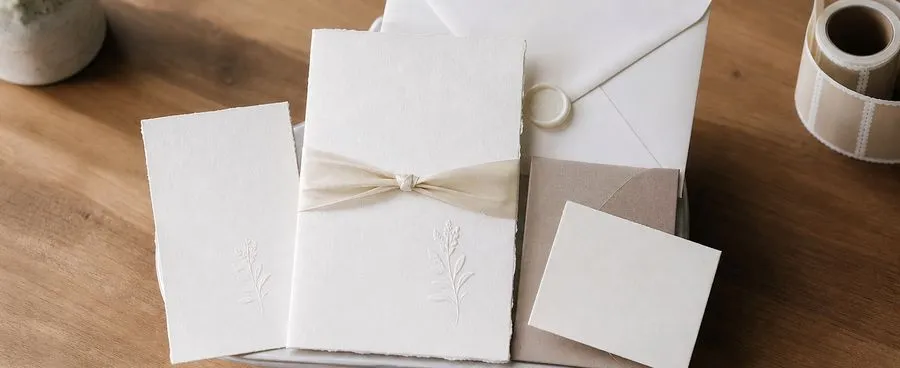
This page links to stationery sellers in the categories below; some of those links may earn this site a commission. That has no bearing on which provider type this tool points you toward. See our review-methodology page for how sources and rates are checked.
Give this tool a guest count and a few details about your envelope and suite, and it turns that into an invitation-order range and a postage estimate, both shown as ranges because the published guidance behind them disagrees with itself.
It will not give you a per-invitation print price, a vendor recommendation, a single "correct" household ratio, or a postage figure that skips a final check against usps.com.
It differs from the site's whole-event planning timeline tool, which owns the full wedding calendar; this page is the mail-room slice only, and it's the version of this math the site's guides on households and on postage link back to rather than re-deriving.
For the wider picture first, start in our wedding invitations hub.
What You Put In
The inputs are ordinary questions, not a form you need a calculator for.
You start with your guest headcount, the number of names on the list. Most people only know that number, not how many separate households it breaks into, so an inline helper estimates households from guests if you don't want to count them by hand.
From there you tell it whether you're sending save-the-dates (they get their own count later), your envelope class - standard rectangular, square, or a large flat piece - and whether anything about that envelope flags it as non-machinable: a wax seal, a rigid insert, extra thickness, or a closure that sticks out past the edge.
You also enter your assembled suite's weight tier, one, two, or three ounces, with a helper that estimates weight from how many pieces are in the stack if you haven't weighed one yet. A standard suite usually runs three to five pieces; closer to seven or more for a destination wedding, a multi-day event, or a very formal one.
Add any international guests, and a line for extras - photographer copies, addressing mistakes, pieces that get lost in the mail. None of this is stored, sent anywhere, or tied to an account; close the tab and it's gone.
How Many Invitations You Actually Need
Here's the mistake I made on my own wedding: I counted guests, not households, and ordered forty invitations more than I needed.
A guest list of 150 names isn't 150 invitations - most of those names share an address, a couple, or a family unit, and each shared address gets exactly one envelope. (Mine are still in a closet somewhere, forty invitations nobody needed.)
How many households, though, depends on which source you read, and none of the three main versions agrees with the others. One puts your household count at about half your guest total. Another says 50 to 60 percent.
A third, working backward from a guest-divided-by-two-plus-buffer shortcut, lands closer to 60 to 65 percent.
None of the three carries more authority than the others - they're all somebody's rule of thumb, not an industry standard - so this tool shows you the low end and the high end rather than picking one.
The buffer on top of that household count disagrees even more sharply.
Published guidance ranges from a flat five to ten extra invitations, up through 10 to 15, and 10 to 20, past a 10-to-15-percent buffer and a 15-to-20-percent buffer, all the way to one stationer's flat rule of at least twenty-five extra - and 25 percent more envelopes if you're hand-addressing them.
A quick shortcut some sources use when the guest list isn't final yet, guest count divided by two plus 15 to 20 percent, or that same division plus a flat 25, is napkin arithmetic, not a rule to build an order around.
One Guest Count, Two Honest Answers. For a stated 150-guest list:
| Approach | Households | Buffer applied | Invitations to order |
|---|---|---|---|
| Low-end ratio (50%) + smallest buffer | 75 | +10% | 83 |
| Low-end ratio (50%) + flat add-on | 75 | +25 flat | 100 |
| High-end ratio (65%) + percentage buffer | 98 | +20% | 118 |
| High-end ratio (65%) + flat add-on | 98 | +25 flat | 123 |
Order between 83 and 123 invitations for this list - not because the math is sloppy, but because the sources it's built from never agreed on the ratio or the buffer to begin with. Round up rather than down, and lean toward the high end if your list skews toward large, multi-generation households rather than couples.
That range is wide on purpose. A single confident number would hide exactly the disagreement you need to see before you commit to a print run. For the counting edge cases - unmarried couples, adult children still at home, roommates - see count households, not guests.
What Your Envelope Weighs, and What It Costs to Mail
Postage is where a well-planned order still goes wrong, because the price isn't only about weight. USPS sorts most letters by machine, and a machine needs a rectangular, flexible, evenly thick envelope to run through it.
Anything that breaks that shape gets pulled for hand processing and charged more: a square envelope, a rigid insert like a vellum panel, extra thickness from layered cardstock, or a wax seal or ribbon closure that leaves the flap uneven.
Any one of those triggers can add the charge on its own; more than one at a time doesn't multiply it.
Weight works separately from shape.
A single card in a thin envelope usually clears the first-ounce tier; add an inner envelope, an RSVP card with its own return envelope, a details card, and a wax seal, and you're often into the second ounce before you've noticed.
That's why this tool asks for a weight tier instead of assuming one.
One mechanic worth knowing before you buy anything: a Forever-type stamp, once bought, keeps covering a standard one-ounce letter even after the base rate rises later. It's one of the few places in this whole process where buying ahead costs you nothing if the rate changes.
Weigh It First: A 4-Step Check Before You Buy Stamps.
- Assemble one complete suite exactly as it will be mailed - the final envelope, every insert, and any embellishment.
- Weigh it on a postal or kitchen scale and round the result up to the next full ounce, never down.
- Check the envelope against the trigger list - square, wax seal, rigid insert, over-thickness, protruding closure - before assuming the standard letter rate applies.
- Confirm the current rate for that weight and class at usps.com immediately before buying stamps in bulk.
Illustrative Postage Reference - Verify Before You Buy Stamps
| Piece | Illustrative rate | Basis | Confirm before mailing? |
|---|---|---|---|
| Forever-rate letter (1 oz) | $0.82 | Official USPS rate, effective July 12, 2026 | Yes - check usps.com |
| Metered letter (1 oz) | $0.78 | Official USPS rate, effective July 12, 2026 | Yes - check usps.com |
| Domestic postcard | $0.65 | Official USPS rate, effective July 12, 2026 | Yes - check usps.com |
| International letter/postcard (1 oz) | $1.75 | Official USPS rate, effective July 12, 2026 | Yes - check usps.com |
| Each additional ounce | $0.29 | Official USPS rate, effective July 12, 2026 | Yes - check usps.com |
| Non-machinable envelope (square, rigid, wax-sealed, over-thick, protruding closure), 1 oz | $1.31 total | Official combination-stamp denomination (base rate plus surcharge) | Yes - check usps.com |
| Large envelope/flat (1 oz) | $1.69 | Official USPS rate, effective July 12, 2026 | Yes - check usps.com |
Watch for one specific error on more than one stationery blog: quoting the same total for a two-ounce square envelope as for a one-ounce non-machinable one. Those aren't the same piece - the second ounce still adds its own charge on top, so a 2-ounce square envelope runs to roughly $1.60, not the $1.31 you'd pay for a 1-ounce one.
A figure that matches for both weights dropped a step (old habit from a personal-finance desk: when two totals match that shouldn't, check the math before trusting either one).
The rates above take effect July 12, 2026.
Every figure on this page, official or estimated, was last checked against its source on August 30, 2026, and none of it replaces weighing your own assembled suite and confirming the current rate at usps.com before you buy postage for the full batch.
For the full assembly order and what to check before sealing, see what shape and weight do to your postage.
Save-the-Dates and the Mailing Timeline
Save-the-dates get their own line in this tool's output, not a share of the invitation count. They're a different piece, usually lighter, often a card or magnet without the same envelope stack, and they go out on a different schedule well before the invitations themselves.
That schedule is where this page stops.
The stationery calendar has five separate windows: when save-the-dates go out, when you need to place the invitation order, when the invitations themselves have to be in the mail, when the RSVP deadline falls, and how much production time the printer needs before any of that.
Published guidance disagrees on every one of those windows, sometimes by weeks, sometimes by months, and this tool isn't going to average five disagreeing sources into one falsely tidy calendar.
That reconciliation, worked backward from your wedding day into actual dates, lives at when the invitations actually have to go out - a different page for a reason: it owns the calendar, this one owns the count and the postage.
Want the whole event mapped out, not just the paper goods? The full month-by-month wedding planning timeline covers venue, vendors, and every other deadline alongside the mailing dates. This page's timing content is the stationery slice only, not a second version of that calendar.
Where This Tool Sends You Next
Once you have a quantity and a rough postage number, the next question is who prints it. This tool sorts that by type, not by name - which type fits depends on what your answers imply about formality and budget, not on any deal running in the background.
A low invitation count paired with a formal, heavier suite points toward the premium and heritage side of the market - houses like Rifle Paper Co. and Crane & Co., where price per piece runs higher and the paper stock and print method are usually the point.
A high count with a tighter budget points the other way, toward the semi-custom catalogs: Minted, Basic Invite, Zazzle, Vistaprint, and Paper Source all sit here, with lower per-piece pricing at volume.
If your answers show a fully digital or hybrid format, the postage math above doesn't apply to you at all, and the tool routes you instead to the digital-only pair, Greenvelope and Paperless Post - no postage applies there, full stop.
Affiliate relationships play no part in which group shows up or in what order; the routing follows your answers, not any commercial arrangement. This is a shortlist by type, never one named "best" company.
What This Estimator Will Never Tell You
A few things this page leaves out, on purpose, every time.
No per-invitation print price or vendor price - that depends on paper, print method, and seller, and lives on the entity and comparison pages, not here. No single household ratio or buffer percentage presented as the rule; you've seen why above. No postage figure without its effective date and source noted, and none of them replace the usps.com check before you mail anything.
No fixed stamp count presented as enough regardless of shape or weight. No guaranteed mailing or delivery date, and no promised production turnaround either. No etiquette or wording verdict, and no registry guidance - counting invitations isn't the same job as wording them.
One more: if your computed quantity comes out low for a premium technique, roughly under 10 cards for flat-foil, or under 50 for foil-stamp, the tool flags a heads-up about needing more than planned, never a push toward any one vendor's minimum.
Frequently Asked Questions
How many invitations do I need for a 150-guest list? Between about 83 and 123, using the low and high household ratios and both buffer methods above. Where you land inside that range should follow your own guest mix, not a guess.
Why does this tool give me a range instead of one number? Because the sourced guidance genuinely disagrees - three versions of the household ratio, seven of the buffer, none of them official. One confident figure would hide that disagreement.
Does a square or wax-sealed envelope cost more to mail? Yes. Both are non-machinable triggers, along with a rigid insert, extra thickness, or a protruding closure, each adding the charge shown as illustrative above, pending its usps.com check.
What happens if I don't put enough postage on my invitations? It comes back to you or reaches your guest postage-due, against an RSVP deadline you can't move. Weighing one sample before buying stamps for the batch is the fix.
Can I just order more invitations later if I run out? You can, but a small reorder is widely described as pricier per piece than ordering extra upfront, though no source quantifies how much. Use the buffer range above instead.
Do save-the-dates need their own postage calculation? Yes. They're typically lighter and on a different schedule, so this tool gives them their own count and postage line rather than folding them in.
Run your own guest count through the tool above, then follow whichever provider-type link matches your result - not a company guessed at before you know your numbers.