 Goes Wedding
How Much Postage for Wedding Invitations, and What Goes In
 Written by Tessa Broussard
 · Reviewed by Renata Halloran, CWP· Published 2026-08-28· Last checked 2026-08-30
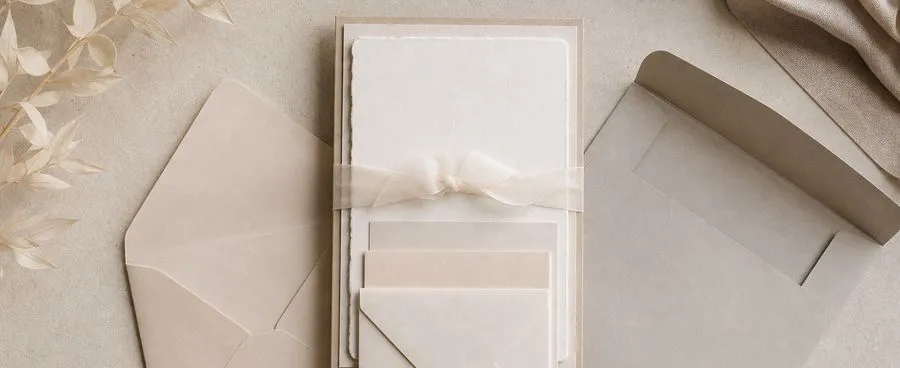
The invitation card is the part everyone photographs.
It is not the part that gets mailed, weighed, and paid for as a single package - and by the time most couples think about postage, the pieces are already printed and the deadline is close.
This article covers what actually goes in the envelope, the order those pieces stack in before you seal anything, and what it costs to mail: current rates, dated and sourced, kept separate from the stale numbers still floating around stationery blogs.
Assembly and postage only. Wording and quantity are settled elsewhere and linked where relevant.
What's Actually in a Wedding Invitation Suite
Search "wedding invitation cost" and most of what comes back prices one piece: the printed invitation card. That's a misleading way to think about a mailing, because what actually goes in the envelope is a coordinated set - the industry calls it a suite - and the card is only one part of it.
Three pieces are effectively required. The invitation card states who, what, when, and where. The response instrument, usually called an RSVP card, gives guests a way to reply by mail, typically paired with its own small, pre-addressed reply envelope.
The details or enclosure card carries logistics that don't belong on the invitation itself - a hotel block, shuttle times, a wedding website address, or a registry note - and research on real suites treats it as commonly included, not strictly mandatory the way the first two are.
Everything past those three is optional, and each one adds weight, cost, or both. An inner envelope names exactly who in the household is invited and sits between the stack and the outer envelope, a formal touch a growing number of DIY couples skip outright. A belly band, a paper strap wrapped around the assembled stack, holds everything together without an inner envelope.
A vellum overlay adds a translucent, textured layer over the invitation card. An envelope liner is decorative paper glued inside the outer envelope, invisible until it's opened. A wax-seal-style closure replaces the standard gummed flap.
Table 1: What's in the Suite
| Piece | Required or optional | Role | Approx. weight/cost impact |
|---|---|---|---|
| Invitation card | Required | States who, what, when, and where | Base card weight - the reference point for every added piece below |
| Response instrument (RSVP card) | Required | Lets guests reply by mail, usually with its own small reply envelope | Adds a second card plus a second envelope's weight |
| Details/enclosure card | Required (commonly included) | Carries logistics - hotel block, shuttle times, website | Adds one more card's weight |
| Inner envelope | Optional | Names exactly who in the household is invited | Adds paper weight; skipped in many casual and DIY suites |
| Belly band | Optional | Paper strap that bundles the stack before sealing | Minimal weight; mostly visual |
| Vellum overlay | Optional | Translucent overlay layered on the invitation card | Adds thickness; can push a suite into the next weight tier |
| Envelope liner | Optional | Decorative paper glued inside the outer envelope | Negligible weight; adds rigidity |
| Wax-seal-style closure | Optional | Seals the outer envelope in place of a gummed flap | Adds uneven thickness - a common non-machinable trigger |
A standard letter has to clear a 3.5-ounce ceiling before it needs a different rate entirely, so the weight column above matters more than it looks like it should.
Suite Assembly Checklist
Before you sit down to assemble anything, gather the pieces you've actually decided to use:
- Invitation card
- Response card, plus its own small reply envelope
- Details/enclosure card
- Inner envelope - skip it for a casual or DIY suite; the outer envelope alone still carries the address
- Belly band - skip it if the stack already holds together on its own
- Vellum overlay - skip it if you're already close to the next weight tier
- Envelope liner - skip it if you'd rather put the budget elsewhere; it's purely decorative
- Wax-seal-style closure - skip it if you don't want to ask about hand-cancellation at the counter (more on that below)
None of this decides how anything is worded, and none of it decides how many suites to print. Those questions belong to the wording article and the household-count guide. This section is only about which pieces belong in the envelope, and which ones are optional weight.
Assembly Order: How the Pieces Stack and Seal
Once every piece is printed, proofed, and in hand, assembly is the easy part, as long as you do it in a consistent order.
This is the stacking convention most stationers and etiquette sources describe, not a disputed-free official standard - but it's the order a recipient expects, and it keeps you from reopening a sealed envelope to fix a mistake.
Assembly & Sealing Order
- Lay the invitation card face-up.
- Set the details/enclosure card on top, also face-up.
- Tuck the response card inside its own small, stamped reply envelope and add it to the stack.
- Wrap the stack in a belly band or vellum overlay now, if you're using either.
- Slide the assembled stack into the inner envelope, if you're using one, names facing the back flap so they read correctly when it's opened.
- Insert everything into the outer envelope, address and postage facing out, and seal - by hand, or with the wax-style closure.
That's the whole sequence. It isn't complicated, but it's easy to get backward two hundred envelopes in, moving fast, on the third cup of coffee.
One more thing before you buy a single stamp: your assembled sample needs to be weighed before the mail-by date in the mailing timeline.
Current USPS Postage Rates for Wedding Invitations
$0.82.
That's what one Forever stamp costs today, and it covers a single, standard, one-ounce First-Class letter, effective July 12, 2026, per USPS Notice 123. (In years spent comparing vendor quotes for a living, I have watched more than one couple do careful math on the price of the printed card and never once price the stamp.) Every figure below carries that same effective date, and every one should be re-checked against the live USPS rate page before you buy stamps for a full batch - postage changes on a recurring, PRC-docketed cycle, and an accurate number today is no guarantee for next spring.
Table 2: Current USPS Postage Rates
| Mail type | Rate | Effective date | Confirmation status |
|---|---|---|---|
| First-Class letter, 1 oz (Forever stamp) | $0.82 | July 12, 2026 | Official - USPS Notice 123 |
| Each additional ounce | $0.29 | July 12, 2026 | Official - USPS Notice 123 |
| Large envelope / flat, 1 oz | $1.69 | July 12, 2026 | Official - confirmed across four separate USPS pages |
| Non-machinable starting rate (square, rigid, or oversized) | $1.31 | July 12, 2026 | Official - USPS Notice 123, the full rate you pay |
| International First-Class non-machinable letter surcharge | $0.49 | July 12, 2026 | Official - International Mail Manual 241.217 |
A standard letter tops out at 3.5 ounces before it needs a different rate entirely; a large envelope or flat can run up to 13 ounces on the $1.69 tier. A loaded suite - invitation, RSVP card and its own envelope, details card - can cross the one-ounce line faster than people expect.
That $1.31 non-machinable line deserves a caveat. Vendor pages routinely describe it as a base rate plus a separate surcharge, the way the confirmed $0.49 international figure works. I could not confirm an itemized domestic surcharge amount from any official USPS source, even after a dedicated follow-up search.
Treat $1.31 as the total you pay for a non-machinable letter, not $0.82 plus an add-on - and be skeptical of any page quoting a specific domestic surcharge number, since the figures circulating for it, usually $0.49 or $0.40, don't trace back to an official page.
One more caution: plenty of stationery and wedding blogs still quote $0.78 as the current Forever-stamp rate. That figure was accurate before July 12, 2026. It isn't now.
If a page doesn't show its own effective date next to a postage figure, assume it's stale and check usps.com directly.
Why Square, Oversized, or Heavily Embellished Envelopes Cost More
A square envelope looks the same to you as a rectangular one. To a USPS sorting machine, it doesn't.
Automated sorting equipment is built around a narrow range of shapes and thicknesses: rectangular, flexible, evenly thick from corner to corner. Anything outside that range gets pulled out and processed by hand, and hand processing is what the non-machinable rate actually pays for. It isn't a penalty for looking different.
It's the cost of a person doing what a machine can't.
The practical triggers, in order of how often they show up on a wedding suite: a square shape, first and most common. Thick or rigid card stock, the kind used for a heavily layered or letterpress invitation. Uneven thickness, usually from a wax seal or a ribbon closure that leaves one edge of the envelope thicker than the rest.
And oversized dimensions, on an envelope that runs past the standard letter-size window.
Any one of those, on its own, is enough to trigger the $1.31 starting rate from the table above. There is no single fixed "non-machinable surcharge" added on top of a base price - the $1.31 figure is the rate itself, confirmed and dated, not an estimate layered onto something else. If your envelope hits any trigger on that list, that's the number to budget, not the standard letter rate.
(A square envelope always photographs beautifully for a save-the-date flat-lay. It never looks like a line item until you're standing at the counter.)
Protecting Wax Seals, Ribbon, and Dark Envelopes From the Mail Sorter
At a retail counter, a clerk can request hand-cancellation for a piece a machine would otherwise damage - a wax seal that cracks, ink that smudges, a closure that catches on the rollers. It's a real accommodation, worth asking for whenever something embellished is going out.
It is not a guarantee. Enforcement is reported to vary by location and by how busy the counter is that day - never something to promise a client, a vendor, or yourself will happen automatically. The only way to actually get it is to ask, in person, before you hand over the full batch, not by writing a request on the outside of the envelope and hoping someone notices.
Bring one assembled sample when you ask. Let the clerk look at it directly and tell you whether they'll flag the batch for hand processing. A different location, or a different day, can give you a different answer.
That inconsistency is frustrating, but it's the honest one - not a rule I can hand you with confidence.
Worked Example: Pricing a 100-Guest Suite by Envelope Type
The Knot's 2026 Real Weddings Study, drawing on roughly 10,474 couples married in 2025, puts average total spend on the invitation suite and paper goods at $510.
A couple of other figures circulate for this same category, $518 and $530, but those come from different editions and different years, so this article uses only the 2026 study's number, named with its year every time.
Postage rarely shows up as its own line in that budget conversation, but it should. Here's what it actually looks like for a mid-sized guest list, using the rates confirmed above.
Table 3: Mailing a 100-Guest Suite, by Envelope Type
| Envelope type | Rate applied | Total postage for 100 pieces |
|---|---|---|
| Standard rectangular | $0.82 | $82 |
| Square or otherwise non-machinable | $1.31 | $131 |
| Oversized or multi-page enclosure (large-envelope tier) | $1.69 | $169 |
The gap between the cheapest and most expensive option here is $87 for a hundred-piece batch, and the gap between standard and non-machinable alone is $49, just from envelope shape. That's not a rounding error against a $510 paper budget. It's roughly ten percent of it, decided by whether the envelope is a rectangle or a square, before a single design choice about the card itself even enters the picture.
None of this is an argument against a square or wax-sealed envelope. Plenty of couples decide the look is worth $49 or $87 more. It's an argument for knowing the number before you commit to two hundred of them, not after.
Red Flags: What Happens If You Underpay or Misjudge the Envelope
A returned envelope doesn't come with a note explaining why. It just comes back, days later, sitting in your own mailbox instead of your guest's, and now you're behind on a deadline you can't move.
There's no waiver for underpaid postage.
If a piece goes out short, USPS either returns it to the sender or delivers it anyway with the shortfall billed to the recipient - a mailing that arrives at a friend or relative's house asking them to pay for the privilege of receiving it, which can delay that person's RSVP while they sort it out.
Neither outcome is a small inconvenience on a fixed guest-response timeline.
Delivery-Failure Warning Signs
- The assembled envelope doesn't lie flat.
- There's uneven bulk from enclosures, a wax seal, or a ribbon.
- Postage was estimated by eye instead of counter-weighed.
- A square or non-standard envelope is priced at the standard rate instead of $1.31.
- No one checked the as-of date on the postage figure before buying stamps in bulk.
Any one of those, on a fully assembled sample, is worth a second look before you buy for the whole batch. The fix is the same every time: assemble one complete piece exactly as it will be mailed, and have it weighed and rate-checked at a retail counter. It costs nothing but a trip to the post office, and it's cheaper than two hundred pieces coming back.
Frequently Asked Questions
Can I skip the inner envelope?
Yes. It's optional, and plenty of casual and DIY suites leave it out, with the outer envelope alone carrying the address and postage. Skipping it barely moves the postage math on its own, unless you're also adding other optional pieces that push the stack toward the next ounce.
Is there a law about how wedding invitations must be worded or addressed?
No. Only the mailing mechanics - classification, mailability, weight limits, postage - are federally regulated, by USPS and the Postal Regulatory Commission.
Wording and addressing are social convention with no legal force; check the addressing format before you seal two hundred envelopes covers that separately.
Will a wax seal or ribbon cause problems in the mail?
It can, through smudged ink or a cracked seal in an automated sorter. Requesting hand-cancellation at a retail counter is the real mitigation, but enforcement varies by location and is never guaranteed - ask in person before the full batch goes out.
What is the current price of a Forever stamp?
$0.82, effective July 12, 2026. A Forever stamp you already own keeps covering a standard one-ounce letter even after a later increase, but stamps you buy after that increase price at the new rate.
How do I make sure all my invitations actually arrive?
Assemble one complete sample, have it hand-weighed and rate-checked at a retail counter before buying stamps for the whole batch, and use the correct non-machinable rate for any square, oversized, or embellished piece.
Ask for hand-cancellation on anything embellished, without assuming it will be granted.
Run your assembled sample envelope through the checklist above, then have it hand-weighed and rate-checked at a retail counter before buying postage for the full batch. If the postage math changed your mind about paper entirely, here's the digital route.
And if you haven't settled on envelopes or printers yet, compare envelope options, printers and the postage estimator before you order anything.