 Goes Wedding
DIY, A La Carte or Full-Service Wedding Flowers
 Written by Tessa Broussard
 · Reviewed by Renata Halloran, CWP· Published 2026-08-28· Last checked 2026-08-30
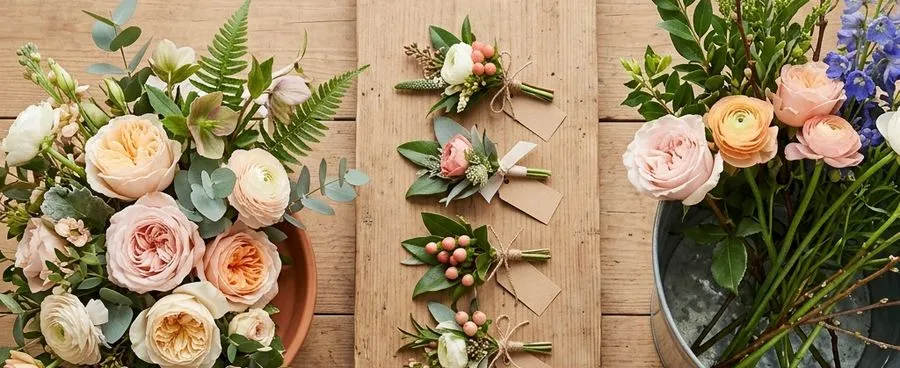
Wedding flowers come down to one non-repeatable Saturday and three ways to get there: pay someone to handle it, order finished pieces and set them up yourself, or buy the stems and build everything with your own hands.
That's the whole decision, and it isn't a taste question.
It also isn't a math problem with one universally cheaper answer - it's a trade between money, your own hours, and how much risk you're willing to carry into the reception.
Most of what gets written about this picks a side before the first paragraph. DIY blogs make it sound like an afternoon craft project.
Florists make it sound like a liability waiting to happen. Neither one is being straight with you.
What follows is a real service comparison, a centerpiece-sizing formula you can run on your own guest list, the documented reasons DIY flowers wilt before the toast, and an honest answer on whether moving your ceremony flowers to the reception is worth the trouble.
This is a labor swap, not a coupon.
What Full-Service, A La Carte, and DIY Actually Include
Three models cover almost every way couples in the US buy wedding flowers, and each one bundles a different amount of service into the price.
Full-service means a florist handles the whole arc: a consultation, usually a mock-up round or two, then delivery, on-site setup, and breakdown on the day itself, with someone on call if a stem snaps or a boutonniere goes missing.
A la carte means you order pre-designed pieces from a shop's fixed menu, then pick them up or have them dropped off, and set everything out yourself - no consultation, no on-site crew. DIY means you and your helpers source the flowers and build every arrangement from scratch, on your own timeline, in your own kitchen or a rented workspace.
| Buying model | Consultation & mock-up | Delivery, setup & breakdown | Day-of recourse if something goes wrong | Who does the assembly |
|---|---|---|---|---|
| Full-service | Full consultation, typically 1-3 mock-up rounds | Florist delivers, sets up and breaks down on-site | Florist has staff and backup stock on call | The florist's team |
| A la carte | None, or a brief order confirmation only | You pick up or arrange delivery; you set everything out yourself | Limited to whatever the shop's own return or replacement policy covers | You, from finished pieces |
| DIY | None - you design it yourself | You transport, arrange, and place everything | None; you troubleshoot on-site with no backup | You and your helpers, from raw stems |
Here's a detail worth knowing before you sign anything: a full-service engagement in the US almost always includes an in-person or photographed mock-up, often more than one round. If a florist skips that step entirely, consumer sources treat it as a red flag, not a normal shortcut.
I go through the rest of the red-flag list, line by line, in Going full-service or a la carte? Read the quote line by line before you sign - this article stays focused on which model fits you, not on vetting one specific contract.
What actually separates a full-service price from an a la carte one isn't the flowers themselves. A rose costs roughly what a rose costs no matter who's holding it. What you're paying for in full-service is the service wrapped around it: the planning hours, the delivery van, the person who shows up at 2pm and disappears by 11.
Cost, Labor, and Risk: The Real Comparison
Put the three side by side on more than price and the picture gets more useful.
| Buying model | Relative cost position | Time you put in | Failure risk | Recourse if it goes wrong |
|---|---|---|---|---|
| Full-service | Highest | Lowest - a consultation and a few check-ins | Lowest - a professional troubleshoots in real time | Florist has staff and backup stock on-site |
| A la carte | Mid, but can climb fast with a large bridal party | Moderate - a pickup-and-setup afternoon | Moderate - you're placing finished pieces with no crew | Limited to the shop's own policy |
| DIY | Lowest, if nothing goes wrong | Highest - an estimated 15-30 hours of assembly labor | Highest - no professional backup if flowers arrive damaged or wilt early | None beyond what you can fix yourself |
Full-service costs the most in dollars and the least in your own hours; the florist absorbs the labor and, mostly, the risk. A la carte sits in the middle on service, but don't assume it sits in the middle on total cost. It's easy to price every bouquet, boutonniere, and centerpiece separately and watch the total climb past what you expected.
Price a typical wedding party piece by piece - bridesmaids, groomsmen, both mothers, both grandmothers, a flower girl - and the total adds up to real money before a single centerpiece joins the list. A la carte is not automatically the cheap option; it's the option where you're doing your own math.
DIY costs the least in dollars, assuming nothing goes wrong, and the most in your own time. Every source I found agrees the labor runs long: figure roughly 15-30 hours of assembly work at the scale of a silk-material build, spread across the week before the wedding.
I want to be honest that none of the research quantifies fresh-flower hours specifically, or how long a proper practice run takes, so treat that range as a floor, not a promise. (I've spent enough years reading vendor quotes for a living that a confident "DIY saves you a tidy round number" claim makes me want to see the math behind it - the buffer stems, the tools, the actual hours - before I believe it. Most posts that make that promise never show their work.) If you're weighing fresh against a longer-lasting material before you commit to a build, Assembling it yourself weeks ahead? Compare what each material lets you do covers that choice on its own page.
Recourse is where the real gap sits. A full-service florist has a stake in fixing a problem before the ceremony starts. A DIY build has you, a bucket, and whatever daylight is left.
How Many Centerpieces You Actually Need
Sizing a centerpiece order is arithmetic dressed up as a design decision, and most couples do it backward - they guess a round number, then panic three weeks out when it's clearly wrong for the room. Run it forward instead.
How to Size Your Centerpiece and Stem Order
- Count your reception tables using the common 8-10-guests-per-table assumption, then check it against your own actual table plan - a handful of six-tops or a sweetheart table for two will throw a straight average off.
- Apply one centerpiece per table as your starting baseline.
- Add a piece for every specialty surface actually in use: the sweetheart or head table, the cake table, the welcome table, the bar.
- If you're using a long banquet-style table, pick a focal-point spacing. One guideline says every 4-6 ft; a conflicting one says every 3-4 ft. Divide the table length by whichever you choose, and note that denser spacing looks fuller and costs more.
- Total the exact stem count across every arrangement in the design.
- Add roughly 10% extra stems on top of that total as your bulk-order buffer.
- Order from your bulk supplier with enough lead time to absorb a shipment that arrives damaged, short, or substituted - never order the exact day-of count with zero slack.
Notice step four doesn't pick a winner between the two spacing guidelines. I'm not going to average 4-6 ft and 3-4 ft into a tidy middle number, because neither source claims that figure and averaging two guesses doesn't make a third guess more accurate. Pick one, own the reason, and move on.
The guests-per-table figure in step one is doing a lot of work, and it's a soft number - most sources land somewhere between eight and ten without citing where the range comes from. If your reception mixes six-tops for family with ten-tops for everyone else, don't force one number across the whole floor plan.
Table 3 runs the math for three common guest counts, so you can find your rough range without doing the arithmetic yourself.
| Guests | Reception tables (at 8-10 guests/table) | Baseline centerpieces | Specialty surfaces to add on top |
|---|---|---|---|
| 80 | About 8-10 tables | About 8-10 | Sweetheart table, cake table, welcome table, bar - as used |
| 120 | About 12-15 tables | About 12-15 | Sweetheart table, cake table, welcome table, bar - as used |
| 160 | About 16-20 tables | About 16-20 | Sweetheart table, cake table, welcome table, bar - as used |
Ordering Bulk Stems Without Running Short
If you're buying the flowers yourself, you're shopping wholesale, not retail.
Sites like Blooms By The Box, FiftyFlowers, Whole Blossoms, Flower Moxie, and The Bouqs Co. all ship loose stems straight to your door or your venue, cutting the florist out of the sourcing step entirely.
Each one runs its own lead times and minimum-order sizes, and those change often enough that I won't print a number here - confirm both directly on the current site before you commit to a date.
Timing matters more than it does for a la carte, too: a supplier's stated delivery window is a target, not a guarantee, and Buying bulk stems is cheapest when you buy what is actually in season is its own question, worth reading before you pick a delivery date.
Build your buffer into the order before you place it, not after you discover you're short. The rule of thumb professionals repeat is about 10% extra stems on top of your exact design count, to absorb breakage, bent stems, and the odd bloom that just isn't usable. It's a small percentage that saves you from a Thursday-night grocery-store run.
Here's the part vendor pages don't lead with: a bulk shipment can arrive damaged, short-counted, or with a substituted variety altogether, and you have no contracted florist standing behind the order the way you would with a full-service booking.
That's not a reason to avoid DIY. It's a reason to order early enough that a bad box doesn't become a crisis, and to open every box the moment it lands instead of the morning of the wedding.
Why DIY Flowers Wilt Before the Reception
Every wedding-flowers forum has at least one photo of a wilted DIY centerpiece, and it's almost never bad luck.
Four causes show up again and again in professional floral-handling material: not enough water-contact time before the event, water levels in the vase or bucket that dropped too low, stems cut too short to reach water at all, and a storage room that ran warm.
None of those are exotic mistakes. They're the four things that get skipped when you're also managing a seating chart and a rehearsal dinner.
The fix isn't more skill. It's a checklist you actually follow the week of.
DIY Flower Handling Checklist
- Cut every stem at an angle immediately before it goes into water - a stem left dry too long, or cut too short to reach the waterline, is a documented cause of early wilting.
- Keep every vase and bucket topped up with water for the full run-up to the wedding; low water level is one of the most commonly reported causes.
- Give every stem real water-contact time before the event - arranging too close to the ceremony, without adequate hydration first, is a repeat offender.
- Store finished arrangements in the coolest room you have, out of direct sun and away from heating vents.
- Do one full practice arrangement before wedding week if you can manage it. I can't tell you how long it takes - nothing I found quantifies that - but the sources that recommend it are consistent enough to trust.
- Build your roughly-10% stem buffer into the order before you start, not after you're already short.
(If I had to bet on which of these six gets skipped most by couples juggling a seating chart, it's the practice run. It's the easiest one to defer once life gets busy, and then it just doesn't happen.)
I'd frame this list as prevention, not a warning label. Every cause on it has a fix that costs nothing but attention.
Can You Reuse Your Ceremony Flowers at the Reception?
Moving ceremony flowers to the reception is not a corner-cutting move.
It's a genuinely normalized, actively recommended way to stretch a budget in the US, and it works best under one condition: both events share a venue, and the pieces were designed with moving in mind from the start.
Not everything travels well. Garlands pinned to chair backs, cascading or floating arrangements, and loose scattered petals are hard to relocate without damage or a mess someone has to clean up mid-transition. An asymmetric piece, built to be viewed from one side only, may need a quick rework before it makes sense facing a different room.
Altar arrangements on freestanding stands, urns, and anything designed to be picked up and carried usually make the move with no trouble at all.
Here's the honest math, though: the flip only saves money if moving the flowers costs less than ordering new ones. There's a reported case where the labor or service fee to physically relocate arrangements ran higher than a fresh order would have. At that point, reusing isn't a saving, it's a sunk cost with extra steps.
Ask whoever's moving the flowers what that labor actually costs before you build the reuse into your budget as a given.
Timing is the other real risk, and it's the one couples underestimate. A ceremony that runs fifteen minutes long eats directly into the window someone has to move flowers before guests arrive at the reception space. If your ceremony has any history of running long, or the two venues aren't a short drive apart, build in more transition time than you think you need.
Which Buying Model Actually Fits You
Everything above is context. Here's the decision itself, broken into the four questions that actually separate one model from another.
Which Buying Model Fits You
- Do you have real, reliable helper labor, more than just yourself, available in the 24-48 hours before the wedding?
- No: go full-service or a la carte. DIY without hands is DIY that doesn't get finished.
- Yes: continue to question 2.
- Do you have somewhere to keep buckets of stems cool and out of direct heat or sun until arrangement time?
- No: DIY risk rises sharply. Consider a la carte instead.
- Yes: continue to question 3.
- Is the design simple - single-flower-type centerpieces, loose garden-style bunches - rather than structurally complex, like cascading, wired, or gridded work?
- Complex: full-service is the safer choice.
- Simple: DIY is realistically achievable.
- Regardless of the DIY-or-full-service split: do you want delivery, setup, and breakdown handled for you, or are you fine transporting and placing everything yourselves?
- Handled for you: full-service, or ask an a la carte vendor whether they offer optional delivery.
- Fine doing it yourselves: a la carte or DIY.
The estimator further up this page runs the same four questions against your own guest count and answers, and lands on the same kind of result: a rough centerpiece count plus a side-by-side cost, labor, and risk sketch for all three models.
Neither the tree nor the tool picks a winner for you. Once you've settled on a model, Everything else in flowers and decor covers what comes next, from booking to setup.
One line, if you remember nothing else from this page: this is a labor swap, not a coupon. The honest answer depends on the time and help you actually have, not on which option a single vendor's blog called cheapest.
Frequently Asked Questions
What does "a la carte" mean for wedding flowers? A la carte means you order pre-designed pieces from a florist's fixed menu, then pick them up or have them delivered, and set everything out yourself. There's no full consultation and no on-site delivery, setup, or breakdown included. You're buying finished flowers, not a service.
Is DIY wedding flowers actually worth it, or do florists just say it's harder than it is? It genuinely trades money for time, skill, and risk, and both sides of that trade are real. DIY is realistically achievable for simple designs when you have actual helper labor and somewhere cool to store stems; it gets genuinely risky without either. Run your own answer through the decision tree above rather than trusting a blanket verdict from either side.
How many centerpieces do I need for my reception? Start from one centerpiece per guest table, using roughly 8-10 guests per table as your baseline, then add pieces for any specialty surfaces you're actually using. The worked examples above give you a rough range for 80, 120, and 160 guests. Adjust for your real floor plan rather than trusting a single average.
How many extra stems should I order if I'm buying flowers myself? Plan on roughly 10% more stems than your exact design count. That buffer absorbs breakage, bent stems, and a bulk shipment that arrives short or substituted. Build it into the order from the start, not after you've already counted what you have.
Why do DIY flowers wilt before the reception, and how do I stop it? The recurring causes are too little water-contact time, low water in the vase or bucket, stems cut too short, and a storage room that ran warm. The handling checklist above addresses each one directly, and none of the fixes require any special skill. A cool room and a full bucket handle most of it.
Can I reuse my ceremony flowers at the reception, or does moving them cost more than it saves? Often yes, especially when both events share one venue and the pieces were designed to be moved. Some arrangement types, like garlands and loose petals, don't relocate well without damage. If the labor to move them would cost more than ordering fresh pieces, it isn't worth doing.
Run the centerpiece and buying-model estimator above to turn any of this into a rough count and a side-by-side cost, labor, and risk sketch built from your own guest list.
If your result leans full-service or a la carte, Going full-service or a la carte? Read the quote line by line before you sign before you sign anything - this isn't a vendor or platform endorsement, just the logical next stop.
For the rest of the cluster, start at Everything else in flowers and decor.
A note on the vendors named above: they're mentioned because they came up repeatedly in the vendor and consumer research behind this article, not because of any paid placement.