 Goes Wedding
Wedding Flowers in Season by Month and Region
 Written by Tessa Broussard
 · Reviewed by Renata Halloran, CWP· Published 2026-08-28· Last checked 2026-08-30
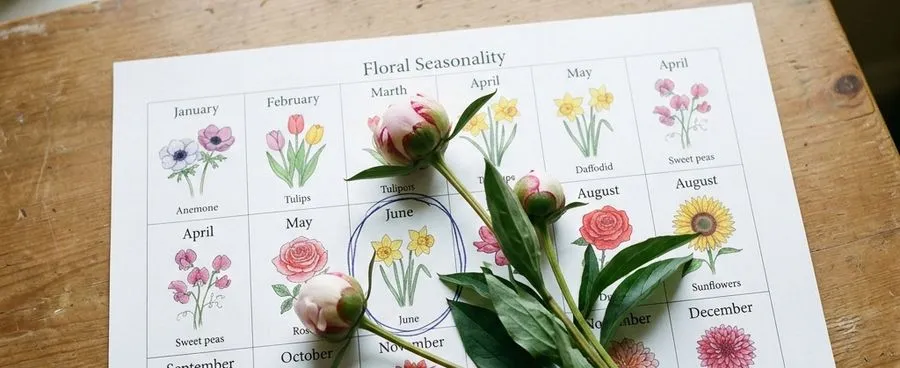
Type "wedding flowers by season" into a search bar and you will land on some version of the same chart within a few clicks: twelve boxes, one flower assigned to each, and an unspoken promise that picking from the right box keeps the price down.
Then a florist quote arrives, and the flower that chart called cheap and in season costs like it flew in from somewhere else. It probably did.
A national or hemisphere-level bloom calendar describes a growing pattern across an entire country, not a promise about your city or your invoice.
This guide opens with an honest month-by-month baseline.
From there it works through the peony example, where four different sources genuinely disagree about the window, and closes on a straight number for what it costs to want a flower outside that window anyway.
In Season by Month, and Why That's Not the Whole Story
The chart most couples find online is really a bloom calendar broken into two-month blocks. Table 1 reframes it into something more useful: not just what tends to bloom when, but which pricing tier a flower falls into. True seasonal, local stems are cheapest in their own window and lose that edge everywhere else.
A second group grows in greenhouses year-round, so its price barely moves with the calendar - call it steady rather than cheap. A third group is rare or hard to source no matter the month, and costs about the same in January as it does in June.
Table 1. In Season, Year-Round, or Always a Premium: the Three Pricing Tiers
| Period (Northern Hemisphere) | Blooms typically at natural peak | Pricing tier |
|---|---|---|
| January-February | Tulips, anemones | True seasonal - cheapest and freshest in this window |
| March-April | Ranunculus, hyacinth | True seasonal - cheapest and freshest in this window |
| May-June | Peonies, roses | True seasonal - cheapest and freshest in this window |
| July-August | Hydrangea, sunflowers | True seasonal - cheapest and freshest in this window |
| September-October | Dahlias, chrysanthemums | True seasonal - cheapest and freshest in this window |
| November-December | Amaryllis, orchids | True seasonal - cheapest and freshest in this window |
| Any month | Not season-specific | Globally greenhouse-grown - available essentially year-round, with only a minor seasonal price swing (no specific species named; none are sourced in this research) |
| Any month | Not season-specific | Rare or hard-to-source specialty - premium-priced regardless of season |
Northern Hemisphere growers only; the pattern runs six months out of phase south of the equator.
No agricultural-extension or horticultural-society source backs any row here - every seasonal claim in this table traces to commercial florist and vendor content, disclosed plainly rather than dressed up as independent research.
"Year-round" in that middle row is a pricing category, not a list of species - no source here ties a specific flower to guaranteed year-round availability, so none is named. Ask your florist which stems in that tier are realistic for your date.
The six-month Southern Hemisphere shift noted above is also why counter-seasonal stock exists in the flower trade at all, and it matters most once you trace where those imports actually land in your own city's pricing.
Why "In Season" Doesn't Mean "Available Where You Live"
A flower can be nationally in season and still be a regional specialty, grown or flown in from somewhere else entirely. The United States imports roughly 80 percent of its cut flowers, so for most couples, "in season" is frequently a fact about a supply chain rather than a fact about their own backyard.
How much does being in season actually save you? It depends who you ask, and neither answer comes with a definition you can check. One commonly cited range puts in-season flowers at roughly 30 to 50 percent cheaper than their out-of-season counterparts; another puts it at 30 to 70 percent.
Neither figure traces to a single named, dated source, and no vendor behind either number explains what they mean by "in season" - grown domestically, or simply not imported.
That gap is wide enough to throw a flower budget off by a third or more, so this guide keeps both ranges side by side instead of averaging them into a tidier, less honest number. (More than one couple I have sat with has assumed their florist made an error when the in-season chart and the actual quote did not match. The florist was right; the chart was just describing a different place.)
Myth vs. Fact: "In Season" Is Not a Local Promise
| Myth | Fact |
|---|---|
| If a national chart says my flower is in season this month, it will be affordable and available near me. | The US imports roughly 80% of its cut flowers. "In season" often describes where a flower is grown or economically sourced, not your own climate zone. |
| In-season flowers save you a fixed percentage off any out-of-season stem - it's one settled number. | This research holds two conflicting estimates, roughly 30-50% and roughly 30-70%, built on no shared definition of "in season." Both appear in this guide, never merged into one. |
| An out-of-season flower simply isn't available. | It is usually still available through import or cold storage, at a documented premium, and for peonies specifically, with color choices narrowed mostly to white and blush. |
Read those three pairs before you let one percentage from a single site set your flower budget.
The Peony Problem: One Flower, Four Answers
No flower in this research illustrates the regional problem better than the peony. Four different sources give four different answers to a question that sounds simple: when is peony season?
Table 2. Peony Bloom Window: Four Sources, Four Scopes
| Source | Region / scope | Claimed bloom window | Peak |
|---|---|---|---|
| Poppy Flowers | Southern US | Late March-May | April |
| Poppy Flowers | Mid-Atlantic / Midwest | Late April-early June | May |
| Poppy Flowers | Northeast / Pacific Northwest | May-mid-June | Late May |
| Poppy Flowers | Northern states (e.g., Minnesota, Wisconsin) | Late May-late June | Early June |
| Lacybird | National, single window | May-June | Not given |
| Peonita | National, single window | Late April-early June | Not given |
| The Gathering Garden | One grower's shipping window | May 10-July 7 | Not given |
Do not average or rank these four rows against each other. The regional breakdown is more granular, not more correct - and if your date sits near either edge of your region's window, confirm it with a local florist regardless of which row you read.
Read the four rows in order and a pattern shows up fast.
Poppy Flowers is the only source that breaks the country into regions at all, and its picture is the most useful one here: peonies bloom earliest in the Southern US, roughly late March through May, and progressively later moving north, finishing in states like Minnesota and Wisconsin as late as the end of June.
Lacybird and Peonita each give a single national window instead - May through June, and late April through early June. The Gathering Garden adds a fourth data point: one grower's specific shipping dates, May 10 through July 7. None of these is wrong exactly; each is answering a narrower question, their own inventory or the country as a whole, rather than your particular growing zone.
The regional breakdown wins on detail, not on being more correct, and no agricultural-extension or horticultural-society source stands behind any of the four claims - averaging them would just produce a fifth number nobody actually measured.
If your date sits near the edge of peony season for your region, confirm it with a local florist before you build a color palette around a flower that may already be gone.
What It Actually Costs to Want a Flower Out of Its Window
Wanting a flower before or after its natural window has a price, and the research gives two overlapping estimates for it: roughly two to three times the in-season price by one account, three to four times by another.
Treat that as a range to budget against, not a number you can pin to the dollar - neither figure comes from a single named source.
Peonies have the better-documented version of that same math.
Two peony-focused guides put the off-season premium at roughly three to four times the in-season price, and both add a detail the general estimate does not carry: once sourcing shifts to import or cold storage, color options narrow, mostly down to white and blush.
Wanted a deep burgundy peony for a January wedding?
That is the honest limitation, not a shortage of florists willing to try. (I have seen this exact line item on more real quotes than I can count, and it rarely comes with an explanation unless someone asks for one.)
One thing this section deliberately leaves out: any fee percentage, minimum order, or contract clause a florist might attach to sourcing an out-of-season stem. That is a question about how to read the quote itself, not about the seasonal math behind it.
Year-Round Blooms vs. Truly Seasonal Ones
Step back from any single wedding date and the three-tier framework from Table 1 becomes a planning tool rather than a chart you check once.
A couple with a long engagement, or one that is not set on a single specific bloom, can lean toward the greenhouse-grown, year-round tier on purpose - not because it is cheap, but because its price barely moves.
Book a caterer eighteen months out and plenty can shift before the wedding; a flower whose cost holds roughly steady through all of that is worth something on its own.
Steadier is not the same as cheapest, and it is worth saying plainly: a true seasonal, locally grown flower bought inside its own window is still the least expensive tier when you can get it. Year-round buys predictability. In-season, done right, buys the lowest price on the page.
Most couples end up mixing both tiers - a seasonal centerpiece flower, a steadier greenhouse-grown filler - rather than picking one for the whole order.
Flowers That Survive Your Ceremony's Climate
Heat is a separate problem from seasonality, and couples planning an outdoor summer ceremony conflate the two more often than you would think. A flower can be perfectly in season and still wilt within a few hours of direct midday sun; soft, thin-petaled garden-style blooms are the most exposed. That is a same-day climate risk, not a calendar problem, and no amount of checking a bloom-window chart protects against it.
In my experience, most florists will flag a heat-sensitive stem if you ask directly, though not all volunteer it upfront - so ask.
Cold works the same logic in the other direction for outdoor winter ceremonies.
Hardier, sturdier stems generally hold up better through a long, exposed setup in freezing air than delicate ones do, for the same underlying reason: it is about the material, not the month on the seasonal chart.
If Your Date Falls Outside the Window: The Decision Tree
Put the last few sections together and a genuinely useful question falls out: which tier is this flower in, and does your date fall inside its window? The tree below walks through both.
Your Flower Isn't in Season for Your Date: Now What?
- Which pricing tier is this bloom? (Table 1)
- Globally greenhouse-grown: proceed. Expect a steadier price with only a minor seasonal swing.
- Rare or hard-to-source specialty: expect a premium price in every month. Your date does not change that.
- True seasonal: continue to step 2.
- Does your wedding date and region fall inside that bloom's natural window? (Table 2 for peonies; your own regional judgment for other true-seasonal stems.)
- Yes: proceed at the in-season price tier, and still confirm with a local florist if your date sits near either edge of the window.
- No: continue to step 3.
- Three real choices, not a ranked recommendation:
- Move the date, if you have that flexibility.
- Accept the documented off-season premium, and for peonies, the narrower color range, and budget for it deliberately.
- Substitute a similar in-season stem. Got the list? Here is how to read what a florist quotes you for it covers how a substitution clause works in a contract, and Set on a flower that is out of season for your date? Look at what a durable material does instead is worth a look if a non-fresh material now fits the plan better than a fresh out-of-season one.
This is exactly the kind of check that is faster to run than to reason through by hand, which is what the Seasonal Bloom Picker further down this page is built for.
Plug in your month and your rough climate zone and it sorts your options into these same three tiers - and every result it gives repeats the same reminder this guide has made throughout: a seasonal pattern is not a guarantee for your exact city, so confirm an edge-season date with a local florist before you rely on it.
See the full flowers and decor guide for the rest of the series.
Questions Couples Actually Ask
When is peony season, and can I still get them for a fall wedding?
Peony's natural window runs roughly late March through late June, depending on your US region.
A fall date falls outside that window everywhere in the country, so fall peonies come only via import or cold storage, at a documented premium and with color choices narrowed mostly to white and blush.
My florist says peonies are "in season" this month, so why are they still so expensive near me?
A national seasonality chart describes a growing pattern, not a promise about your specific address.
The US imports roughly 80 percent of its cut flowers, and your region's bloom window may already have closed even while it is open elsewhere - national "in season" and local "in season" are not always the same claim.
Do heat-tolerant wedding flowers exist for an outdoor summer ceremony?
Heat-wilt is a same-day risk separate from calendar seasonality; some stems handle direct sun and a long outdoor setup far better than others. Ask your florist to name the heat-sensitive stems in your own order rather than assuming "in season" means "heat-tolerant."
How much more does it actually cost to order a flower out of season?
Roughly two to four times the in-season price, depending on source and variety - estimates range from two to three times by one account to three to four times by another. For peonies, the documented figure is closer to three to four times, plus a narrower color range.
My favorite flower isn't in season for my date. What are my actual options?
Three real choices, from the decision tree above: move the date if you can, accept the documented premium and budget for it deliberately, or substitute a similar in-season stem. Each option is legitimate.
Run your wedding month and rough climate zone through the Seasonal Bloom Picker above before you lock in a flower wishlist - it sorts your options into the same three tiers this guide uses, with no guaranteed date or price, since nothing here supports one.
Take the result to a florist and compare it against a real quote. See the full flowers and decor guide for what comes next.