 Goes Wedding
Wedding Planning Timeline: What to Book First
 Written by Tessa Broussard
 · Reviewed by Renata Halloran, CWP· Published 2026-08-28· Last checked 2026-08-30
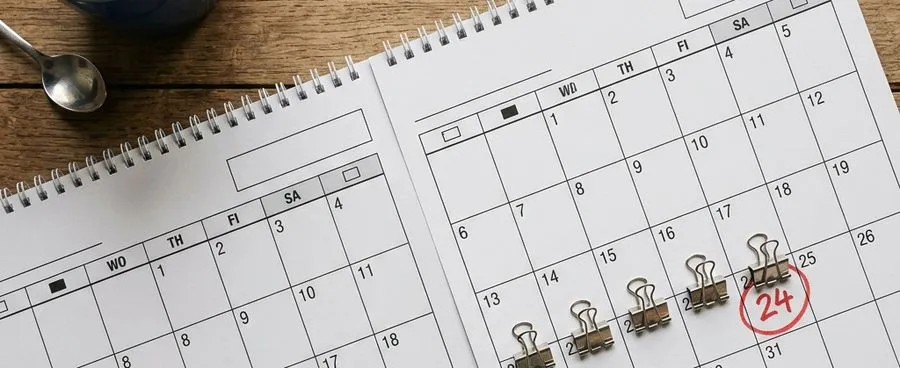
Every couple who gets engaged eventually finds a wedding planning checklist online, and almost all of them have the same shape: a column of tasks running down a column of months, with no reason attached to either.
Nobody explains where those numbers came from, and that's the real problem, because most aren't independent deadlines at all - they're calculated backward from a later, harder deadline you haven't hit yet.
The venue window exists because good Saturdays book up early. The dress order-by date exists because of the fitting sitting behind it, not because a gown takes that long to sew.
This article walks the cascade in the order it actually falls, works two of those chains all the way back so you can see the logic instead of memorizing a number, and ends with a recovery plan if you're already behind.
You're probably not as far behind as it feels.
Before You Call a Single Vendor: Set Your Budget and Guest Count
Before you call a single vendor, you need two numbers you probably don't have yet: a total budget ceiling and a guest count range.
Not a finished guest list - a range, somewhere between your smallest realistic version and your largest, because the exact count won't exist until people actually RSVP, and you cannot wait that long to start booking a venue.
Which of those two comes first, the budget or the guest count, is a genuinely contested question, and I'm not going to pretend there's a settled answer, because I haven't found one I trust. Some planners say build the guest list first and let the budget follow it; others set the ceiling first and let the list bend to fit inside it.
Both camps agree, without exception, that neither number can be missing when you sit down with a venue.
Do not book anything until the budget exists - start with the category split and the other anchor decision: a guest-count range you can actually pay for go deeper into their own halves of this than this article has room for.
One thing I'll say about money in an article that otherwise won't touch it: your guest count is the single biggest lever on your total budget, ahead of the venue, ahead of the dress, ahead of the flowers.
Everything past this section assumes you've already worked through this step.
The Vendor Booking Timeline: Venue, Photographer, Caterer, DJ, Florist, and Baker
Table 1 lays out the vendor cascade at a glance, and the "what it's driven by" column is worth reading as closely as the lead-time column, because the two aren't related the way most people assume.
The venue comes first and takes the longest, twelve to eighteen months out, and that isn't because choosing a venue is a harder decision than choosing a photographer. It's because a venue only has so many Saturdays on its calendar in a year, and the good ones go first.
Photographers, caterers and DJ or band acts follow at nine to twelve months (one source narrows that to ten to eleven), for the same underlying reason: a photographer you actually want only shoots one wedding per date, so that calendar fills the way a popular venue's does.
Florists and bakers come in later, six to eight months out, with somewhat more slack because most markets simply have more of them to choose from.
None of the figures below carry the warning label the dress figure gets two sections from now.
This is the ordinary, broadly agreed-on set - commercial sources only, no government or audited figure exists for any of it, but the ranges themselves aren't in genuine dispute the way the dress order-by date is.
Table 1: The Vendor Booking Timeline
| Decision | Typical lead time before the wedding | What it's actually driven by | Fixed by contract or soft? |
|---|---|---|---|
| Venue | 12-18 months | Date availability - good weekends book first | Soft - customary spacing |
| Photographer | 9-12 months (one source: 10-11) | One wedding per date, the same scarcity pattern as the venue | Soft - customary spacing |
| Caterer | 9-12 months | Kitchen and staffing capacity per date | Soft - customary spacing |
| DJ/band | 9-12 months | One performance per date, calendar fills like a venue's | Soft - customary spacing |
| Florist | 6-8 months | More suppliers per market, somewhat more slack | Soft - customary spacing |
| Baker | 6-8 months | More suppliers per market, somewhat more slack | Soft - customary spacing |
| Marriage license | No fixed lead time - set by your state and county | A legal requirement, not vendor scarcity | State-set, not vendor-fixed - see below |
Hiring help changes these dates: a planner comes in early, a coordinator late if you're weighing outside help against doing this timeline yourself.
And once a date actually lands on a contract, the venue deadline ends in a signature - check these clauses before you sign it covers what you're agreeing to when you put down a deposit.
Pull every decision in this article into one sequence and it reads like this.
Your Book-First-to-Last Sequence
- Set your budget ceiling and guest-count range
- Book the venue and lock the date
- Book photographer, caterer and DJ/band
- Book florist and baker
- Order the dress
- Mail save-the-dates
- Mail invitations
- Attend alteration fittings
- RSVP deadline passes
- Submit final headcount to caterer/venue
- Standing reminder: check marriage-license timing with your county clerk early - no date attached, start whenever it comes to mind
The Dress Order-By Date: Why It's Set by the Fitting, Not the Dress
Here's the mechanism, and it matters more than any single number: the dress order-by date isn't set by how long a seamstress needs to sew the gown. It's set backward from your final fitting, which is set backward from the alteration window you need, which is set backward from the wedding date itself.
Order too late and you don't just wait longer for a box to arrive - you compress the alteration window on the other end, the part that touches your actual body and can't be rushed the way shipping can.
Now the part I have to be honest about. Ask three sources for the order-by lead time and you'll get three different answers, sometimes from the same source.
Table 2: Two Sources, Two Timelines - The Dress Order-By Conflict
| Source | Order-by lead time claimed | What it does not tell you |
|---|---|---|
| Commercial guide A - checklist table | 12 months | Doesn't explain why its own article text below the table gives a shorter figure |
| Commercial guide A - same article's narrative text | 9-10 months | Contradicts its own table above by two months, with no note reconciling the two |
| Commercial guide B | 6-9 months, delivery only | Counts delivery alone; alterations sit on top of this window, not inside it |
The number that matters is the one your own salon puts in writing.
I'm not going to average those figures into one falsely precise answer, because that answer wouldn't mean anything.
The safe rule is this: order early enough to clear the alteration window you actually need, and treat every published figure, including the ones in that table, as a starting estimate rather than a deadline.
The number that governs your specific gown is whatever your own salon writes on your own order form - not a range you read in an article, including this one.
I learned this the expensive way. I counted from the wrong anchor. I'd read that "the dress takes about nine months" and worked forward from the day I ordered it, instead of working backward from the fitting date my seamstress actually needed.
By the time I caught the mistake, I'd lost two weeks I couldn't get back, and I spent the week before my own wedding in a tighter, more stressful fitting than I needed to have. The dress still fit fine in the end. The margin for error didn't.
The Invitation Chain: From Save-the-Date to Final Headcount
Work this chain backward and it makes more sense than working it forward.
Start at the end: your final headcount is due to the caterer or venue about one week before the wedding, and unlike almost everything else in this article, that date is typically fixed by the contract you signed, not a customary convention you can nudge.
Miss it and you haven't disappointed a vibe - you've missed a term you agreed to in writing.
Everything upstream of that date exists to protect it.
The RSVP deadline sits about a week earlier than the headcount due date, three to four weeks before the wedding, and that buffer week exists for one reason: chasing down the guests who don't answer invitations on time, because some of them never do.
Invitations go out six to eight weeks before the wedding as the standard window, though some sources stretch that to eight to twelve weeks; plan on ten to twelve weeks for a destination wedding, or a full twelve if you skipped save-the-dates entirely, since guests need more runway to reply without that earlier heads-up.
Save-the-dates themselves go out six to eight months ahead, longer still if guests need to book flights or a hotel block to reach you.
One more contract date lives inside this same chain, and covering it properly isn't this article's job.
The venue deadline ends in a signature - check these clauses before you sign it has the deposit and balance-due terms that ride alongside your final headcount date; this piece only sequences when things happen, not what any of it costs.
Build Your Own Countdown
You don't need a tool to run this math once you know the order, though one exists if you'd rather not do it by hand.
Take your wedding date and count backward through four steps: subtract six to eight months for your save-the-date date, subtract six to eight weeks for your invitation-mailing date, subtract three to four weeks for your RSVP deadline, then subtract roughly one more week for your final-headcount date.
Each of those is a customary range, not a promise, so leave yourself room on either side instead of treating the earliest possible date as the only correct one. (If you're the spreadsheet type rather than the calendar type, the math works exactly the same either way.)
Here's what that looks like for one illustrative wedding, a Saturday next October.
Worked example: wedding date Saturday, October 9, 2027
| Step | Range applied | Resulting window |
|---|---|---|
| Save-the-dates mailed | 6-8 months before | February 9 - April 9, 2027 |
| Invitations mailed | 6-8 weeks before | August 14 - August 28, 2027 |
| RSVP deadline | 3-4 weeks before | September 11 - September 18, 2027 |
| Final headcount due | about 1 week before | October 2, 2027 |
These are typical spacings, not contract terms - check your own vendor's contract for the date that actually binds you.
Run the same math against your own date, or generate a dated checklist from your own wedding date to cover every vendor and deadline in this article at once, not just the invitation chain.
One Deadline We Won't Give You a Number For: Your Marriage License
Every deadline in this article so far comes from wedding-industry convention. This one doesn't, and I'm not going to pretend otherwise by inventing a typical figure. A marriage license carries its own waiting period and its own validity window, both set by state law and sometimes by county practice on top of that.
What holds in one state can be entirely wrong one county over, and publishing a single figure here, even framed as "typical," would tell some readers something false about their own paperwork.
The move is unglamorous: call your county clerk's office or check your state's vital-records website directly, and do it early enough that a records office running behind schedule doesn't become your problem the week of the wedding.
This is the one item on the checklist above with no date attached to it, on purpose.
Already Past a Deadline? Here's the Recovery Plan
Not every missed deadline costs you the same thing, and your recovery plan depends entirely on which kind you missed. A soft, customary deadline has room to compress.
A contract-fixed one, like your final headcount, doesn't - if that's the one that's already past, call your caterer or venue today and ask what the actual cutoff is on their end, since the figure in this article is a convention, not your specific contract.
Missed the venue-booking window
- Call venues you'd already ruled out and ask specifically about cancellations and off-season or weekday dates - both loosen once you're flexible on timing.
- Widen your acceptable date range by a full season rather than holding out for one exact weekend.
Missed the dress order-by window
- Contact the salon the same day, not the same week, and ask directly about rush production.
- If rush isn't available for your specific gown, ask about floor samples or off-the-rack options, or check sample sales at other retailers.
Missed a save-the-date or invitation mailing window
- Compress the RSVP window rather than the mailing itself - a shorter reply period is a smaller ask than delaying invitations further.
- Say so plainly on the invitation ("kindly reply by" with the tighter date) instead of silently shortening the window and hoping nobody notices.
A missed date on this list is a scheduling problem with a next step attached to it. None of the branches above end the wedding. The couples I've watched handle this best are the ones who called the vendor the same day instead of sitting with the bad news for a week first.
Questions Couples Ask About the Order of Things
Do marriage license rules vary by state?
Yes. The waiting period, the validity window and the required documents all differ by state and often by county. Direct any specific question to your own state's vital-records office or county clerk rather than a published range - this article publishes no number for exactly that reason.
How do I generate my own wedding countdown checklist?
Use the inline countdown above to sanity-check the invitation chain against your own date, then head to the category hub's full generator for every vendor and deadline at once. The inline version above covers one chain by hand; the generator covers the whole timeline, including the vendor and dress deadlines this FAQ item doesn't touch.
I missed my dress order-by deadline - what do I do?
Contact the salon the same day about rush production options, and evaluate off-the-rack or sample-sale alternatives if rush production isn't possible. The recovery plan earlier in this article walks through the fuller sequence, including what to ask the salon.
Why do wedding checklists give different deadlines for the same thing?
Because there's no official or government-grade source behind any of these lead times - every checklist online is built from a commercial industry survey, and the dress order-by figure specifically has genuine, several-month disagreement even within a single source.
Trust the range over any one number, and trust your own vendor's written timeline over any published checklist, including this one.
My caterer wants my final headcount before my RSVP deadline has even passed - is that normal?
Yes, and it's more common than it feels when you're the one staring at the calendar.
The final headcount is typically due to the caterer or venue about one week before the wedding, which commonly lands about a week after the RSVP deadline itself, leaving a narrow window to chase non-responders; because this is usually a contract-fixed date, build your RSVP deadline with that gap already in mind rather than treating it as a surprise.
Use the inline countdown above to check the invitation chain against your own date, then go to generate a dated checklist from your own wedding date for the version that covers every vendor at once.
None of it replaces actually reading your own signed contract for the dates that are genuinely fixed - this article only tells you the order to expect them in.