 Goes Wedding
Shutterfly vs. Mixbook vs. Artifact Uprising: Which Wedding Album Is Worth It?
 Written by Tessa Broussard
 · Reviewed by Renata Halloran, CWP· Published 2026-08-28· Last checked 2026-08-31
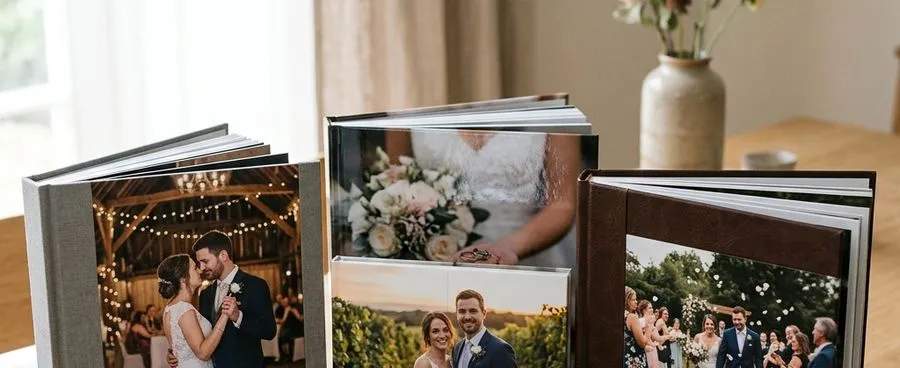
You have the photographer's files and three tabs open.
This page settles what those tabs will not: whether Shutterfly, Mixbook or Artifact Uprising is worth ordering once all three are priced at the same size, page count and cover material.
An album order runs close to a single attempt, so it matters which parts are reversible (a reprint, a defect claim) and which functionally are not, like redoing an entire design pass after you have committed to a size and page count.
No winner is named below. The research does not support one.
How We Compared These Three Wedding Photo Books
The reference configuration is a hardcover album, roughly 20 pages, standard-tier cover material. Every figure here was checked on 2026-08-31, and none of it was re-confirmed against the live pages at publish time, so treat all of it as a starting point to check rather than a quote.
A clean three-way match is not achievable from this research, and you should know that before you see a single number. Shutterfly publishes an official price at exactly this configuration. Artifact Uprising's nearest wedding-line hardcover product has no confirmed page count or trim size anywhere in the research.
Mixbook has no official pricing page captured at all, only an undated third-party citation at a different size and page count.
Promotional and discount pricing (coupon codes, Prime and Costco tie-ins) is excluded from every column. That money is real, but it is time-bound, and folding it into a comparison makes a brand look cheaper on a day that has already gone.
This site may earn a commission on some outbound links below. That played no part in which brands are covered, in what order, or in what is reported about any of them, and no commission figure, affiliate network name or cookie window is published anywhere on this site.
How entities get picked here and what stays untested is on our review methodology page, and the rest of the post-wedding checklist sits one level up.
Shutterfly vs. Mixbook vs. Artifact Uprising: The Numbers Side by Side
Use the configuration-matching checklist above before you compare a single price. It takes a minute, and it is the whole difference between a fair comparison and the one almost everybody makes.
I made the same category of error with my own wedding invitations. I counted guests, ordered by that number, and ended up forty invitations over because invitations go to households, not to people. Wrong unit, confidently applied.
Comparing an 8x8 softcover starting price against a 10x10 hardcover starting price is that error in a different aisle.
Two cells below are not clean matched numbers, and they are the two most likely to mislead you: Artifact Uprising's price comes from a catalog range whose size and page count research could not confirm, and Mixbook has no official price at all.
Read those as gaps rather than as high or low figures. A per-page fee also means the number on the product tile is not the number on the receipt. Shutterfly's own guide lists $1.09 for each page past the base count, and the older Artifact Uprising review cited $4.50 to $6.00, so twenty extra pages moves either total sharply.
| Shutterfly | Mixbook | Artifact Uprising | |
|---|---|---|---|
| Reference configuration actually priced (not fully matched across the three) | 8x8 hardcover glossy, 20 pages, matching the reference configuration | 10x10 Matte Hardcover Premium Lustre, 40 pages: a different size and page count, and from a third party | Wedding-labeled catalog products; size and page count not confirmed in research |
| Starting price at that configuration | $39.98 official | No official figure captured | $19 to $165 across the wedding-labeled catalog (Photo-Wrapped Hardcover $40, Elopement Layflat $165) |
| Per-page fee past the base count | $1.09 per extra page, per the general pricing guide | Not captured | $4.50 to $6.00 per extra page in an older review, likely superseded |
| Where an official price could not be captured | Not applicable: pricing guide and wedding page are both published | No official pricing page located. The only figure available is $240 for the configuration above, cited by a third-party blog with no date attached | Current catalog is published; the configuration behind the range is not stated |
| Independent test finding | No independent hands-on build-quality test located | NYT Wirecutter: top overall pick after 120+ hours and 29 books; second-thickest pages and closest color match of brands tested. Digital Camera World: excellent sharpness for the price, one oversaturated cover, one weak-black spread | One independent reviewer rated print quality "superb" for the price |
| Independent overall reputation score (BBB or Trustpilot) | None located | None located | None located |
| Documented self-contradiction | $24.98 general 8x8 softcover against $29.99 wedding line, same domain; $39.98 official against $36.49 paid by Tom's Guide | Own 2026 guide claims 700+ templates; NYT Wirecutter reports 175 "everyday" templates | Current catalog tops out at $165; A Practical Wedding's still-cited review range is $149 to $609 |
| Price check date | 2026-08-31 | 2026-08-31 | 2026-08-31 |
What Independent Testing Actually Found
NYT Wirecutter ran the most serious program in this research: more than 120 hours of hands-on work across 29 books, with Mixbook coming out as its top overall pick. The finding that matters for an album is physical. The tested Mixbook book, 20 pages at 11x8.5 inches, had the second-thickest pages of any brand in that test and the closest color match to the original files.
Page thickness is what keeps a spread from telegraphing the image printed on its back. Color match is what keeps your reception lighting from going orange on paper. Wirecutter also noted that a coupon of roughly 50% off is frequently available at Mixbook, which is worth knowing and worth keeping out of any price column, because it is not there every week.
Digital Camera World tested Mixbook separately and came back less uniformly positive. Sharpness and resolution were excellent for the price. One cover photograph printed oversaturated, and on one black-and-white spread the blacks did not go as dark as competing books managed.
The reviewer flagged a print defect and a free replacement arrived promptly. That last part is the one I would underline, because it tells you a defect claim on a photo book is a working path and not a theoretical one.
Artifact Uprising has a thinner but consistent independent read. One reviewer called the print quality superb for the price and said an album would have to cost thousands of dollars, ordered through a professional photographer, before it visibly outperformed. One review, one set of eyes, no page-thickness measurements to compare against Wirecutter's.
Shutterfly is the gap. No equivalent independent hands-on build-quality test of a Shutterfly album turned up in this research, beyond the single price data point in the next section. That is an absence in the record, not a bad result.
Nobody tested it and reported poorly; I could not find anybody who tested it at all.
Where Each Brand's Own Pages Disagree With Themselves
This is the part of the page that took the longest, so I am not going to soften any of it.
Shutterfly quotes two different starting prices on its own domain. Its photo book pricing guide puts a general 8x8 softcover at $24.98 plus $1.09 per extra page. Its wedding photo books page starts the wedding line at $29.99.
Those read like the same entry configuration.
Both are published, both were live at the check date, and I am not picking one as the real number, because nothing in the research says which is current, which carries a wedding-line surcharge and which is simply old.
The second Shutterfly case is smaller and more useful. The pricing guide lists $39.98 for an 8x8 hardcover glossy at 20 pages. Tom's Guide reported paying $36.49 for the same stated configuration.
A gap that size could be a promotion, a regional difference or a price change since the test, and Tom's Guide's article URL was not captured in this research, so the outlet is named here and not linked until its live page is confirmed.
Artifact Uprising's current catalog tops out at $165 for wedding-labeled products.
A Practical Wedding's Artifact Uprising wedding album review, undated in this research and still widely cited, quotes $149 to $609 for what it calls the same product line.
Discontinued line, price change over time, naming mismatch: research could not reconcile those, and averaging the two ranges would invent a number nobody published.
Mixbook's own 2026 comparison guide claims more than 700 templates. Wirecutter, testing the same service, counted 175 everyday templates. Those figures may describe different things, a full library against one occasion category, but neither source reconciles them, so both stand as published.
Where They Genuinely Differ
Shutterfly
Breadth is the argument. Shutterfly carries the widest range of sizes, cover materials and finishes of the three, and it sits inside the deepest discount ecosystem, including Prime and Costco tie-ins that surface regularly.
Against that: independent reviews consistently place its build quality behind the other two, and no independent overall reputation score, whether BBB or Trustpilot, was located for Shutterfly itself in this research.
You are buying range and a good chance of a coupon, from the brand with the least outside evidence about how the finished object feels in your hands.
Mixbook
Of the three, Mixbook is the one with extensive hands-on testing from a major outlet behind it, and the design tools are genuinely flexible, including collaborative editing if a partner or a sibling is helping build the layout.
Two real limitations.
No official pricing page was captured in this research, so you cannot price a Mixbook album from a published tier ladder the way you can with Shutterfly, and you will be pulling a live quote from the configurator.
Its own template-count marketing also conflicts with what its most credible independent reviewer counted.
Artifact Uprising
Archival matte paper and a stripped-back look you pay a premium for, from a company founded in 2012 by a family of professional photographers according to independent media reporting. The limitations are about evidence rather than product. Its recycled-materials and domestic-manufacturing claims trace only to the company's own materials as relayed by media, with no independent confirmation in this research.
Its most-cited historical price range runs several times above what the current catalog shows, which means a lot of what you will read about this brand online is describing something that may no longer be for sale.
Where the Evidence Runs Thin
The key above separates what a brand says about itself from what somebody outside the company checked. Three specific holes in this page's evidence are worth naming, because none of them is the generic "do your own research" caveat.
No independent overall reputation score, BBB or Trustpilot, exists anywhere in this research for Shutterfly itself. Not a low score: no score located. Of the three, it is the brand with the least outside record of any kind here, which is worth sitting with for a second before an absence starts reading like reassurance.
No official Mixbook pricing page was captured. The entire Mixbook price column rests on one undated citation from a third-party comparison blog, at a size and page count that do not match the reference configuration. That number belongs to the blog, not to Mixbook.
Artifact Uprising's sustainability and domestic-manufacturing claims trace to the company's own materials as relayed by media outlets, never to an independent audit or a third-party check. Company-sourced is not the same as false, and it is not the same as corroborated either.
Who Should Choose Which Album
There is no winner row on this page and no score, because the three brands do not fail or succeed at the same task.
If your constraint is budget or time, and you want the widest choice of sizes and materials plus a live shot at a discount code, Shutterfly is the practical pick. Order it knowing the trade you are making: independent reviewers rate its build behind the other two, and there is no outside reputation score to fall back on if the finished album disappoints you.
If you want the strongest independently verified print quality without paying a premium price, Mixbook is where the evidence points. Wirecutter's page-thickness and color-match findings are the closest thing to a measured result anywhere in this comparison.
Get a live quote from the configurator before you build anything, because no published price ladder exists to check it against, and confirm the template selection you actually want is there rather than trusting a count.
If the aesthetic described above is the one you want and the premium is acceptable to you, Artifact Uprising is a defensible spend, with one independent reviewer's print-quality read behind it.
Price your exact configuration on the current catalog page and ignore older review figures entirely, and treat the sustainability and manufacturing claims as the company's own until somebody outside it confirms them.
One thing that applies whichever way you go: a reprint or a defect claim is recoverable, and Digital Camera World's replacement arrived without a fight. Committing to a size and page count is the decision that is expensive to undo, because it means rebuilding the layout from scratch.
FAQ
Which is actually the best wedding photo book: Shutterfly, Mixbook, or Artifact Uprising?
None of them, in the sense the question asks.
The evidence supports a split by situation rather than a ranking: Shutterfly for breadth and discount pricing, Mixbook for independently tested print quality without a premium price, Artifact Uprising for the archival look if you will pay for it.
A single winner is not in the research.
Is Mixbook's "best overall" reputation actually deserved, or is it just marketing?
It rests on testing, not a press release. NYT Wirecutter spent more than 120 hours across 29 books and found Mixbook's tested 20-page book had the second-thickest pages and the closest color match to the originals of any brand compared. In the same breath: Mixbook's own 2026 guide claims more than 700 templates while that outlet counted 175 everyday ones, and neither source explains the gap.
Why do Shutterfly's own pages show two different starting prices for a wedding album?
Nothing in this research explains it. Shutterfly's pricing guide lists a general 8x8 softcover at $24.98, while its wedding photo-books page starts the wedding line at $29.99, both on shutterfly.com. Confirm the price for your exact size, page count and cover material directly on Shutterfly's site rather than trusting either figure blind.
Should I just order my wedding album through my photographer instead of one of these three companies?
It is worth a quote, on one piece of evidence rather than a rule. This research turned up a professional print-lab consumer product that a reviewer rated behind ordering through your own photographer on print quality: one finding, one product. This page compares these three direct-to-consumer brands against each other, not against a photographer's lab.
Ask what an album through that lab costs at your size and page count, then set it beside the table above.
Related Reading
Each of the three has its own page here, with the full detail this comparison compresses: Shutterfly's full price ladder and its two conflicting starting prices, what independent testing actually found on Mixbook, and whether Artifact Uprising's premium is worth it.
If you have not narrowed the images yet, start with how to pick the photos before you pick the printer.
Before you open any of those, settle your own numbers: the size you want, the page or spread count, the cover material, the binding, the finish. Run them through the configuration-matching checklist above, then follow whichever monograph matches your profile, breadth and price, independently tested quality, or the archival look. I am not sending you to one brand, because the evidence does not point at one.