 Goes Wedding
Wedding Dress Preservation Cost and Timeline
 Written by Tessa Broussard
 · Reviewed by Renata Halloran, CWP· Published 2026-08-28· Last checked 2026-08-30
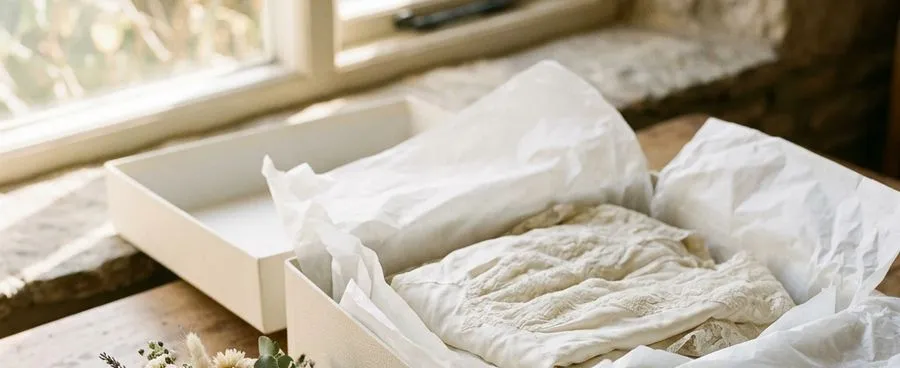
Two preservation companies will quote you three hundred dollars and eleven hundred for the same dress, and neither one is going to volunteer why the number moved.
I've watched couples pick the cheaper quote out of relief and the pricier one out of fear, and neither reason has much to do with what actually drives the price.
This piece breaks down what does: complexity tier for the dress, method choice for the bouquet, the two deadlines already running whether you've noticed them or not, and a disagreement between specialists that most preservation companies won't put anywhere near their own pricing page.
No official or government body regulates dress or bouquet preservation in the United States, and none of the ranges below come from a verified industry standard - they're commercial and media-sourced estimates, cited individually throughout. A preservation guarantee is not damage or loss insurance, whatever the marketing copy implies. Confirm every figure and every guarantee term with your own provider before you pay.
The Action Deadline: Why Waiting Is the Real Risk
Preservation decisions run on two different clocks, and mixing them up is where I see couples waste money or lose something they can't get back. The dress works on a soft deadline.
One gown brand's own materials warn that an untreated white dress can start visibly yellowing around the six-month mark - take that figure with the grain of salt it deserves, since it's a company that sells dresses, not a conservation lab.
The bouquet works on a hard deadline, twenty-four to forty-eight hours fresh, covered in full further down, but worth naming here because it's the one clock that doesn't forgive procrastination the way the dress's does.
The one post-wedding task with a shorter deadline than this one runs on a tighter calendar than the dress does, which is exactly the kind of comparison that makes "I'll get to it" dangerous advice.
Six months sounds like plenty of runway until you're four months in and the gown is still zipped in the garment bag from the venue.
So which clock applies to you? Work through this before reading any further.
Which deadline applies to you?
- Dress only. Has it been close to or past six months since the wedding, and the dress still hasn't been cleaned? Treat cleaning and preservation as due now, not "sometime this year." Inside that window, you have room, but it isn't indefinite.
- Bouquet only. Is the wedding within the last 24 to 48 hours? If yes, and freeze-drying is the goal, ship it to a professional today. If that window has already closed, the realistic path is DIY drying from whatever remains, not professional freeze-drying of a fresh bouquet.
- Both. Run both checks separately. The two clocks don't share a deadline, and being on time for one tells you nothing about the other.
Wedding Dress Preservation Cost and Turnaround by Complexity
Nobody regulates this market.
There's no licensing board or published fee schedule the way there might be for, say, a notary in some states, so every number below comes from a preservation company's own pricing page or a single named specialist quoted in the press, not a government survey.
That doesn't make the numbers useless. It means you read them as a bracket, never as one "typical" price you hold a quote against.
The spread is genuinely wide. Budget mail-in services start around 169 dollars for a straightforward gown.
A couture piece with heavy beading and a full train can run past 2,000 dollars, and Vogue's interview with preservation specialist Jonathan Scheer puts the top of that range as high as 2,000-plus, with a turnaround of ten to sixteen weeks for the most involved work.
What sits between those extremes depends on three things: how much beading and lace the gown carries, whether there's staining that needs treating before the dress goes anywhere near a box, and how delicate the fabric itself is to work with.
Turnaround follows the same logic. Four weeks is realistic for a simple satin gown with no staining. Sixteen weeks, sometimes longer in peak season, is realistic for a heavily beaded couture piece a preservation company has to hand off to a specialist.
Ask for a turnaround stated as a range when you call, not a single number, and treat any quote promising a fast turnaround on a heavily beaded dress with some skepticism.
Dress preservation cost and turnaround by complexity
| Complexity tier | What's typically included | Price band | Turnaround range |
|---|---|---|---|
| Simple | Clean lines, minimal embellishment, no significant staining | $250-$400 (budget mail-in from about $169) | About 4-8 weeks |
| Moderate | Lace, beading, light staining | $400-$700 | About 8-12 weeks |
| Heavy/couture | Heavy beading, delicate fabric, set-in stains | $700-$2,000+ | About 10-16 weeks |
The Sealed-Box vs. Breathable Storage Disagreement
Ask five preservation companies whether a sealed box is safe and you'll get five confident answers, and at least two of them will contradict each other. That's not incompetence on anyone's part. It's a live disagreement among people whose actual job is textile conservation.
Jonathan Scheer, the specialist Vogue interviewed for its own piece on this exact question, warns that a fully sealed, airtight box can trap residual moisture inside if the gown wasn't completely clean and dry before the box closed, and that trapped moisture is what can lead to mold or yellowing months or years later, quietly, with nobody watching.
Plenty of preservation vendors, meanwhile, market the sealed box as the standard and the safer method, full stop, no caveat attached.
Here's the mechanism behind the disagreement, because understanding it matters more than picking a side. A sealed box keeps dust and pests out, which is genuinely protective. But it also traps whatever is already inside the box along with the dress.
If the gown went in perfectly clean and bone-dry, a sealed environment is arguably fine. If any moisture went in with it - a trace of dry-cleaning solvent, a spot that wasn't fully treated - the same seal that keeps pests out also keeps that moisture in.
I'm not issuing a verdict here.
I don't think there's an honest one to issue from the sources I have, and any preservation company that tells you the sealed-box question is settled science is telling you more about its sales pitch than about textile conservation.
What you can do instead is ask the one question this whole disagreement actually turns on: exactly how was my dress cleaned and dried before it went into whatever box you use, and can you show me that in writing?
A company with a real answer will give you one. A company that gets vague on that specific point is telling you something too.
Bouquet Preservation Methods Compared
If what you want is a flat keepsake you can frame and hang, air-drying or silica gel gets you there for next to nothing, and that's where I'd start any budget-conscious couple before pointing them toward the expensive option.
Silica gel runs somewhere around 30 to 80 dollars in supplies and takes one to seven days if the bouquet goes into the gel promptly.
Air-drying costs even less, essentially nothing beyond a rubber band and somewhere dark and dry to hang it, but it produces the least durable result on this list; colors fade and petals go brittle, and a bouquet air-dried five years ago usually looks it.
Pressing sits a step up in both cost and durability. Figure 150 to 400 dollars for a professional press, weeks rather than days for turnaround, and a flat, two-dimensional keepsake that holds up well once it's framed and kept out of direct light.
Resin lands in a similar cost band, roughly 200 to 600 dollars, but the result is different in kind: the flowers get locked into a solid block at whatever shape and color they had the moment the resin set, permanently, with none of the slow fading a pressed flower can show.
Then there's freeze-drying, the premium option, and it earns the premium honestly.
Figure 150 to 700-plus dollars, with most quotes I've seen clustering between 250 and 600, and a total turnaround commonly running four to twelve weeks - the physical drying step alone often taking twelve to fourteen days.
What that buys is a three-dimensional bouquet that keeps something close to its fresh shape and color, closer to what it actually looked like in your hands at the altar than a flattened or resin-set piece can manage.
If a flat, framed keepsake genuinely does the job for you, freeze-drying is money you don't need to spend. If you want the bouquet to still look like a bouquet, it's the only method here that delivers that.
Bouquet preservation method comparison
| Method | Approx. cost | Turnaround | Result/durability |
|---|---|---|---|
| Air-dry | Near-free | Days to weeks | Least durable; flattens and fades over time |
| Silica gel/DIY | About $30-$80 in supplies | 1-7 days | Holds shape and color reasonably well if done promptly |
| Pressing | About $150-$400 | Weeks | Flat 2-D keepsake, durable once framed |
| Resin | About $200-$600 | Weeks | Locked permanently into a solid block at set-time shape and color |
| Freeze-dry, professional | About $150-$700+, most $250-$600 | About 4-12 weeks total | Closest to fresh 3-D appearance; most durable display option, highest cost |
The 24-48 Hour Bouquet Shipping Window
Of every deadline in this article, this is the one that doesn't bend. Get a fresh bouquet to a preservation provider within 24 to 48 hours of the wedding if freeze-drying is the goal. Flowers start degrading at room temperature within hours, not days, and professional freeze-drying needs a bouquet that's still fresh going in.
Ship a wilted one and the process can't undo what already happened before it arrived.
That window sounds brutal in the middle of a wedding weekend, when you're packing gifts and writing checks to vendors, with a honeymoon flight leaving the next morning. It is brutal. It's also the one deadline on this page I won't soften for anyone, because softening it would misrepresent what freeze-drying can actually do.
Already past 48 hours? Say so to yourself plainly rather than hoping a provider has a workaround, because mostly they don't. Professional freeze-drying of an already-wilted bouquet stops being the strong option.
Drying what remains yourself with silica gel, or letting it air-dry, is the honest path at that point - a different result from the fresh-bouquet one, not a lesser version of it.
What a Preservation Guarantee Actually Covers
A preservation guarantee sounds like insurance. It isn't. What it typically covers - and I want to be precise about "typically," since there's no universal contract to point to - is free retreatment if new staining or yellowing shows up after the fact.
That's it. It is not compensation if the box is lost in shipping, damaged, or if the item is somehow harmed during the process itself.
Most companies don't spell that distinction out clearly, which is exactly where I'd push back if I were sitting across from a salesperson. Affordable Preservation Co. is the one provider in my research that names a genuinely separate insurance line, priced at 2,000 or 3,000 dollars of coverage on top of its preservation service.
That tells you something useful: if a real insurance product exists as a distinct, priced add-on at one company, then "guarantee" and "insurance" aren't interchangeable words at any of the others either, whatever their marketing implies.
Before you pay anyone, get the guarantee's exact scope in writing. Ask what it covers and what it doesn't, in plain language, not a link to terms buried in a footer. And ask one more question almost nobody thinks to ask: does breaking the box's factory seal - to show your mother, say, or take the dress out for an anniversary - void the guarantee?
Some do. Find that out before you seal anything, not after.
Red Flags and a Documented Failure to Avoid
Here's what I'd watch for before mailing something I can't replace. Guarantee language that stays vague no matter how directly you ask, phrases like "fully protected" with nothing underneath them. No turnaround estimate at all, or one so soft it isn't really an estimate; "incredibly fast" is not a number.
A "premium" or "archival" claim on the box or the process that, when you actually ask what makes it archival, turns out to describe an ordinary product with a markup attached. And any provider that won't put its guarantee terms in writing before you pay - that alone should end the conversation.
Red flags to watch for:
- Vague or unverifiable guarantee language that won't commit to a specific scope
- No turnaround estimate, or only a vague one ("incredibly fast" isn't a number)
- A "premium" or "archival" claim that, on closer inspection, describes an ordinary product at a markup
- Refusal to put guarantee terms in writing before you pay
One case from a wedding forum has stuck with me, and I want to be careful about how I present it.
A bride reported that her dress came back from a preservation service still stained and folded inside its own box, with the service's unremoved stain tags still attached - meaning nobody had actually checked the work before shipping it back to her.
I can't verify that account beyond the forum post itself, so I'm presenting it as exactly what it is: a single reported complaint, not proof of an industry-wide pattern. It's still exactly the kind of outcome the red flags above exist to catch before you're the one holding the box.
Before You Ship: Provider Checklist and How to Choose
Before anything goes in a box, work through this list. It's the same discipline whether you're shipping a dress or a bouquet, and skipping a step here is where I've seen people lose leverage they didn't know they had.
Before you ship, and after it comes home:
- Photograph the item's condition, dated, before it ships. Preserving the dress? Back up the photographs the same week covers the other archive decision most couples put off at the same time.
- Get the guarantee's exact scope in writing: retreatment only, or something more.
- Get a turnaround estimate stated as a range, never a vague promise.
- Confirm the item is fully clean and completely dry before it goes into any sealed box.
- Ship with tracking and insurance.
- Keep every receipt and order confirmation.
Once the box is home, the one variable still in your control is where you keep it.
Long-term textile storage is generally recommended around 40 to 60 percent relative humidity and 60 to 70 degrees Fahrenheit, away from direct light and away from an attic or basement where temperature swings hard between seasons.
That's general guidance, not a figure calibrated to your specific climate, so treat it as a starting point, not a rule.
My own stance on all of this: compare at least two providers, by price tier and turnaround, before you commit to either one. I missed my own alteration window by two weeks because I'd budgeted the money for my wedding down to the dollar and never once put a date on the calendar for the parts that weren't about money.
Comparing providers before you ship is the other half of that same discipline - the deadline half, not the budget half, and the cheaper mistake of the two to avoid. Compare the services and finish the rest of the list rounds up everything else on the post-wedding checklist, if preservation was just the first item you tackled.
FAQ
How much does wedding dress preservation cost? Expect somewhere between 250 and 1,000 dollars for most dresses, more for couture pieces that can run past 2,000, and less for a budget mail-in service starting around 169 dollars. The number moves almost entirely on complexity - beading, lace, staining and fabric type - not brand or location. Check the cost-tier table above before you weigh a quote against anything you've read online.
How much does bouquet freeze-drying cost? Figure 150 to 700-plus dollars, with most quotes clustering between 250 and 600. The drying step itself typically takes 12 to 14 days, but the full process, shipping and finishing included, commonly runs 4 to 12 weeks total.
Is it safe to store a wedding dress in a sealed preservation box? That's a real, unresolved disagreement among specialists, not a question with one right answer.
Conservator-attributed sources warn a fully sealed box can trap residual moisture and contribute to mold or yellowing if the gown wasn't completely clean and dry first, while many vendors market sealed storage as the safer standard.
This article doesn't issue a verdict on that; ask your provider directly how the dress was cleaned and dried before it goes into the box.
What are signs of a bad wedding dress preservation company? Vague guarantee language, no stated turnaround range, an "archival" claim that doesn't hold up once you ask what makes it archival, and refusal to put terms in writing before you pay.
One forum-reported case involved a dress returned still stained with the company's own unremoved stain tags attached - a useful cautionary example, even though it's a single account, not a verified pattern.
Freeze-drying vs. pressing a wedding bouquet - which is better? It depends on what you want the keepsake to look like. Freeze-drying keeps the bouquet closest to its fresh, three-dimensional shape and color, at the highest cost and the longest wait. Pressing is cheaper and faster but produces a flat keepsake meant for a frame, not a display piece.
When should I ship my bouquet for preservation? Within 24 to 48 hours of the wedding, ideally. Flowers degrade at room temperature within hours, and professional freeze-drying needs the bouquet fresh, not already wilting, to produce its best result.
I missed the window to preserve my bouquet fresh - is it too late? Not too late for a keepsake, just too late for the fresh-bouquet freeze-dried result specifically.
Professional freeze-drying needs a fresh bouquet, so once it's wilted, DIY drying or pressing from what remains is the realistic, honest option - not a workaround that recovers what freeze-drying would have delivered.
Whatever you decide, get the guarantee's exact scope in writing and compare at least two providers by price tier and turnaround before you ship anything. That's not a push toward any single company named here; the point of the price-tier table above is to let you check a quote against a range, not a sales pitch.